
Written by: Chief Nutritionist Vasanthi Senthilvel
21 years of experience | Newtrist Nutritionist Dietitian Dietician
Best Nutritionist in Bangalore with multiple awards for excellence in clinical nutrition, weight loss, holistic health and nutrition innovation.
Medically reviewed by: Dr Prathiba G MBBS, DNB, FIRM, FMAS | Dr Sunil kumar N MBBS, MD, DM | Dr Vinay Prasad MBBS, MD, DM
Medical Disclaimer: Nutritional needs vary based on an individual’s profile. The information on this page is for general educational purposes only and is not intended to replace personalised medical or nutrition care.
If you have already stopped rice, dairy or coffee and weight loss still feels difficult, the answer may not be to restrict more foods. A sweetened drink most afternoons, biscuits whenever work gets busy or takeaway meals several times a week may matter more to your routine than the foods you have been blaming.
This 10 foods to avoid for PCOS weight loss list is therefore not a universal PCOS blacklist. It is a priority list for identifying recurring foods and eating situations that can make weight management harder because of their frequency, preparation, limited fullness, overall intake or what they repeatedly replace.
Key takeaway: A PCOS foods-to-avoid list should not be treated as a universal blacklist. When weight loss is the goal, the foods most worth reviewing first are usually recurring sweetened drinks, desserts, bakery foods, fried foods, refined convenience meals and packaged snacks that add substantial energy without lasting fullness.
Table of Contents

PCOS Foods to Avoid When Weight Loss Is the Goal
The foods most worth limiting with PCOS are usually those that repeatedly make hunger control, fullness or overall diet quality harder, rather than foods eaten occasionally. When weight loss is the goal, frequency and preparation often matter more than placing individual foods on a permanent blacklist.
Frequency changes the importance of a food. A dessert eaten occasionally at a celebration may matter much less than a sweetened drink, bakery snack or packet food that appears almost every working day.
Preparation matters too. Rice and fried rice do not present the same weight-management question. Fresh chicken and heavily battered fried chicken are not equivalent choices. Plain curd and a sweetened dairy dessert play different roles. So rather than treating every food in a category as forbidden, use the ten categories below to identify recurring pressure points worth reviewing first.
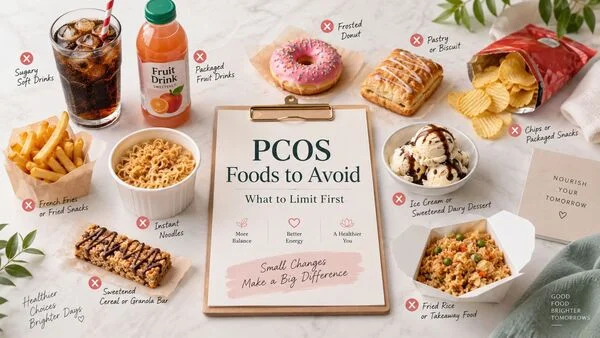
Which 10 Food Categories Should You Review First for PCOS Weight Loss?
1. Sugar-Sweetened Soft Drinks and Packaged Fruit Beverages
Sweetened beverages are often worth checking early because they can contribute substantial energy without providing the fullness of a solid eating occasion.
Regular soft drinks, sweetened packaged fruit beverages and sugar-heavy cafe drinks are common examples.
Their contribution can also be easy to overlook because they are often consumed alongside meals or during breaks rather than counted mentally as food.
A drink can become automatic: with lunch, while commuting, during an afternoon slump or whenever tea or coffee is purchased outside.
For weight management, make an important distinction between whole fruit and a sweetened fruit drink. They are not equivalent.
The useful review is how often the drink appears, what has been added to it and whether changing that habit would be more meaningful than removing a nutritious food elsewhere.
2. Indian Sweets and Sugar-Heavy Desserts
Indian sweets and desserts become a higher priority when they are frequent rather than occasional.
Laddoo, halwa, jalebi, payasam and similar foods may appear after meals, during celebrations, at work or as small bites across the day.
One festive serving is not the same as a daily pattern.
Jaggery, honey and brown sugar should also not be treated as weight-loss shortcuts simply because they differ from white sugar. They still serve as added sweeteners.
Instead of asking which sugar sounds healthier, ask: How often is added sweetness appearing in my day?
3. Refined-Flour Bakery Foods
Biscuits, puffs, pastries, cakes and similar bakery foods can become important when they repeatedly fill hunger gaps without keeping you satisfied for long.
Many combine refined flour with added fat, sugar or both.
They also commonly appear in predictable situations: tea breaks, long meetings, travel, late workdays or when an earlier meal was too light.
That context matters. Before eliminating wheat or bread altogether, check whether the real pressure point is a particular bakery product, how often you eat it or why you need it at that time of day.
4. Deep-Fried Snacks and Fried Takeaway Foods
Deep-fried foods may deserve attention when their preparation and frequency make the complete eating occasion much more energy-dense.
Samosa, pakora, bhujia, chips and fried takeaway dishes are common examples.
The underlying ingredient is not necessarily the problem. A vegetable is still a vegetable, but a frequently eaten deep-fried vegetable snack has a different role in weight management. Home-cooked chicken and fried takeaway chicken should not automatically be grouped together either.
Also look beyond the single food. A fried snack plus a sweetened beverage and other accompaniments may be more relevant than any one ingredient viewed alone.
5. Instant Noodles and Ready-to-Cook Refined Meals
Convenience meals deserve review when they frequently replace meals that would otherwise provide greater protein, vegetables, fibre or fullness.
Instant noodles, ready-to-cook pasta dishes and similar mixes are popular because they are quick and predictable.
Convenience itself is not the problem.
The relevant question is whether these meals repeatedly leave you hungry soon afterwards or become the default whenever work or family schedules become difficult.
Judge the finished meal, not simply the word ‘noodles’. Adding suitable vegetables or protein-containing foods creates a different eating occasion from relying mainly on the instant product itself.
6. Sweetened Breakfast Cereals, Granola and Snack Bars
Foods marketed as healthy, light or fitness-oriented can still deserve review when their finished nutritional profile does not match the impression created by the packaging.
Sweetened cereals, granola products and snack bars can contain substantial added sweeteners and may be easy to eat without much attention to quantity.
Words such as ‘whole grain’, ‘protein’, ‘natural’ or ‘with nuts’ should therefore not be the only basis for deciding whether a product fits your weight-loss routine.
Check the complete product, how much you normally eat and, importantly, how long it actually keeps you satisfied.
7. Ice Cream and Sweetened Dairy Desserts
Sweetened dairy desserts belong on this list because of their form, not because dairy itself needs to be removed.
Ice cream, sweetened yoghurt, flavoured milk desserts, puddings and custards may become relevant when they are frequent additions.
This distinction prevents a common overcorrection.
Plain curd, milk, paneer and other suitable dairy foods should not automatically be eliminated simply because sweetened dairy desserts deserve review.
Their role depends on tolerance, nutritional contribution and the overall eating pattern.
8. Processed Meat and Fatty Restaurant Meat Dishes
Processed meat and rich restaurant preparations should be distinguished from fresh, simply prepared meat.
Sausages, salami and similar processed products are different from fresh meat.
Likewise, a heavily fried meat dish or rich restaurant gravy creates a different weight-management situation from a simpler home-cooked chicken or meat dish.
The useful distinctions are fresh versus processed, simpler versus heavily fried, home-cooked versus restaurant-prepared, and occasional versus frequent.
Red meat itself does not require a universal PCOS ban.
9. Fried Rice and Refined-Starch Takeaway Meals
Some takeaway meals become important because a large starch base is combined with added fat and energy-dense accompaniments while providing less fullness than expected from the amount eaten.
Fried rice, creamy pasta and pizza-style takeaway meals are common examples.
Rice itself is not the complete issue.
The same staple included in a home meal with vegetables and a suitable protein source presents a different eating situation.
For this category, review the preparation, frequency, accompanying foods and how satisfying the entire meal actually feels.
10. Packaged Snack Mixes, Crackers and Chips
Packaged snacks are often practical early targets because they can become repeated eating that happens almost automatically.
Namkeen, snack mixes, crackers and chips may be eaten while working, travelling, scrolling or watching television, sometimes directly from a larger packet.
In those situations, the amount eaten may be influenced more by the environment than by hunger.
They also commonly occur outside the household’s main meals. That makes this category worth checking because changing it may not require redesigning the entire family diet.
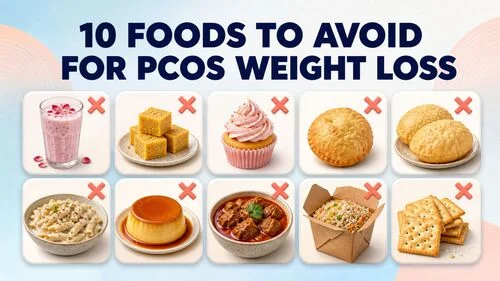
Why Do Frequency and Fullness Matter More Than a Longer Blacklist?
A frequently repeated food that offers little lasting fullness may deserve more attention for weight loss than several foods eaten occasionally.
A useful way to evaluate the ten categories is to ask five questions:
Frequency: Does this food appear occasionally, several times a week or almost every day?
Fullness: Does it actually satisfy hunger, or do you soon need something else?
Preparation: Is the basic food the problem, or does a particular preparation change its role?
Eating occasion: What usually comes with it?
Displacement: What more filling or nutritionally useful food does it repeatedly replace?
This is why ranking food habits is more useful than giving every food on an avoidance list equal importance.
Do Rice, Fruit, Eggs, Chicken, Dairy, Soy or Coffee Automatically Belong on the List?
No. These foods do not automatically need removal for PCOS weight loss.
| Food | Practical Weight-Loss Answer |
| Rice | Does not automatically need elimination. Its quantity, preparation, accompanying foods and place in the overall eating pattern matter. |
| Whole fruit | Is different from sweetened fruit beverages. Whole fruit does not require a universal PCOS weight-loss ban. |
| Eggs | Can contribute protein. Preparation and the foods eaten with them determine the complete meal. |
| Chicken | Fresh or simply cooked chicken is different from heavily battered, fried or rich takeaway preparations. |
| Plain dairy | Plain curd, milk and suitable dairy foods are different from sweetened dairy desserts. |
| Soy foods | Minimally processed soy foods do not automatically require removal. Their role depends on the individual diet. |
| Red meat | Does not require universal exclusion. Form, preparation and frequency are more useful considerations. |
| Coffee | Coffee itself is not one of the ten priority categories. Sweet additions, frequency, tolerance and effects on sleep can change its relevance. |
If your question is specifically whether carbohydrates, dairy, gluten or fasting must universally be restricted, read the PCOS diet myths guidance.
This page has a narrower purpose: identifying recurring food categories worth reviewing when weight loss is the goal.
Which of the 10 Categories Should You Check First?
Start with the food or drink that occurs frequently, is easy to overlook and can be changed without making the rest of your diet unnecessarily restrictive.
Start with drinks you consume most days
A daily sweetened beverage may deserve attention before an occasional dessert.
Then look at automatic snacks
Biscuits, bakery foods, namkeen or packaged snacks may repeatedly fill the same workday or travel gap. Ask whether you are genuinely choosing them or simply repeating the same response to hunger, tea breaks, travel or convenience.
Then review recurring takeaway and convenience meals
If takeaway meals appear several times during a normal week, the useful question is not only what you ordered. It is also why takeaway keeps becoming the easiest option.
Perhaps work runs late. Perhaps lunch is too light. Perhaps there is no realistic dinner option on certain days. That information helps identify the actual pressure point.
Protect useful home foods unless they genuinely need changing
Useful home foods should not be removed first simply because they are easy to blame.
For the broader questions of whether weight loss is appropriate, how to manage hunger, why progress may plateau and how to build a sustainable strategy, use the dedicated PCOS weight-loss diet guidance.
What Changes When Insulin Resistance Is Also Present?
Confirmed insulin resistance may change which carbohydrate-containing foods and meal patterns deserve closer attention, but it should not be assumed simply because someone has PCOS.
When insulin resistance has been identified, factors such as carbohydrate quality, fibre, protein, meal composition and relevant metabolic findings may affect how the ten categories above are prioritised.
That is a deeper metabolic question than this food-priority list is designed to answer.
Use the dedicated PCOS insulin resistance nutrition guidance when confirmed insulin resistance is the main concern.
Does Avoiding All 10 Guarantee Weight Loss With PCOS?
No. Avoiding all ten categories does not guarantee weight loss, and complete avoidance is not the purpose of this list.
Weight change depends on the full eating pattern and wider factors such as hunger, activity, sleep, routine and what replaces the foods you reduce.
A replacement can also leave the original pattern largely unchanged. For example, replacing one sweet snack with a health-branded sweet snack may alter the product name without meaningfully changing the eating situation.
The purpose of this article is therefore to identify which repeated food choices deserve attention first, not to create ten permanent bans.
When Should a Food Choice Be Personalised Rather Than Removed?
Personalisation becomes useful when you can identify a possible weight-loss pressure point but cannot tell what the appropriate change should be.
You may recognise four categories from this article, but that does not mean all four deserve equal attention.
Perhaps biscuits appear every afternoon. The real decision may be whether to change the biscuit, improve the earlier meal or solve a workday gap that repeatedly leaves you hungry.
Perhaps takeaway food appears several evenings a week. The answer may involve frequency, meal choice, preparation, quantity or having a realistic alternative available on those specific days.
Perhaps rice has become the food you are most worried about, while sweetened drinks, bakery snacks or restaurant meals are occurring much more frequently.
This is where another food blacklist becomes less useful.
How Chief Nutritionist Vasanthi Senthilvel Turns the List Into Individual Priorities
Chief Nutritionist Vasanthi Senthilvel can review your real eating pattern to identify which few foods or eating situations deserve attention first.
The assessment can bring together which of these ten categories you actually consume, how often they occur, when hunger becomes difficult, what happens on work and travel days, how your household normally cooks, relevant health findings, medications, previous dieting experiences and your current weight goal.
The result is not simply a shorter blacklist. It is a priority order.
For one person, the first meaningful change may be a sweetened drink consumed every day. For another, a recurring bakery snack may be the symptom of an earlier meal that does not provide enough fullness. For someone else, the highest-value decision may involve takeaway meals while ordinary rice, fruit, eggs or family foods remain largely unchanged.
A generic list can show you ten places to look. A personalised assessment can identify the two or three places most worth changing in your routine and determine the quantities, substitutions and practical adjustments that fit your weight goal.
Consult Chief Nutritionist Vasanthi Senthilvel for a personalised PCOS weight-loss diet plan built around your food pattern, hunger, health findings, everyday routine and weight-management priorities.
Author
Chief Nutritionist Vasanthi Senthilvel leads Newtrist Nutritionist Dietitian Dietician, providing personalised diet plans for weight management and clinical nutrition for children, adolescents, adults and families.
She has 21 years of experience in nutrition and has received professional recognition for her work.
- Pride of Bharat Awards 2026: Outstanding Achievement in Holistic Health & Nutrition Innovation
- Doctor of The Year: Nutritionist 2026: Excellence in Clinical Nutrition and Weight Loss.
Her approach considers age, growth, health history, medical conditions, laboratory reports, medication, body composition, weight history, dietary preferences, regional food habits, family routines, activity, sleep and personal health goals. Recommendations are developed according to individual needs rather than using one standard diet for everyone.
Consultations are available in person at Bangalore HSR Layout, Koramangala, Bellandur, Haralur and Electronic City, as well as online across India.
Independent Medical Review Panel
Newtrist health and nutrition articles undergo medical review, where appropriate, by doctors with relevant specialist expertise. The medical professionals listed below contribute to Newtrist’s review process within their respective specialties.
| Speciality | Doctor |
|---|---|
| Endocrinology | Dr Vinay Prasad MBBS, MD, DM |
| Gastroenterology & Hepatology | Dr Sunil kumar N MBBS, MD, DM |
| Gynaecology | Dr Prathiba G MBBS, DNB, FIRM, FMAS |
| Nephrology | Dr Priyashree R MBBS, MD, DNB, DM |