
Written by: Chief Nutritionist Vasanthi Senthilvel
21 years of experience | Newtrist Nutritionist Dietitian Dietician
Best Nutritionist in Bangalore with multiple awards for excellence in clinical nutrition, weight loss, holistic health and nutrition innovation.
Medically reviewed by: Dr Dr Prathiba G MBBS, DNB, FIRM, FMAS | Dr Sunil kumar N MBBS, MD, DM | Dr Vinay Prasad MBBS, MD, DM
Medical Disclaimer: Nutritional needs vary based on an individual’s profile. The information and calculator on this page is for general educational purposes only and is not intended to replace personalised medical or nutrition care.
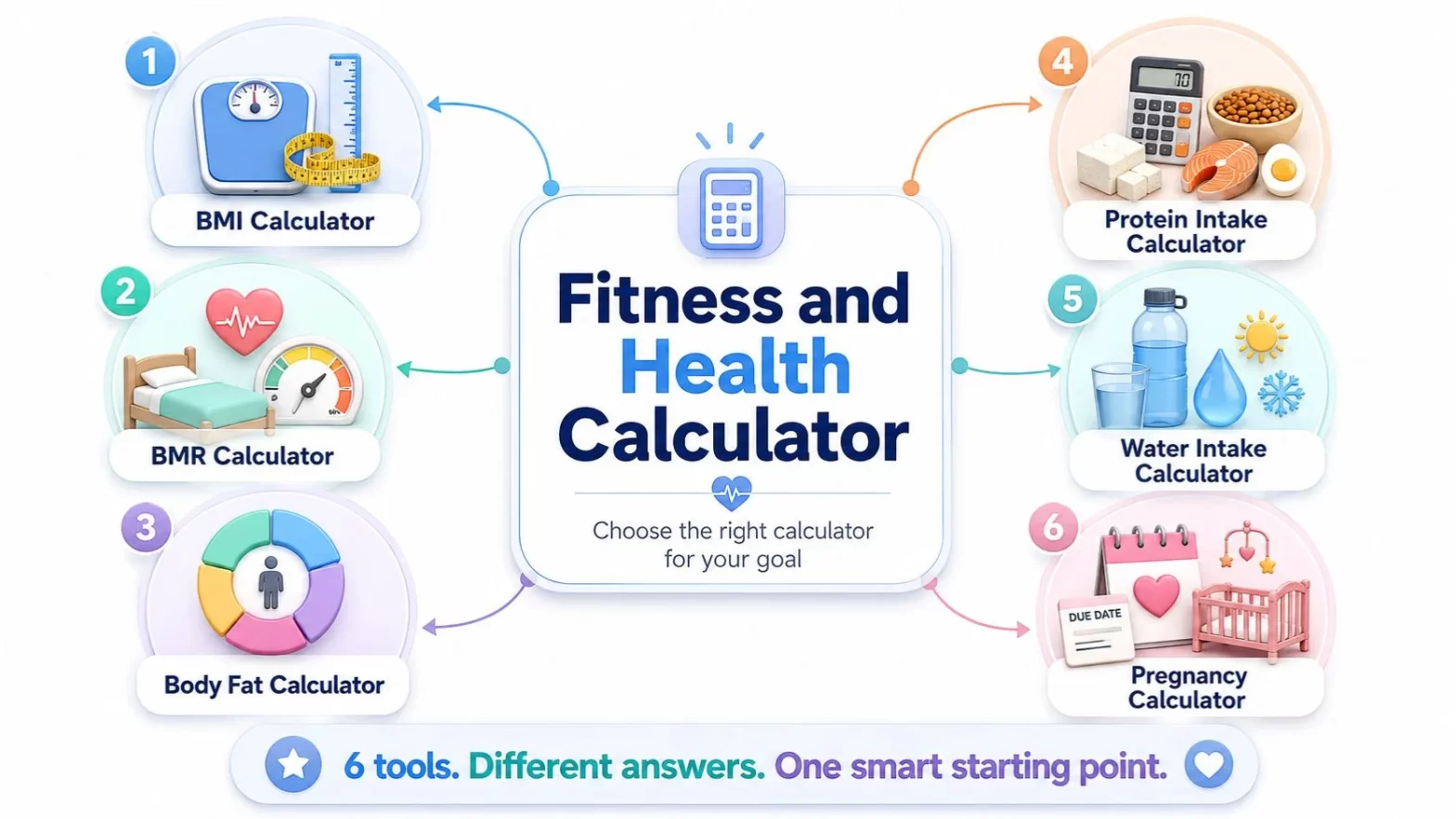
Health and fitness calculators can turn a broad question into a useful starting point. You may want to understand weight in relation to height, estimate resting energy use, look at body composition, estimate protein or water needs, or work out an expected pregnancy due date. The fitness and health calculator hub brings these tools together so you can choose the calculator that matches the question you are actually trying to answer.
Key takeaway: The fitness and health calculator hub helps you choose between BMI, BMR, body-fat, protein-intake, water-intake and pregnancy due-date calculators. Each tool provides a different type of estimate, so the results should be interpreted for their intended purpose rather than combined into one overall health score. Individual nutrition decisions may require information that a calculator does not collect.
Which calculator should you use?
The most useful calculator is the one that matches your question. You do not need to use every tool, and using more calculators does not automatically provide a more complete assessment.
| Calculator | What it estimates | Useful when you want to know |
| BMI Calculator | Body mass index, based on weight relative to height | Whether you want a quick screening measure of weight status relative to height |
| BMR Calculator | Estimated energy used by the body at rest | Your estimated resting energy expenditure before considering wider daily energy needs |
| Body Fat Calculator | Estimated percentage of body weight that is fat | A body-composition estimate rather than relying on body weight alone |
| Protein Intake Calculator | Estimated daily protein requirement | A starting estimate of protein needs based on the information entered |
| Water Intake Calculator | Estimated daily water requirement | A starting estimate of hydration needs based on the information entered |
| Pregnancy Calculator | Estimated pregnancy due date | An estimated due date based on menstrual information |

Why different calculators give different types of information
Health measurements can look related because several calculators use information such as height, weight, age or activity. The result, however, depends on what the calculator is designed to estimate.
BMI compares body weight with height and is commonly used as a screening measure. Body-fat percentage focuses on estimated body composition rather than weight alone. BMR is concerned with the energy the body uses at rest, while protein and water calculators estimate specific nutritional requirements. A pregnancy due-date calculator answers a completely different question by estimating pregnancy timing from menstrual information.
This is why two calculator results should not be judged as though they are competing scores. A result is useful when it is interpreted within the question that produced it. Detailed formulas, reference ranges and limitations belong on the individual calculator pages, where they can be explained without turning this hub into several articles on one page.
When more than one measurement may be useful
Sometimes one question leads naturally to another. A person exploring weight management, for example, may be interested in BMI, body composition and resting energy use because each describes a different part of the picture. Protein or hydration estimates may become relevant for a separate nutrition or activity question.
That does not mean every result should be combined into a single target. Measurements such as BMI, body-fat percentage and BMR describe different things, and their practical importance can vary with age, body composition, activity, health history and personal goals. The value of using more than one calculator is the additional context, not the creation of a universal score.
The pregnancy calculator should be considered separately from body-composition and nutrition calculators. Its role is to estimate a due date, not to assess nutritional adequacy or overall health.
What can a fitness and health calculator tell you?
A fitness and health calculator can provide a quick estimate based on the information entered. This can help you identify the measurement that is relevant to your question, understand a starting value and decide what you may want to explore further.
- Turn a general question into a measurable starting point.
- Distinguish between weight, body composition, resting energy, protein, hydration and pregnancy due-date questions.
- Help you follow changes in the same type of measurement when the calculator is appropriate for that purpose.
- Prepare more focused questions if you later seek individual nutrition guidance.
A calculator cannot assess every factor that may matter to an individual. It cannot determine overall health from one number, diagnose a condition or create a complete personalised diet plan. It also cannot account for information that is not part of its inputs.
The limitation is not a reason to ignore calculators. It is a reason to use them for what they do well: provide a focused estimate and a clear starting point.
From a calculator result to a nutrition decision
The important question after receiving a result is not simply whether the number is good or bad. A more useful question is what the number means for the goal you are considering.
If you only wanted a measurement or estimate, the relevant calculator page may provide all the information you need. If you want to use the result to change your weight, body composition, food intake, sports nutrition approach or pregnancy nutrition, the next decision becomes more individual.
For example, a calculated value does not automatically determine how much food a person should eat, whether weight should change, or how a nutrition plan should be structured. Age, life stage, body composition, activity, appetite, health history, dietary pattern, sleep, routine and personal goals can change how a result is interpreted.
This distinction is especially useful because two people can receive similar calculator values while needing different nutrition approaches. The calculator supplies the estimate. Individual assessment determines how much importance that estimate should have in the wider nutrition picture.
Frequently asked questions
Do I need to use all the calculators?
No. Choose the calculator that answers the question you currently have. BMI, body-fat percentage and BMR may all be relevant to some weight-management questions, while protein and water calculators answer more specific nutrition questions. The pregnancy due-date calculator has a separate purpose. Using a tool without a clear reason can create more numbers without adding useful understanding.
Which calculators may be relevant to weight management?
BMI, body-fat and BMR calculators can each provide a different type of information that may be relevant to weight management. BMI relates weight to height, body-fat percentage estimates body composition, and BMR estimates resting energy use. None of these results alone determines whether a person should lose or gain weight or what dietary approach would be appropriate.
Can I compare my calculator results with someone else’s?
A direct comparison may be misleading because calculator results depend on the inputs, purpose and individual context. Even when two people have a similar result, differences in age, body composition, activity, health history, dietary pattern and goals can change what the number means in practice. It is usually more useful to interpret your result according to the calculator’s purpose.
When is a calculator result not enough?
A calculator result may not be enough when you need an individual decision rather than a general estimate. This can include planning for weight management, sports nutrition, pregnancy nutrition or clinical nutrition, especially when several personal factors need to be considered together. A personalised assessment can help place the calculator result within the wider context rather than treating the number as a stand-alone instruction.
Conclusion
The Fitness and Health Calculator hub is designed to help you begin with the right question, not to produce one number that defines health. Choose the tool that matches your purpose, interpret the result within that purpose, and consider individual assessment when the next step depends on factors the calculator cannot capture.

When personalised nutrition guidance may help
Calculator results can be useful starting points, but personalised nutrition planning looks beyond the number. Depending on the reason for using a calculator, an individual assessment may consider age, life stage, health history, body composition, eating patterns, appetite, activity, sleep, dietary preferences, daily routine, laboratory findings where relevant and personal goals.
This wider context matters when someone wants to translate a calculator result into decisions about weight management or clinical nutrition. The same calculated value can have different practical significance for different people, so a general estimate should not automatically become a personal dietary target.
Chief Nutritionist Vasanthi Senthilvel can assess the relevant factors and develop a personalised diet plan for weight management or clinical nutrition where individual guidance is appropriate. The purpose is to place calculator information within a practical nutrition approach suited to the person rather than relying on a generic calculation alone.
Consult Chief Nutritionist Vasanthi Senthilvel for personalised nutrition guidance when you need help translating calculator results into an approach suited to your health needs, food preferences and daily routine.
Author
Chief Nutritionist Vasanthi Senthilvel leads Newtrist Nutritionist Dietitian Dietician, providing personalised diet plans for weight management and clinical nutrition for children, adolescents, adults and families.
She has 21 years of experience in nutrition and has received professional recognition for her work.
- Pride of Bharat Awards 2026: Outstanding Achievement in Holistic Health & Nutrition Innovation
- Doctor of The Year: Nutritionist 2026: Excellence in Clinical Nutrition and Weight Loss.
Her approach considers age, growth, health history, medical conditions, laboratory reports, medication, body composition, weight history, dietary preferences, regional food habits, family routines, activity, sleep and personal health goals. Recommendations are developed according to individual needs rather than using one standard diet for everyone.
Consultations are available in person at Bangalore HSR Layout, Koramangala, Bellandur, Haralur and Electronic City, as well as online across India.
Independent Medical Review Panel
Newtrist health and nutrition articles undergo medical review, where appropriate, by doctors with relevant specialist expertise. The medical professionals listed below contribute to Newtrist’s review process within their respective specialties.
| Speciality | Doctor |
|---|---|
| Endocrinology | Dr Vinay Prasad MBBS, MD, DM |
| Gastroenterology & Hepatology | Dr Sunil kumar N MBBS, MD, DM |
| Gynaecology | Dr Prathiba G MBBS, DNB, FIRM, FMAS |