
Written by: Chief Nutritionist Vasanthi Senthilvel
21 years of experience | Newtrist Nutritionist Dietitian Dietician
Best Nutritionist in Bangalore with multiple awards for excellence in clinical nutrition, weight loss, holistic health and nutrition innovation.
Medically reviewed by: Dr Dr Prathiba G MBBS, DNB, FIRM, FMAS | Dr Sunil kumar N MBBS, MD, DM | Dr Vinay Prasad MBBS, MD, DM
Medical Disclaimer: Nutritional needs vary based on an individual’s profile. The information and calculator on this page is for general educational purposes only and is not intended to replace personalised medical or nutrition care.
A BMI calculator gives you a quick way to compare your weight with your height. The result places an adult into a broad BMI category, but it does not show how much of your weight comes from fat, muscle or bone, and it cannot decide whether you should lose, gain or maintain weight. Use the number as a screening value, then interpret it in the context of your body composition, health background and goals.
Key takeaway: The BMI calculator uses height and weight to estimate body mass index (BMI) and place the result within a standard adult weight category. BMI is useful as a quick screening measure, but it is not a direct measure of body fat and is not a diagnosis. For Indian and other South Asian adults, health risk can occur at lower BMI levels than standard general-adult categories suggest, so individual context matters.
Enter your height and weight in the calculator to see your BMI. The calculator uses only these two measurements, so its result should be understood within the limits of the information provided.
BMI Calculator
Your BMI is......
| BMI | Classification |
|---|---|
| less than 18.5: | Underweight |
| 18.5 - 24.9: | Normal weight |
| 25 - 29.9: | Overweight |
| 30 - 34.9: | Class I Obese |
| 35 - 39.9: | Class II Obese |
| 40 upwards: | Class III Obese |
What does your BMI result mean?
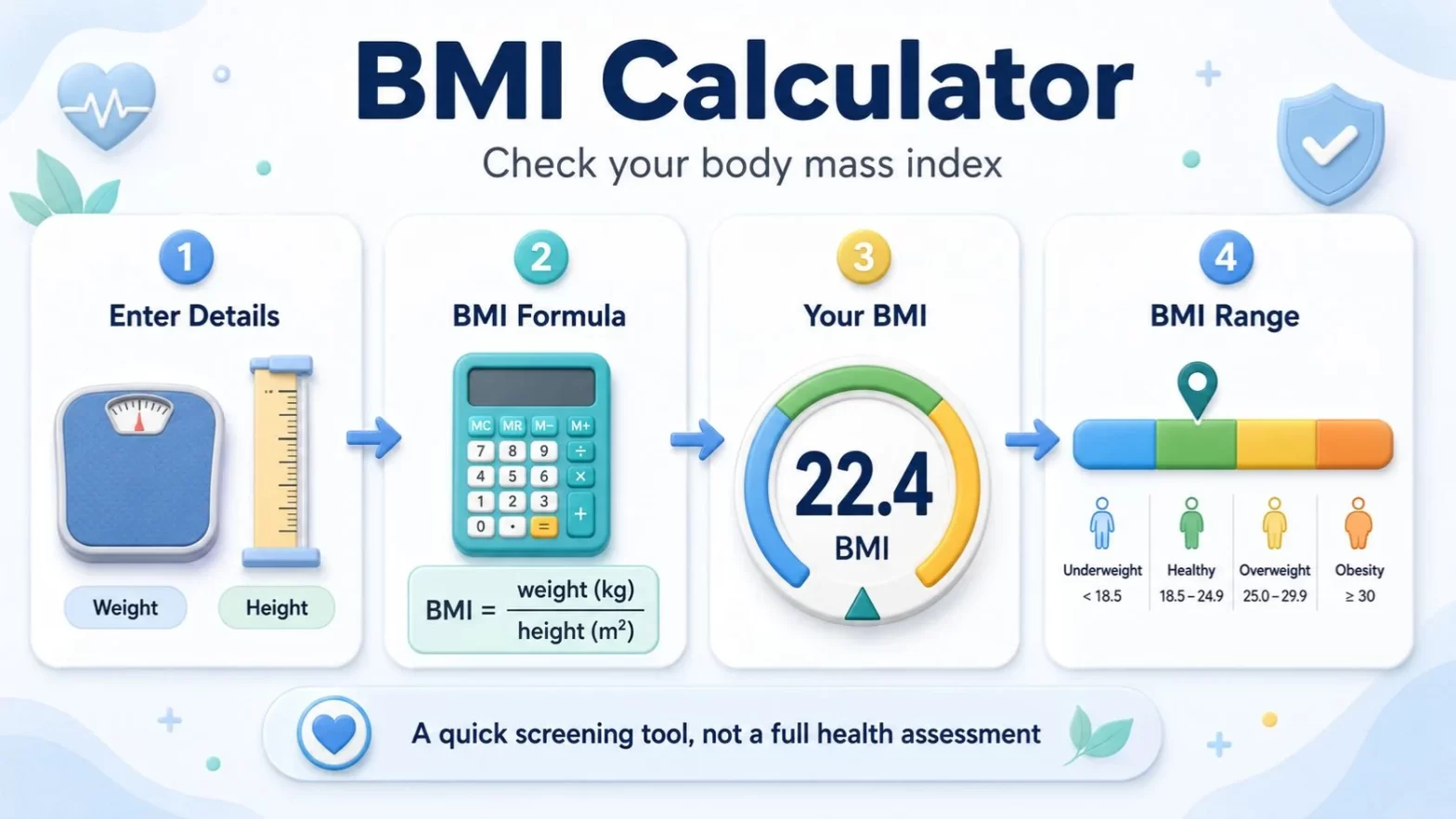
BMI groups an adult result into a broad weight category. The categories below are widely used for general adult screening and are useful for understanding where a calculated BMI sits, but they should not be treated as a complete assessment of health.
| Adult BMI | Standard category |
| Below 18.5 | Underweight |
| 18.5 to 24.9 | Healthy weight |
| 25.0 to 29.9 | Overweight |
| 30.0 to 34.9 | Obesity class I |
| 35.0 to 39.9 | Obesity class II |
| 40.0 or above | Obesity class III |
The category tells you how your weight relates to your height; it does not explain why you are in that category. Two adults with the same BMI can have different body composition, activity patterns, weight histories and nutritional needs.
A note for Indian and South Asian adults
Standard BMI categories are useful for general screening, but they do not reflect every population in exactly the same way. People from South Asian backgrounds can develop cardiometabolic risk at lower BMI levels than the standard cut-offs used for the general adult population. For an Indian adult, this means a BMI result is better viewed as a starting point for interpretation rather than a stand-alone judgement about health.
Get a personalized diet plan designed by Chief Nutritionist Vasanthi, with 21 years of experience and multiple awards in clinical nutrition, weight loss, holistic health, and nutrition innovation.
Consult in person at Bangalore HSR Layout, Koramangala, Bellandur, Haralur, or Electronic City, or online across India.
How is BMI calculated?
BMI is calculated by dividing body weight in kilograms by height in metres multiplied by itself.
BMI = weight (kg) / [height (m) x height (m)]
The calculator performs the calculation for you after you enter height and weight. If standard units are selected, the calculator handles the required unit conversion before displaying the result.
Why BMI does not tell the whole story
BMI has an important advantage: it is simple. Its main limitation is equally simple: the calculation knows only your height and weight. It cannot identify what makes up that weight or how your body composition is distributed.
Muscle and fat can therefore produce the same BMI even though they have different implications for body composition. Someone with substantial muscle mass may have a higher BMI without having a correspondingly high body-fat percentage. At the other end, an adult can fall within the standard healthy-weight BMI category while still having body-composition or nutrition concerns that BMI cannot detect.
Age also changes the context. The BMI formula for adults does not use age, yet muscle mass and fat distribution can change over time. The same BMI may therefore carry different practical meaning for two adults of different ages or physical profiles.
Pregnancy is another situation where ordinary adult BMI interpretation is not suitable for judging changing body weight, because pregnancy itself changes body weight and body composition. The general calculator on this page should not be used as a pregnancy weight-management tool.
BMI and body-fat percentage are not the same
BMI compares weight with height, while body-fat percentage estimates how much of total body weight is fat. If your question is specifically about body composition rather than weight relative to height, the body fat calculator is the more relevant next tool. Each measure has its own limitations, so one should not be used as a substitute for the other.
Can BMI tell you whether you should lose or gain weight?
No. A BMI category is not a personal prescription for weight loss or weight gain. It can flag that your weight is lower or higher relative to your height, but the appropriate response depends on more than the category itself.
Before turning a BMI result into a weight-management goal, it can be useful to consider factors such as weight history, body composition, appetite, activity, eating patterns, sleep, health history and the reason you are concerned about your weight. A person who wants to improve sports performance may need a different interpretation from someone whose main concern is long-term weight change, even when the BMI number is similar.
This is also why copying another person’s diet based on a similar BMI can be misleading. BMI does not tell you the amount or pattern of food that suits your nutritional needs, and it does not provide an individual target weight.
When a BMI result needs more context
The calculator may be enough when you simply want to know your BMI and understand the standard adult category. More context becomes useful when you are trying to decide what the result means for your own nutrition or weight-management goal.
Individual interpretation may be especially useful when your BMI seems inconsistent with your body composition, when your weight has changed substantially over time, when you have a strong fitness or muscle-building background, or when the category does not match how you expected your weight to be interpreted. The aim is not to make the number more complicated, but to prevent a simple screening measure from becoming an overly simple decision about your diet.
Frequently asked questions
Is this BMI calculator suitable for children and teenagers?
No. Children and teenagers are still growing, so BMI needs to be interpreted in relation to age and sex rather than with adult categories alone. This calculator uses only height and weight and is intended for adult BMI screening. A child’s growth pattern and developmental stage require a different assessment approach.
Is BMI useful for athletes or people with high muscle mass?
BMI can still provide a weight-to-height value, but it may be less informative about body composition in someone with substantial muscle mass. Because BMI cannot separate muscle from fat, a muscular adult can fall into a higher BMI category without having the body-fat level that someone might assume from the category.
Can I use this BMI calculator during pregnancy?
This general adult BMI calculator is not suitable for judging changing body weight during pregnancy. Pregnancy changes body weight and body composition as part of normal physiological changes. When BMI is relevant in pregnancy care, clinicians usually consider appropriate pregnancy-specific context rather than interpreting current weight with an ordinary adult calculator.
Does BMI become less useful as you get older?
BMI can still be calculated in adults as they age, but interpretation may need more context. Age-related changes in muscle mass and body composition are not included in the BMI formula. For this reason, the same BMI number can describe adults with different proportions of muscle and fat.
Conclusion
A BMI calculator is useful for one clear purpose: showing how an adult’s weight relates to height and placing the result within a broad screening category. The number becomes more useful when its limitations are recognised, particularly when body composition, age, ethnicity or an individual weight-management goal changes how the result should be understood.

When personalised nutrition guidance may help
A BMI result can show where your weight sits in relation to your height, but it cannot tell you what dietary approach is appropriate for you. Personalised weight management may consider body composition, weight history, appetite, eating patterns, activity, sleep, health history, food preferences, regional food habits, work routine and personal goals together rather than treating BMI as the only decision point.
Readers who need individual guidance may consult Chief Nutritionist Vasanthi Senthilvel at Newtrist Nutritionist Dietitian Dietician for a personalised diet plan for weight management. The assessment can help identify nutritional priorities and develop practical recommendations suited to the individual’s needs, preferences and routine without assuming that everyone in the same BMI category requires the same approach.
Consult Chief Nutritionist Vasanthi Senthilvel for a personalised diet plan developed around your weight-management goals, body composition, health history, food preferences and daily routine.
Author
Chief Nutritionist Vasanthi Senthilvel leads Newtrist Nutritionist Dietitian Dietician, providing personalised diet plans for weight management and clinical nutrition for children, adolescents, adults and families.
She has 21 years of experience in nutrition and has received professional recognition for her work.
- Pride of Bharat Awards 2026: Outstanding Achievement in Holistic Health & Nutrition Innovation
- Doctor of The Year: Nutritionist 2026: Excellence in Clinical Nutrition and Weight Loss.
Her approach considers age, growth, health history, medical conditions, laboratory reports, medication, body composition, weight history, dietary preferences, regional food habits, family routines, activity, sleep and personal health goals. Recommendations are developed according to individual needs rather than using one standard diet for everyone.
Consultations are available in person at Bangalore HSR Layout, Koramangala, Bellandur, Haralur and Electronic City, as well as online across India.
Independent Medical Review Panel
Newtrist health and nutrition articles undergo medical review, where appropriate, by doctors with relevant specialist expertise. The medical professionals listed below contribute to Newtrist’s review process within their respective specialties.
| Speciality | Doctor |
|---|---|
| Endocrinology | Dr Vinay Prasad MBBS, MD, DM |
| Gastroenterology & Hepatology | Dr Sunil kumar N MBBS, MD, DM |
| Gynaecology | Dr Prathiba G MBBS, DNB, FIRM, FMAS |