
Written by: Chief Nutritionist Vasanthi Senthilvel
21 years of experience | Newtrist Nutritionist Dietitian Dietician
Best Nutritionist in Bangalore with multiple awards for excellence in clinical nutrition, weight loss, holistic health and nutrition innovation.
Medically reviewed by: Dr Prathiba G MBBS, DNB, FIRM, FMAS | Dr Sunil kumar N MBBS, MD, DM | Dr Vinay Prasad MBBS, MD, DM
Medical Disclaimer: Nutritional needs vary based on an individual’s profile. The information on this page is for general educational purposes only and is not intended to replace personalised medical or nutrition care.
If you have searched for a thyroid diet, you may have found advice that seems to contradict itself. One source says to reduce certain foods, another recommends them, and a third offers the same diet plan for every thyroid problem.
The reason is simple: thyroid conditions do not create identical nutrition needs. Hypothyroidism, hyperthyroidism and Hashimoto’s-related thyroid dysfunction can affect eating and nutritional priorities differently. Before deciding what to change on your plate, it helps to identify which thyroid condition you are eating for and what nutrition problem actually needs solving.
Key takeaway: There is no single thyroid diet plan that suits every thyroid condition. Start with the diagnosis, then match the nutrition approach to the person’s appetite, food intake, body-weight pattern, digestive comfort and wider needs. Hypothyroidism, hyperthyroidism and a practical weekly meal-plan search should not be treated as the same nutrition problem.
Table of Contents

Is There One Diet for Every Thyroid Condition?
No. A general thyroid diet can provide broad nutrition principles, but it cannot give the same food strategy to everyone with a thyroid condition.
The practical issues can be very different.
Someone with hypothyroidism may need to review meal adequacy, constipation or weight concerns. Someone with hyperthyroidism may instead need to maintain food intake, body weight or muscle when nutritional needs have changed.
So the first useful question is not:
“What are the best foods for thyroid?”
It is:
“What nutrition problem needs to be solved in my thyroid condition?”

Which Thyroid Diet Guidance Applies to You?
The most useful guide depends on the thyroid condition and what you want help with.
| Situation | Main nutrition concern | Best Newtrist guide |
|---|---|---|
| Hypothyroidism / underactive thyroid | Meal adequacy, protein, bowel comfort and nutritional gaps | Hypothyroidism diet |
| Hyperthyroidism / overactive thyroid | Adequate intake, weight stability, muscle and digestive tolerance | Hyperthyroidism diet chart |
| Hashimoto’s disease with hypothyroidism | Appropriate hypothyroidism nutrition without unnecessary restriction | Hypothyroidism diet |
| Woman looking for a practical weekly structure | Familiar Indian meals organised across seven days | 7-day thyroid diet chart for women |
Hypothyroidism
With hypothyroidism, nutrition usually focuses on whether the existing diet is adequate and practical rather than looking for foods that are supposed to “activate” the thyroid.
Questions about protein, bowel comfort, important nutrients and Indian food choices belong in the detailed hypothyroidism diet guide.
Hyperthyroidism
Hyperthyroidism can create a different nutrition challenge, particularly when appetite, body weight, muscle or digestive tolerance changes.
The dedicated hyperthyroidism diet chart focuses on maintaining adequate nutrition and practical meal structure rather than mixing this advice with hypothyroidism guidance.
Hashimoto’s Disease
Hashimoto’s disease does not automatically require a completely separate diet.
When it is associated with hypothyroidism, nutrition is usually better considered within the hypothyroidism context. The priority is nutritional adequacy without adding restrictions merely because the condition is autoimmune.
Women Looking for a Practical Weekly Chart
Some people searching for thyroid nutrition are not looking for a clinical explanation. They want to see what a realistic week of Indian meals could look like.
The 7-day thyroid diet chart for women answers that practical search intent without turning this broader hub into another meal-plan page.
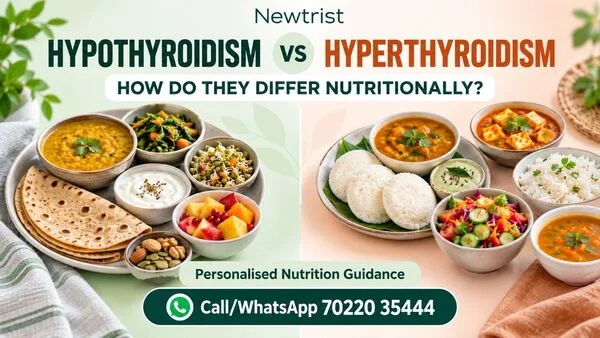
How Do Hypothyroidism and Hyperthyroidism Differ Nutritionally?
Hypothyroidism and hyperthyroidism can create different practical nutrition problems, even though both involve the thyroid.
| Nutrition issue | Hypothyroidism | Hyperthyroidism |
|---|---|---|
| Appetite and intake | Meal adequacy and excessive restriction may need review | Appetite may increase while nutritional needs can also rise |
| Weight concern | Weight gain may concern some people | Unintended weight loss may be a concern |
| Muscle | Preserving muscle remains important | Muscle loss may become more prominent |
| Bowel pattern | Constipation may occur | Faster bowel activity or digestive difficulty may occur |
| Food structure | Balanced, adequate and sustainable meals | Meals may need to support adequate intake and tolerance |
This comparison is meant to help you choose the right direction.
Once the condition is known, the condition-specific guide should provide the detail rather than trying to combine both approaches into one diet.
What Nutrition Principles Apply Across Thyroid Conditions?
Although the details change by condition, three principles remain broadly useful: the diet should provide enough nutrition, muscle-supporting foods should not be neglected, and normal family food should remain usable wherever possible.
Adequate Overall Nutrition
A thyroid diagnosis should not automatically lead to a smaller, narrower or increasingly restrictive diet.
The overall food pattern still needs to provide enough nourishment and variety for the person’s needs.
Protein and Muscle Health
Muscle health matters across thyroid conditions, although the reason may differ from person to person.
Depending on dietary preference, protein-containing foods may include dals, pulses, dairy foods where used, eggs, fish, chicken or suitable plant-food combinations.
The aim is not to find a special thyroid protein. It is to avoid a pattern where protein is consistently missing from normal meals.
Dietary Variety and Familiar Foods
A thyroid diet does not require abandoning regional or family food.
Rice, roti, millets, pulses, vegetables, fruits and preferred protein foods can often remain part of everyday eating. The way those foods are balanced may change, but the cuisine itself does not need to become unfamiliar.
Why Does Iodine Need Condition-Specific Context?
Iodine is important for thyroid physiology, but the same iodine advice does not apply to every thyroid situation.
That is why statements such as “eat more iodine for thyroid” or “avoid iodine if you have thyroid disease” are too broad to guide everyone safely.
At the general thyroid-diet level, the useful principle is simple:
iodine should be considered in the context of the actual thyroid condition, not treated as a universal thyroid solution.
The relevant condition-specific guidance can then address the issue in appropriate detail.

Which Common Thyroid Food Rules Are Oversimplified?
Many thyroid food rules become misleading because they are presented as universal.
Having a thyroid condition does not automatically mean that familiar foods such as rice, roti, millets, soy foods or cruciferous vegetables need to disappear from the diet.
A particular food may need individual review, but there should be a clear reason for changing it.
If your main question is specifically about restrictions, the detailed guide on thyroid foods to avoid addresses that search intent without expanding this page into a long avoidance list.
How Can Weight Changes Differ Across Thyroid Conditions?
Weight concerns can point in opposite directions depending on the thyroid condition.
With hypothyroidism, some people may be concerned about weight gain or difficulty managing body weight. With hyperthyroidism, the concern may instead be unintended weight loss or difficulty maintaining weight.
Even then, thyroid function is only part of the picture.
Appetite, body composition, activity, food intake, sleep, previous dieting and other health factors can influence what happens over time.
This is why a general thyroid diet should not automatically become either a weight-loss plan or a weight-gain plan.
How Do You Choose the Right Thyroid Nutrition Approach?
Start with three questions:
What thyroid condition do I have?
What nutrition problem am I actually trying to solve?
What in my current eating pattern is contributing to that problem?
For one person, the issue may be highly restrictive eating. For another, it may be irregular meals or poor appetite. Someone else may be concerned about body composition, digestive tolerance or how to make normal family meals fit their needs.
At this stage, personalised nutrition can become more valuable than another generic food list.
Chief Nutritionist Vasanthi Senthilvel can assess the thyroid condition together with the person’s existing food intake, appetite, body composition, dietary preferences, symptoms, family meals and daily routine.
A personalised approach can help determine:
- which parts of the existing diet are already suitable
- which nutrition problem actually deserves attention
- where meal balance or structure needs adjustment
- which restrictions are unnecessary
- how food choices can fit normal family and work routines
The purpose is not to make a thyroid diet more complicated. It is to make each change specific enough to be useful.
Frequently Asked Questions About Thyroid Diets
Does a thyroid diet have to be vegetarian?
No. A thyroid diet can be vegetarian, egg-based or non-vegetarian depending on the person’s normal food preferences. The important question is whether the chosen pattern provides suitable nutritional variety and fits the thyroid condition.
Can eating outside the home fit a thyroid diet?
Yes. Restaurant, canteen or travel meals can still fit within an overall thyroid nutrition approach. The aim is to make reasonable choices from what is available rather than expecting every meal to be prepared separately at home.
Do people with thyroid conditions need to eat at fixed times?
Not everyone needs the same meal timing. Work hours, appetite and daily routine can influence when eating is practical. What matters is whether the pattern supports adequate and consistent nutrition for the individual.
How often should a thyroid diet be reviewed?
It is worth reviewing the food pattern when the person’s thyroid situation, appetite, body weight, digestive tolerance, life stage or health priorities change. A diet that suited one stage should not automatically be assumed to remain ideal indefinitely.
Conclusion
A useful thyroid diet begins by identifying the correct condition and the actual nutrition problem.
Hypothyroidism, hyperthyroidism, Hashimoto’s-related hypothyroidism and a search for a practical weekly meal structure should not be forced into one generic thyroid plan.
If the diagnosis is clear but you are still unsure what should change in your own meals, Chief Nutritionist Vasanthi Senthilvel can develop a personalised clinical nutrition approach around your usual food, daily routine and individual nutrition priorities.
Author
Chief Nutritionist Vasanthi Senthilvel leads Newtrist Nutritionist Dietitian Dietician, providing personalised diet plans for weight management and clinical nutrition for children, adolescents, adults and families.
She has 21 years of experience in nutrition and has received professional recognition for her work.
- Pride of Bharat Awards 2026: Outstanding Achievement in Holistic Health & Nutrition Innovation
- Doctor of The Year: Nutritionist 2026: Excellence in Clinical Nutrition and Weight Loss.
Her approach considers age, growth, health history, medical conditions, laboratory reports, medication, body composition, weight history, dietary preferences, regional food habits, family routines, activity, sleep and personal health goals. Recommendations are developed according to individual needs rather than using one standard diet for everyone.
Consultations are available in person at Bangalore HSR Layout, Koramangala, Bellandur, Haralur and Electronic City, as well as online across India.
Independent Medical Review Panel
Newtrist health and nutrition articles undergo medical review, where appropriate, by doctors with relevant specialist expertise. The medical professionals listed below contribute to Newtrist’s review process within their respective specialties.
| Speciality | Doctor |
|---|---|
| Endocrinology | Dr Vinay Prasad MBBS, MD, DM |
| Gastroenterology & Hepatology | Dr Sunil kumar N MBBS, MD, DM |
| Gynaecology | Dr Prathiba G MBBS, DNB, FIRM, FMAS |
| Nephrology | Dr Priyashree R MBBS, MD, DNB, DM |