
Written by: Chief Nutritionist Vasanthi Senthilvel
21 years of experience | Newtrist Nutritionist Dietitian Dietician
Best Nutritionist in Bangalore with multiple awards for excellence in clinical nutrition, weight loss, holistic health and nutrition innovation.
Medically reviewed by: Dr Prathiba G MBBS, DNB, FIRM, FMAS | Dr Sunil kumar N MBBS, MD, DM | Dr Vinay Prasad MBBS, MD, DM
Medical Disclaimer: Nutritional needs vary based on an individual’s profile. The information on this page is for general educational purposes only and is not intended to replace personalised medical or nutrition care.
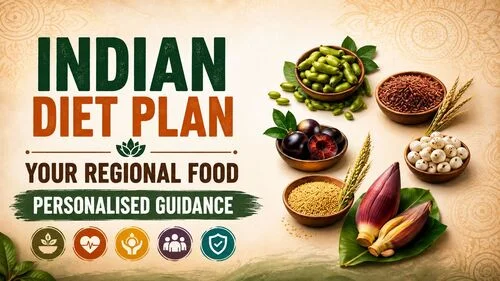
The phrase ‘Indian diet plan’ sounds as if India eats from one kitchen. It does not. Someone who grew up with puttu and fish curry solves a different food-planning problem from someone whose household revolves around bajra, dal and curd, or another family that uses fermented soy, bamboo shoots and rice.
An Indian diet plan for weight loss becomes more workable when regional cuisine is treated as the starting material, not the obstacle. The task is to identify what already fits, where the pattern becomes unnecessarily rich or unbalanced, and what needs personalisation for health, appetite and routine.
Key takeaway: An Indian diet plan for weight loss does not require one standard national menu. Familiar regional grains, pulses, vegetables, dairy foods, fermented foods, fish or meat can remain according to the person’s cuisine and preferences. The useful changes depend on preparation, frequency, nutritional balance, appetite, activity, health and routine, so exact quantities and clinical modifications need individual assessment.
Table of Contents
Why Regional Cuisine Is a Better Starting Point Than a Generic Indian Menu
A plan is easier to understand when it begins with foods the household already buys, cooks and shares. Regional cuisine influences staples, protein sources, cooking fats, vegetables, fermented foods, restaurant choices, festival foods and even what counts as an ordinary snack. Ignoring those factors can produce advice that is technically tidy but difficult to follow.
Starting with regional food does not mean assuming tradition is automatically suitable for weight management. Every cuisine contains everyday foods, richer dishes, fried snacks, sweets, social foods and modern convenience options. The practical goal is to locate the part of the pattern that actually needs attention rather than replacing everything at once.
North Indian Diet Plan for Weight Loss
A North Indian diet plan for weight loss may need to work with wheat breads, rice, dals, pulses, dairy, seasonal vegetables and very different state cuisines. Punjab, Haryana, Himachal Pradesh, Uttarakhand, Uttar Pradesh and Rajasthan each have their own food patterns, so ‘North Indian’ should be treated as a regional doorway rather than a complete prescription.
The detailed North Indian page owns the state-level guidance. At the national level, the important point is that roti, rice, paneer or paratha do not need automatic removal. Preparation, restaurant-style richness, snacks, beverages, social eating and the individual’s requirements may matter more than the staple itself.
South Indian Diet Plan for Weight Loss
A South Indian diet plan for weight loss may include rice, millets, fermented batters, pulses, curd, coconut, vegetables, fish or meat depending on the state and household. Andhra Pradesh, Telangana, Karnataka, Kerala and Tamil Nadu have enough culinary difference that one idli-dosa menu cannot represent the region.
The dedicated South Indian page explains those state differences. The national lesson is simpler: rice, coconut and fermentation are not verdicts. Their role depends on the complete preparation, the balance of the diet and the individual who is eating it.
East Indian Diet Plan for Weight Loss
An East Indian diet plan for weight loss needs to distinguish Bihar, Jharkhand, West Bengal and Odisha. Sattu, forest greens, rice, pulses, fish, mustard, poppy seeds, steamed foods and fermented rice traditions appear in very different combinations across the region.
The Eastern child page owns the state-specific detail. For the parent page, the useful principle is that a famous dish or ingredient should not become a shortcut. Litti, pakhala, fish, rice or sweets need to be understood in the context of everyday frequency and the rest of the eating pattern.
North-East Indian Diet Plan for Weight Loss
A North-East Indian diet plan for weight loss should respect the eight states and the many tribal and community food traditions within them. Rice, fermented soy, bamboo shoots, local greens, smoked foods, fish and meat may appear across the region, but the methods and cultural meaning differ widely.
The dedicated North-East page covers Arunachal Pradesh, Assam, Manipur, Meghalaya, Mizoram, Nagaland, Sikkim and Tripura separately. Traditional preparation methods and local ingredients need to be considered within the overall eating pattern, portion sizes and individual nutrition needs.
West Indian Diet Plan for Weight Loss
A West Indian diet plan for weight loss has to separate Maharashtra, Gujarat and Goa rather than treat them as one coastal-western menu. Millet breads, pulses, farsan, sweet-sour preparations, coconut, seafood, vegetarian dishes and urban street food all appear in different ways.
The West Indian child page owns the state-level guidance. At this level, the key message is that thalipeeth, handvo, fish curry or any other regional food can only be judged inside the person’s complete eating pattern and routine.
Central Indian Diet Plan for Weight Loss
A Central Indian diet plan for weight loss needs to recognise Madhya Pradesh and Chhattisgarh as separate food cultures. Kodo and kutki, corn, rice, pulses, steamed foods, tribal dishes and regional wheat preparations all appear, but not in the same way across the two states.
The Central Indian child page provides the detailed state discussion. The parent-page lesson is that local grains are valuable cultural foods, not magic replacements for rice or wheat. A grain swap cannot compensate for an overall pattern that does not fit the person’s needs.

What Should Stay, and What Actually Needs Reviewing?
A regional Indian weight-management plan often works better when it separates the cuisine from the problem. Familiar staples, culturally important dishes and family foods may be able to stay. The parts that deserve closer review are often preparation, added fats, sweetened drinks, fried extras, frequent restaurant food, snacks, and whether protein, vegetables and overall nutritional adequacy are being overlooked.
That is different from publishing a list of food swaps. Replacing rice with millet, wheat with a special flour, or a regional snack with a packaged ‘diet’ product may change the label without solving appetite, convenience, eating-out or sustainability problems.
Why One Household Can Still Need Different Plans
Regional cuisine explains what a family eats; it does not determine what every family member requires. Two adults can share the same kitchen and have different appetites, body composition, activity, health conditions, medication, sleep, work schedules and weight histories. Children and adolescents have growth needs that should not be managed with adult-style restrictive weight-loss diets.
This is the point where general education reaches its limit. A useful article can explain principles, but it cannot decide the exact quantity, timing or clinical modification for an individual without assessment.
When a Personalised Indian Diet Plan May Be the Better Next Step
Personalisation becomes valuable when a person already knows the broad nutrition advice but cannot translate it into the foods their household actually cooks. Some families mix regional cuisines, some eat differently on workdays and weekends, and people sharing the same kitchen can still have different appetite, body composition, medication, activity, sleep, food tolerance and health needs.
Chief Nutritionist Vasanthi Senthilvel at Newtrist Nutritionist Dietitian Dietician provides personalised diet plans for weight management. The assessment can start with the person’s own regional food pattern, including mixed-cuisine households, and decide what should stay, what needs adjustment and which changes are realistic without forcing a standard national diet chart.
Consult Chief Nutritionist Vasanthi Senthilvel for a personalised weight-management plan developed around the regional Indian foods you actually eat, your health needs and your daily life.
Author
Chief Nutritionist Vasanthi Senthilvel leads Newtrist Nutritionist Dietitian Dietician, providing personalised diet plans for weight management and clinical nutrition for children, adolescents, adults and families.
She has 21 years of experience in nutrition and has received professional recognition for her work.
- Pride of Bharat Awards 2026: Outstanding Achievement in Holistic Health & Nutrition Innovation
- Doctor of The Year: Nutritionist 2026: Excellence in Clinical Nutrition and Weight Loss.
Her approach considers age, growth, health history, medical conditions, laboratory reports, medication, body composition, weight history, dietary preferences, regional food habits, family routines, activity, sleep and personal health goals. Recommendations are developed according to individual needs rather than using one standard diet for everyone.
Consultations are available in person at Bangalore HSR Layout, Koramangala, Bellandur, Haralur and Electronic City, as well as online across India.
Independent Medical Review Panel
Newtrist health and nutrition articles undergo medical review, where appropriate, by doctors with relevant specialist expertise. The medical professionals listed below contribute to Newtrist’s review process within their respective specialties.
| Speciality | Doctor |
|---|---|
| Endocrinology | Dr Vinay Prasad MBBS, MD, DM |
| Gastroenterology & Hepatology | Dr Sunil kumar N MBBS, MD, DM |
| Gynaecology | Dr Prathiba G MBBS, DNB, FIRM, FMAS |
| Nephrology | Dr Priyashree R MBBS, MD, DNB, DM |