
Written by: Chief Nutritionist Vasanthi Senthilvel
21 years of experience | Newtrist Nutritionist Dietitian Dietician
Best Nutritionist in Bangalore with multiple awards for excellence in clinical nutrition, weight loss, holistic health and nutrition innovation.
Medically reviewed by: Dr Prathiba G MBBS, DNB, FIRM, FMAS | Dr Sunil kumar N MBBS, MD, DM | Dr Vinay Prasad MBBS, MD, DM
Medical Disclaimer: Nutritional needs vary based on an individual’s profile. The information on this page is for general educational purposes only and is not intended to replace personalised medical or nutrition care.
Eastern Indian food is often described from the outside by its most famous dishes: rice, fish, litti, sweets. A Bihari home may rely on sattu and seasonal vegetables, Jharkhand has forest and tribal food traditions, Bengali cooking can move from shukto to fish and posto, and Odisha spans temple, coastal and tribal patterns.
An East Indian diet plan for weight loss should work with those differences rather than flatten them into one menu. The useful focus is what the household eats repeatedly, which preparations are richer or more occasional, and how the person’s appetite, health and routine change what is appropriate.
Key takeaway: An East Indian diet plan for weight loss can be built around familiar regional staples, pulses, vegetables, fish or meat where preferred, and traditional dishes from Bihar, Jharkhand, West Bengal and Odisha. Rice, sattu, mustard, poppy seeds or a famous regional dish do not determine weight outcomes by themselves. Preparation, frequency, overall nutritional balance and individual requirements decide how those foods fit.
Table of Contents

How Can an East Indian Diet Plan for Weight Loss Use Regional Foods?
Eastern Indian cuisines offer far more variety than the idea of a single rice-based diet suggests. Pulses, gram flour, sattu, leafy vegetables, gourds, roots, mushrooms, mustard, poppy seeds, fish, curd, rice and regional grains all appear in different combinations. Many households also use steaming, mashing, fermenting and slow cooking alongside frying and richer festive preparations.
The practical advantage of starting with regional food is familiarity. A person is more likely to recognise how sattu, dalma, shukto or a local saag fits family life than to follow an imported list of ‘diet foods’. The limitation is that the same traditional food can still be prepared in very different ways, so the dish name alone cannot determine an individual plan.
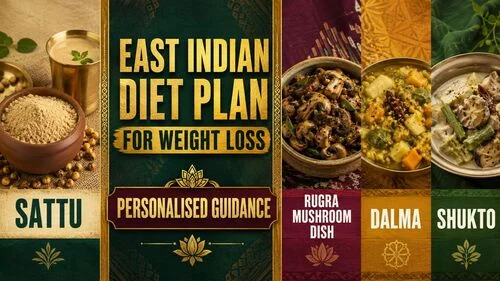
Bihar Diet Plan for Weight Loss: Bihari Foods and Dishes
A Bihar diet plan for weight loss can keep sattu, dal pitha, litti-chokha, chana ghugni, seasonal vegetables, dals, rice and familiar rotis. These foods show that Bihari cuisine already contains pulses, roasted gram, vegetables and grains. The question is not whether litti or rice is allowed, but how the complete preparation and the rest of the person’s eating pattern fit together.
Litti is a useful example because the sattu filling and wheat exterior are only part of the story. The amount of ghee used, the accompaniments and how often the dish is eaten can change its role substantially. Dal pitha, which is commonly steamed, raises a different set of considerations from fried snacks or festival sweets even though both belong to the same cuisine.
Bihar also has a strong seasonal and festival food culture. Thekua, khaja, tilkut and other sweets do not need moral labels, but treating festival foods as everyday foods can blur the pattern that actually needs review. A useful plan keeps culture visible without pretending every traditional dish has the same nutritional role.
| Meal | Diet plan |
| Breakfast | Sattu drink or sattu-based preparation with seasonal vegetables |
| Mid-morning | Seasonal fruit |
| Lunch | Rice with dal, seasonal vegetables and curd |
| Evening | Chana ghugni |
| Dinner | Dal pitha with chokha and cooked vegetables |
Jharkhand Diet Plan for Weight Loss: Jharkhand Foods and Dishes
A Jharkhand diet plan for weight loss should recognise foods that are often absent from generic Indian diet lists. Rugra, koinar saag, kurthi dal, chilka roti, rice, bamboo shoots, pitha and other tribal or rural preparations reflect a food culture shaped by local crops, forests and seasonal availability.
Rugra and local greens show why a regional plan can add variety without exotic imported ingredients. Kurthi dal and rice-chana preparations can contribute pulses and grains, while bamboo shoots appear in several local dishes. Their usefulness still depends on the person’s digestion, preparation method and overall nutritional needs rather than a claim that a rare ingredient is automatically better for weight loss.
Dhuska provides the useful contrast. It is culturally important and popular, but frying changes the nutritional profile compared with steamed or lightly cooked rice-and-pulse preparations. The goal is not to remove such foods from cultural life; it is to recognise which dishes are everyday foundations and which are better understood as occasional or context-dependent foods.
| Meal | Diet plan |
| Breakfast | Chilka roti with a simple pulse-based accompaniment |
| Mid-morning | Seasonal fruit |
| Lunch | Rice with kurthi dal, koinar saag and seasonal vegetables |
| Evening | Steamed pitha |
| Dinner | Rice with a bamboo-shoot or rugra vegetable preparation and dal |
West Bengal Diet Plan for Weight Loss: Bengali Foods and Dishes
A West Bengal diet plan for weight loss can include rice, dal, fish, shukto, posto-based dishes, mochar ghonto, leafy vegetables, mixed vegetable preparations and familiar home food. Bengali cuisine also varies by household, community and geography, so restaurant fish fry, biryani and sweets should not be treated as the entire Bengali diet.
Shukto and mochar ghonto illustrate the vegetable diversity that is often lost when Bengali food is described only through fish and rice. Posto dishes introduce another point: poppy seed paste can contribute flavour and texture, but a dish’s final energy density still depends on the amount used, added oil and what else is eaten around it.
Sweets deserve context rather than alarm. Mishti may be socially and culturally important, yet frequency matters. A personalised Bengali pattern can preserve rice, fish and familiar vegetables while making realistic decisions about fried snacks, sweets, restaurant meals and the parts of the routine that are actually affecting appetite and intake.
| Meal | Diet plan |
| Breakfast | Rice-based or familiar home breakfast with vegetables and curd |
| Mid-morning | Seasonal fruit |
| Lunch | Rice with dal, shukto, mochar ghonto and home-style fish |
| Evening | A simple home-prepared snack with tea or curd |
| Dinner | Rice with leafy vegetables and a light posto-based or mixed vegetable preparation |
Odisha Diet Plan for Weight Loss: Odia Foods and Dishes
An Odisha diet plan for weight loss can work with dalma, pakhala, besara, mandia-based foods, leafy vegetables, rice, fish and other familiar Odia preparations. Odisha’s temple cuisine, coastal food and tribal food traditions are different enough that no single plate should be presented as the state’s universal diet.
Dalma is a useful example of a mixed regional dish because lentils and vegetables are cooked together, yet its role still depends on the rest of the day’s intake and the individual’s needs. Besara brings mustard into vegetable preparations, while Koraput and other tribal areas use mandia or finger millet in ways that differ from coastal household patterns.
Pakhala is often discussed as if fermentation alone makes it a special health food. It is better understood as a culturally important rice preparation whose place in a weight-management pattern depends on the total meal context, accompaniments, food safety, individual tolerance and overall dietary balance.
| Meal | Diet plan |
| Breakfast | Mandia-based preparation with curd or a simple pulse accompaniment |
| Mid-morning | Seasonal fruit |
| Lunch | Rice with dalma, besara and leafy vegetables |
| Evening | A simple home-prepared steamed snack |
| Dinner | Pakhala with a suitable vegetable or fish accompaniment |
Mustard, Sattu, Poppy Seeds and Rice Are Ingredients, Not Verdicts
Eastern Indian cuisine makes it easy to see why single-food rules fail. Sattu can be a convenient pulse-based ingredient without being a fat-loss remedy. Mustard can give Odia or Bengali dishes their characteristic flavour without making every mustard-based preparation light. Poppy seeds are traditional in Bengali cooking but are energy-dense ingredients. Rice is a staple whose effect cannot be judged apart from the complete pattern.
A better assessment looks at frequency, cooking method, added fats, sweetened foods, fried snacks, eating outside the home, appetite and the balance of pulses, vegetables and protein sources. This is more useful than replacing one Eastern staple with another food simply because it has a healthier reputation online.
When Personalised Eastern Indian Nutrition May Be Worth Considering
Personalisation is most useful when the challenge is deciding what a familiar Eastern Indian food pattern actually needs, not simply finding another list of foods to avoid. Sattu, rice, fish, mustard-based cooking, leafy vegetables, festive sweets and local breads can play very different roles from one household to another. Health history, appetite, medication, activity, work routine and food tolerance can change the priority.
Chief Nutritionist Vasanthi Senthilvel at Newtrist Nutritionist Dietitian Dietician provides personalised diet plans for weight management. Consultation can start with the Bihari, Jharkhand, Bengali or Odia foods already eaten at home and distinguish cultural staples from the parts of the pattern that are genuinely limiting progress, so the recommendations remain practical rather than generic.
Consult Chief Nutritionist Vasanthi Senthilvel for an individual weight-management plan built around your Eastern Indian food habits, health needs and day-to-day constraints.
Author
Chief Nutritionist Vasanthi Senthilvel leads Newtrist Nutritionist Dietitian Dietician, providing personalised diet plans for weight management and clinical nutrition for children, adolescents, adults and families.
She has 21 years of experience in nutrition and has received professional recognition for her work.
- Pride of Bharat Awards 2026: Outstanding Achievement in Holistic Health & Nutrition Innovation
- Doctor of The Year: Nutritionist 2026: Excellence in Clinical Nutrition and Weight Loss.
Her approach considers age, growth, health history, medical conditions, laboratory reports, medication, body composition, weight history, dietary preferences, regional food habits, family routines, activity, sleep and personal health goals. Recommendations are developed according to individual needs rather than using one standard diet for everyone.
Consultations are available in person at Bangalore HSR Layout, Koramangala, Bellandur, Haralur and Electronic City, as well as online across India.
Independent Medical Review Panel
Newtrist health and nutrition articles undergo medical review, where appropriate, by doctors with relevant specialist expertise. The medical professionals listed below contribute to Newtrist’s review process within their respective specialties.
| Speciality | Doctor |
|---|---|
| Endocrinology | Dr Vinay Prasad MBBS, MD, DM |
| Gastroenterology & Hepatology | Dr Sunil kumar N MBBS, MD, DM |
| Gynaecology | Dr Prathiba G MBBS, DNB, FIRM, FMAS |
| Nephrology | Dr Priyashree R MBBS, MD, DNB, DM |