
Written by: Chief Nutritionist Vasanthi Senthilvel
21 years of experience | Newtrist Nutritionist Dietitian Dietician
Best Nutritionist in Bangalore with multiple awards for excellence in clinical nutrition, weight loss, holistic health and nutrition innovation.
Medically reviewed by: Dr Dr Prathiba G MBBS, DNB, FIRM, FMAS | Dr Sunil kumar N MBBS, MD, DM | Dr Vinay Prasad MBBS, MD, DM
Medical Disclaimer: Nutritional needs vary based on an individual’s profile. The information and calculator on this page is for general educational purposes only and is not intended to replace personalised medical or nutrition care.
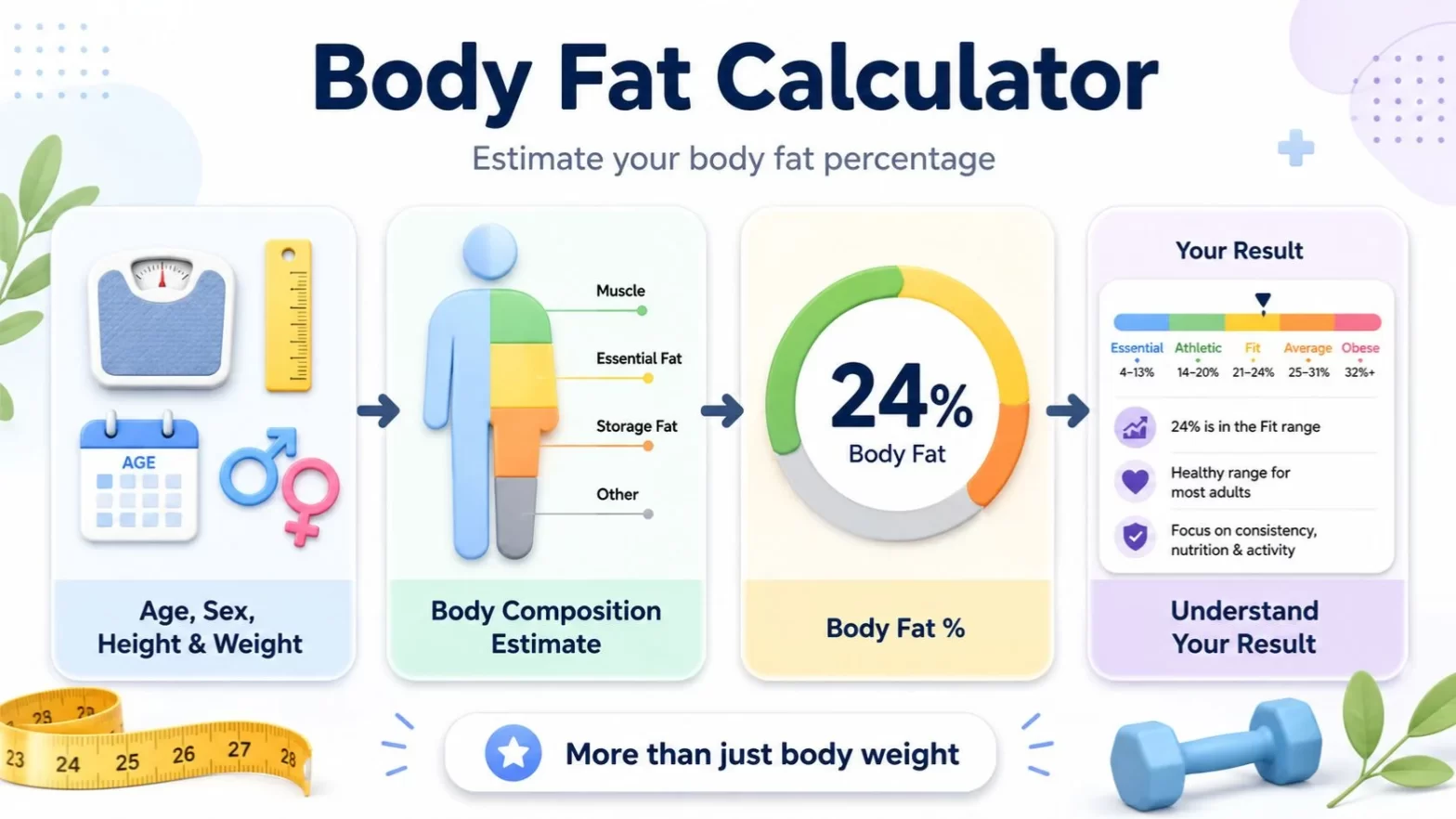
A body fat calculator gives you more context than body weight alone by estimating how much of your total weight is fat mass. This calculator uses your male or female selection, age, height and weight to produce an estimated body-fat percentage. The number can be useful when body composition is the question, but it is still an estimate rather than a direct measurement of the tissues in your body.
Key takeaway: The body fat calculator estimates the percentage of your total body weight that is fat mass. It is useful for understanding body composition, but the result depends on a predictive equation and should not be treated as an exact measurement, a diagnosis or a personal target. Age, sex, body build and the method used can all affect how body-fat percentage should be interpreted.
Enter the details requested by the calculator and use the result as a starting point. The most useful next step is not to chase a particular percentage, but to understand what the estimate does and does not tell you about your body composition.
Body Fat Calculator
Your body fat is ......
What does your body-fat percentage mean?
Body-fat percentage is the estimated proportion of total body weight that comes from fat mass. If a calculator gives a result of 25%, for example, it is estimating that roughly one quarter of total body weight is fat mass. The remaining weight is fat-free mass, which includes muscle, bone, body water and organs.
That distinction is why body-fat percentage can add information that body weight alone cannot provide. Two people can weigh the same while having different proportions of fat mass and fat-free mass, so the number on a weighing scale does not describe body composition by itself.
There is no single body-fat percentage that defines health for every adult. Reference values vary according to sex, age, population, measurement method and the purpose for which body composition is being assessed. A calculator result is therefore more useful when it is interpreted in the right context rather than compared with an arbitrary ideal.
Get a personalized diet plan designed by Chief Nutritionist Vasanthi, with 21 years of experience and multiple awards in clinical nutrition, weight loss, holistic health, and nutrition innovation.
Consult in person at Bangalore HSR Layout, Koramangala, Bellandur, Haralur, or Electronic City, or online across India.
Why body-fat percentage differs between people
Body-fat percentage naturally varies between individuals. Age and sex influence the relationship between body size and body fat, and people with the same height and weight can still have different body composition.
Sex and age affect interpretation
Women generally carry a higher proportion of body fat than men, and body composition can also change with age. This is one reason the calculator asks for age and a male or female selection rather than relying on height and weight alone.
Muscle changes the picture
A person with more muscle may weigh more without having a correspondingly high body-fat percentage. Another person at the same body weight may have less muscle and a higher proportion of fat mass. Body composition therefore provides a different perspective from the scale, although an equation-based estimate still cannot measure muscle and fat directly.
Body build and individual variation matter
Predictive calculators are built around relationships seen across groups of people. Individual body proportions do not always match those average relationships. This is why a calculated value can be useful for orientation while still differing from a result obtained through another body-composition method.
Body-fat percentage versus BMI
Body-fat percentage and BMI answer different questions. Body-fat percentage estimates how much of total body weight is fat mass, while BMI compares body weight with height and places the result into a weight-to-height screening category.
| Measure | What it tells you | Main limitation |
| Body-fat percentage | Estimated proportion of body weight that is fat mass | Calculator-based values are estimates and do not show where fat is stored |
| BMI | Weight in relation to height | Does not distinguish fat mass from muscle, bone or other fat-free tissue |
If your question is specifically about weight relative to height, use the BMI calculator. If your question is about estimated body composition, body-fat percentage is the more relevant measure. Neither result should be treated as a complete assessment on its own.
How accurate is a body fat calculator?
A body fat calculator provides an estimate, not a direct measurement. This calculator uses age, height, weight and the male or female selection to predict body-fat percentage from those basic inputs. Because it does not physically measure fat tissue, its result can differ from a person’s actual body composition.
Other methods, including bioelectrical impedance, skinfold assessment and DXA, use different techniques and assumptions. They can also produce different values for the same person. For this reason, a result from one method should not be treated as interchangeable with a result from another method.
If you use the calculator to follow change over time, consistency is more helpful than repeatedly switching methods. Even then, remember that a change in the calculated percentage does not prove that fat mass changed by exactly the same amount because the calculator is still estimating body composition from a limited set of inputs.
What can the calculator not tell you?
The calculator can estimate total body-fat percentage, but it cannot describe the complete body-composition picture. In particular, it cannot tell you exactly how much muscle you have, where body fat is stored, or whether a particular percentage is the right target for you.
- It cannot identify fat distribution in specific areas of the body.
- It cannot directly measure muscle, bone or internal fat deposits.
- It cannot determine fitness, strength or sports performance from body-fat percentage.
- It cannot decide whether you should lose, gain or maintain weight.
- It cannot create a personal food intake, calorie target or diet plan.
These limits matter because body-composition goals can look very different from person to person. A lower number is not automatically better, and a higher number does not by itself explain what dietary change, if any, is appropriate.
When body-composition results need individual interpretation
A calculator result may be enough if you simply want a rough estimate of body-fat percentage. Individual interpretation becomes more useful when you want to turn that estimate into a practical decision about weight management or a change in body composition.
For example, the same body-fat percentage can have different significance for someone with a long history of weight cycling, someone who has recently changed activity levels, or someone whose main concern is preserving muscle while changing body weight. The number alone does not show appetite, eating patterns, sleep, routine, body-composition history or whether a proposed change is nutritionally appropriate.
If your main goal is reducing body weight or body fat, Newtrist’s weight-loss nutrition guidance explains why sustainable weight management involves more than aiming for a lower calculator result. The appropriate approach still depends on the individual.
Frequently asked questions
Can two people with the same body-fat percentage look different?
Yes. The same estimated body-fat percentage can appear different because people vary in height, muscle mass, body proportions and where fat is stored. Body-fat percentage describes the proportion of body weight estimated to be fat, not body shape or appearance. This is one reason visual comparison is a poor way to judge another person’s body composition.
Can body-fat percentage change even if body weight changes very little?
Yes. Body composition can change when fat mass and fat-free mass move in different directions while total body weight stays similar. However, an equation-based calculator may not detect every such change accurately because it relies mainly on basic measurements rather than directly measuring muscle and fat tissue.
Is a lower body-fat percentage always better?
No. Body fat has normal physiological functions, and the lowest possible percentage is not a health goal. A suitable body-composition range depends on factors such as sex, age, health context and individual goals. The calculator should be used to understand an estimate, not to set an extreme target.
Why is my body-fat calculator result different from another device?
Different methods can produce different estimates because they use different measurements, equations and assumptions. A calculator based on age, height, weight and sex is not measuring the body in the same way as bioelectrical impedance, skinfold assessment or DXA. Comparing results from the same method is usually more meaningful than treating values from different methods as identical.
Conclusion
A body fat calculator can give useful context when you want to look beyond body weight and estimate body composition. The result is still a prediction based on limited inputs, so it is most useful as a starting point rather than a target or diagnosis. Individual goals and body-composition changes need wider interpretation than one percentage can provide.
When personalised nutrition guidance may help
Personalised nutrition guidance may be useful when you want to act on a body-fat result rather than simply understand the number. A weight-management assessment can consider body composition, weight history, appetite, eating patterns, activity, sleep, food preferences, regional food habits, work routine and personal goals together.
Readers who need individual guidance may consult Chief Nutritionist Vasanthi Senthilvel at Newtrist Nutritionist Dietitian Dietician for a personalised diet plan for weight management. The assessment can help place body-composition information within a practical nutrition approach suited to the individual’s needs and routine rather than using one percentage as the complete decision.
Consult Chief Nutritionist Vasanthi Senthilvel for a personalised diet plan developed around your body-composition and weight-management goals, food preferences, activity and daily routine.
Author
Chief Nutritionist Vasanthi Senthilvel leads Newtrist Nutritionist Dietitian Dietician, providing personalised diet plans for weight management and clinical nutrition for children, adolescents, adults and families.
She has 21 years of experience in nutrition and has received professional recognition for her work.
- Pride of Bharat Awards 2026: Outstanding Achievement in Holistic Health & Nutrition Innovation
- Doctor of The Year: Nutritionist 2026: Excellence in Clinical Nutrition and Weight Loss.
Her approach considers age, growth, health history, medical conditions, laboratory reports, medication, body composition, weight history, dietary preferences, regional food habits, family routines, activity, sleep and personal health goals. Recommendations are developed according to individual needs rather than using one standard diet for everyone.
Consultations are available in person at Bangalore HSR Layout, Koramangala, Bellandur, Haralur and Electronic City, as well as online across India.
Independent Medical Review Panel
Newtrist health and nutrition articles undergo medical review, where appropriate, by doctors with relevant specialist expertise. The medical professionals listed below contribute to Newtrist’s review process within their respective specialties.
| Speciality | Doctor |
|---|---|
| Endocrinology | Dr Vinay Prasad MBBS, MD, DM |
| Gastroenterology & Hepatology | Dr Sunil kumar N MBBS, MD, DM |
| Gynaecology | Dr Prathiba G MBBS, DNB, FIRM, FMAS |