
Written by: Chief Nutritionist Vasanthi Senthilvel
21 years of experience | Newtrist Nutritionist Dietitian Dietician
Best Nutritionist in Bangalore with multiple awards for excellence in clinical nutrition, weight loss, holistic health and nutrition innovation.
Medically reviewed by: Dr Prathiba G MBBS, DNB, FIRM, FMAS | Dr Sunil kumar N MBBS, MD, DM | Dr Vinay Prasad MBBS, MD, DM
Medical Disclaimer: Nutritional needs vary based on an individual’s profile. The information on this page is for general educational purposes only and is not intended to replace personalised medical or nutrition care.
You take one katori of rice for lunch and two rotis for dinner. It feels like a reasonable routine. But have you ever checked how much your katori actually holds or how much atta goes into those rotis?
Your everyday portions may be larger or smaller than you think.
A deep katori can hold considerably more rice than a shallow one. Two large chapatis can contain more wheat than three small phulkas.
The difference is not always how many servings you eat. It is how much rice or wheat those servings contain.
Understanding rice and roti portion sizes helps you make more informed choices without giving up familiar Indian meals. Whether you prefer rice with sambar, roti with sabzi, or both together, the goal is to serve quantities that fit your needs.
Key Takeaways
- Rice: Around ¾ to 1 cup of cooked rice, approximately 115 to 160 g, is a practical serving example for some adults.
- Roti: One or two medium rotis, each made with approximately 25 to 30 g of dry atta, provide a useful portion reference.
- Rice and roti together: A combination such as ½ cup cooked rice and one medium roti allows you to enjoy both within a measured grain portion.
- Balanced meal: Include suitable portions of dal, legumes, vegetables, and other protein-rich foods alongside your rice or roti.
These measurements provide a starting reference. The quantity you need depends on your activity, appetite, overall food intake, and nutritional requirements.
Table of Contents
How Much Rice Should You Eat in One Meal?
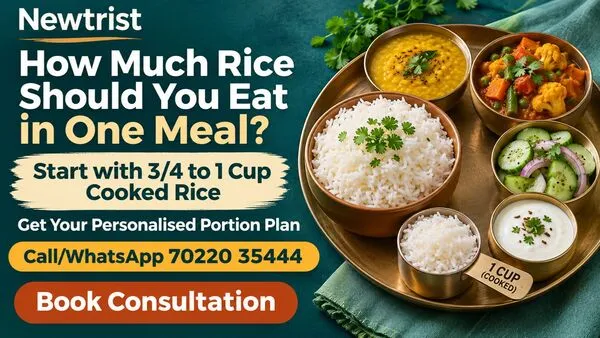
The most useful way to understand a rice portion is to measure the quantity after cooking.
A small-looking serving on a large plate may contain more rice than expected. The size of the serving spoon and the depth of your bowl also affect how much you take.
Cooked Rice Portion Size in Cups and Grams
| Cooked rice portion | Approximate weight |
| ½ measuring cup | 75 to 80 g |
| ¾ measuring cup | 115 to 120 g |
| 1 measuring cup | 150 to 160 g |
| 1½ measuring cups | 225 to 240 g |
These measurements use a standard 240 ml measuring cup. The weight can vary depending on the rice variety and the amount of water absorbed during cooking.
The table refers to cooked rice, not raw rice. Water absorption increases the weight and volume of rice during preparation.
How to Measure Cooked Rice Using Your Regular Katori
You do not need to weigh rice every time you sit down for lunch.
Instead, try this once in your kitchen.
- Take the katori you normally use for rice.
- Fill it with cooked rice to your usual serving level.
- Transfer the rice into a standard measuring cup.
- Note whether your regular serving is closer to ½ cup, ¾ cup, or 1 cup.
You now have a familiar household measure that can help you serve a consistent quantity.
This works whether your family prepares sona masoori, ponni, basmati, or hand-pounded rice.
How Many Rotis Should You Eat Per Meal?
If you usually eat two chapatis, the next question is how much atta is used to make them.
A thin phulka and a large, thick chapati can contain very different quantities of wheat.
For this reason, the weight of dry atta provides a more meaningful portion reference than the number of rotis alone.
Roti Portion Size Based on Atta Quantity
| Roti size | Approximate dry atta used |
| Small phulka | 20 g |
| Medium roti | 25 to 30 g |
| Large chapati | 40 to 45 g |
These quantities refer to plain whole-wheat rotis prepared without added oil or ghee.
Consider two dinner plates.
One contains three small phulkas made using a total of 60 g of atta.
The other contains two large chapatis prepared using 90 g of atta.
Although the second plate contains fewer rotis, it provides more wheat.
This is why the quantity of atta matters more than simply counting chapatis.
How to Calculate the Atta in Your Homemade Rotis
The next time you prepare chapati dough, measure the flour before adding water.
Suppose you use 150 g of whole-wheat atta to make five rotis.
150 g ÷ 5 = 30 g of atta per roti.
Each of your homemade chapatis now has an identifiable flour quantity.
Once you understand your regular roti size, you can use that reference without repeating the calculation every day.
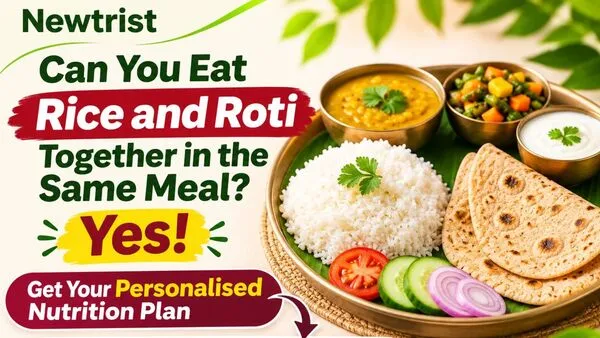
Can You Eat Rice and Roti Together in the Same Meal?
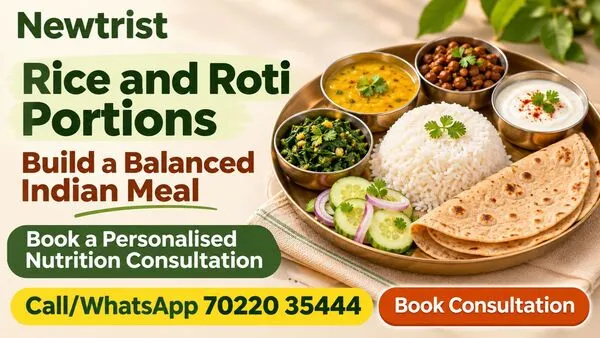
Yes. You can eat rice and roti together in an Indian lunch or dinner.
Both contribute carbohydrates, so what matters is their combined portion.
Think about a Sunday lunch where you enjoy chapati with vegetable curry before eating rice with sambar and curd.
There is no need to abandon that familiar eating pattern.
Instead, consider how much of each staple you want before serving.
How to Balance Rice and Roti Portions Together
If your usual meal contains a full serving of rice and you want to include chapati, you can adjust the rice quantity to make room for the roti.
For example, one medium roti alongside a smaller serving of cooked rice provides a way to enjoy both foods.
When serving your plate, decide on the combined grain quantity first. Then add your preferred dal, sabzi, and other accompaniments.
This is more useful than treating rice and roti as two completely separate full servings.
There is no single rice-to-roti ratio that everyone must follow. The total amount should reflect the meal’s composition and your individual needs.
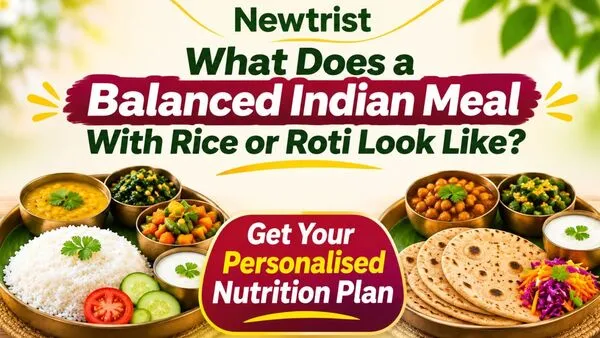
What Does a Balanced Indian Meal With Rice or Roti Look Like?
Once you understand your grain portion, the next question is what accompanies it.
Rice served with a little rasam provides a different nutritional balance from rice served with thick dal, vegetables, and curd.
Similarly, chapatis accompanied by kala chana and leafy vegetables offer more nutritional variety than chapatis eaten with only a small amount of gravy.
You do not need elaborate recipes to make your plate more balanced.
Three Practical Indian Meal Examples
| Meal | Grain portion | Accompaniments |
| Rice-based lunch | ¾ cup cooked rice | Thick toor dal, beans poriyal, cucumber salad, and curd |
| Roti-based dinner | 2 medium whole-wheat rotis | Kala chana curry, amaranth greens, and vegetable salad |
| Rice and roti meal | ½ cup cooked rice + 1 medium roti | Thick vegetable sambar, drumstick-leaf poriyal, and curd |
These are examples of alternative lunch or dinner combinations, rather than a fixed daily diet plan.
Toor dal, kala chana, and other legumes contribute plant protein and fibre. Amaranth greens, drumstick leaves, and seasonal vegetables provide additional vitamins, minerals, and variety.
The aim is to make rice or roti part of a satisfying meal rather than allowing either food to dominate the plate.
Three Serving Habits That Can Increase Your Rice and Roti Portions
Sometimes your actual intake changes without you deliberately deciding to eat more.
1. Taking Rice With Every Accompaniment
You may begin with rice and dal, take another helping for rasam, and finish with curd rice.
Each helping looks small, but the combined quantity can be considerably larger than your initial serving.
If you enjoy eating rice with several accompaniments, set aside the quantity you intend to eat and divide it among the dishes.
2. Taking Another Roti Because It Is Available
Imagine finishing two chapatis and noticing one more in the serving basket.
You might reach for it automatically, even when your meal has already satisfied your appetite.
Before serving another roti, consider whether you are still hungry and whether you have eaten enough of the accompanying foods.
3. Overlooking the Other Starchy Foods on Your Plate
A meal containing rice, chapati, and a substantial potato curry includes carbohydrates from all three foods.
When deciding how much rice or roti to serve, consider the other starchy ingredients in the meal as well.
This does not mean avoiding familiar combinations. It means recognising the complete quantity of carbohydrate-rich foods being served.
Frequently Asked Questions
1. Is Half a Cup of Cooked Rice Equal to One Medium Roti?
Half a cup of cooked white rice and one medium whole-wheat roti made with approximately 25 to 30 g of atta can provide roughly similar amounts of carbohydrates. However, their fibre and overall nutrient composition differ, so they are not exact nutritional equivalents.
2. How Should I Measure Rice in Lemon Rice or Curd Rice?
Measure the cooked rice before mixing it with curd, peanuts, tempering ingredients, or other additions. These ingredients contribute their own nutrients and energy, so consider the complete preparation when deciding your serving.
3. Does Adding Ghee Change the Portion Size of a Roti?
The amount of atta remains unchanged, but adding ghee increases the fat and energy content of the finished roti. Two chapatis made with identical flour quantities can therefore provide different amounts of energy.
4. Can I Use the Same Measuring Cup for Brown Rice and White Rice?
Yes. A standard measuring cup can be used for both cooked brown rice and white rice. However, their cooked weights and nutritional composition may differ, so the same volume does not necessarily provide identical nutrients.
5. How Can I Estimate Rice and Roti Portions When Eating at a Restaurant?
Compare the serving with your usual household measurements. Restaurant rotis may be larger or thicker than homemade chapatis, while rice portions may be served in deeper bowls. Use your familiar roti size and measuring-cup reference to make a practical estimate.
How Much Rice and Roti Is Right for Your Body?
You can measure the rice in your katori. You can calculate the atta in your rotis. But those measurements cannot tell you whether the quantities match your body’s needs.
Perhaps you eat two rotis every evening because that is what your family has always served.
Maybe you feel hungry soon after lunch, even though your plate looks full.
Or you want to enjoy both rice and chapati but are uncertain how much of each fits your daily nutritional requirements.
A standard portion chart can show you how much food is on your plate. Personalised nutrition guidance helps you understand how much should be there.
At Newtrist, Chief Nutritionist Vasanthi Senthilvel provides personalised nutrition guidance based on your eating habits, food preferences, daily activity, nutritional requirements, and individual goals.
Your consultation can help you establish:
- Rice and roti portions suited to your nutritional needs.
- Practical quantities for your regular lunch and dinner.
- Suitable combinations of grains, dal, vegetables, and other familiar Indian foods.
- Portion adjustments that work with your existing family meals and daily routine.
Rather than following someone else’s fixed rule about eating one katori of rice or two rotis, you can understand the quantities that are appropriate for you.
You already know what you enjoy eating. Now find out how much belongs on your plate.
Consult Chief Nutritionist Vasanthi Senthilvel at Newtrist for a personalised diet and nutrition plan.
Author
Chief Nutritionist Vasanthi Senthilvel leads Newtrist Nutritionist Dietitian Dietician, providing personalised diet plans for weight management and clinical nutrition for children, adolescents, adults and families.
She has 21 years of experience in nutrition and has received professional recognition for her work.
- Pride of Bharat Awards 2026: Outstanding Achievement in Holistic Health & Nutrition Innovation
- Doctor of The Year: Nutritionist 2026: Excellence in Clinical Nutrition and Weight Loss.
Her approach considers age, growth, health history, medical conditions, laboratory reports, medication, body composition, weight history, dietary preferences, regional food habits, family routines, activity, sleep and personal health goals. Recommendations are developed according to individual needs rather than using one standard diet for everyone.
Consultations are available in person at Bangalore HSR Layout, Koramangala, Bellandur, Haralur and Electronic City, as well as online across India.
Independent Medical Review Panel
Newtrist health and nutrition articles undergo medical review, where appropriate, by doctors with relevant specialist expertise. The medical professionals listed below contribute to Newtrist’s review process within their respective specialties.
| Speciality | Doctor |
|---|---|
| Endocrinology | Dr Vinay Prasad MBBS, MD, DM |
| Gastroenterology & Hepatology | Dr Sunil kumar N MBBS, MD, DM |
| Gynaecology | Dr Prathiba G MBBS, DNB, FIRM, FMAS |
| Nephrology | Dr Priyashree R MBBS, MD, DNB, DM |