
Written by: Chief Nutritionist Vasanthi Senthilvel
21 years of experience | Newtrist Nutritionist Dietitian Dietician
Best Nutritionist in Bangalore with multiple awards for excellence in clinical nutrition, weight loss, holistic health and nutrition innovation.
Medically reviewed by: Dr Prathiba G MBBS, DNB, FIRM, FMAS | Dr Sunil kumar N MBBS, MD, DM | Dr Vinay Prasad MBBS, MD, DM
Medical Disclaimer: Nutritional needs vary based on an individual’s profile. The information on this page is for general educational purposes only and is not intended to replace personalised medical or nutrition care.
You have reduced your food portions, become more mindful of snacks, and started paying attention to what you eat. Yet, your weight-loss progress is not what you expected.
Before making another change to your meals, think about yesterday.
How many cups of chai did you drink? Did you have coffee during your work break? What about that glass of juice or packaged beverage in the evening?
You probably remember your lunch and dinner. But you may not have counted everything you drank.
Yes, liquid calories can slow weight-loss progress when the energy from beverages increases your daily calorie intake and reduces the calorie deficit needed for weight loss.
The interesting part is that you could be making sensible food choices while overlooking calories from drinks that have become part of your everyday routine.
Understanding those calories may reveal an opportunity you have not considered.
Key Takeaways
- Calories from drinks count: Sweetened tea, coffee, fruit juice, milkshakes and other beverages contribute to your total daily energy intake.
- Fullness can differ: Some calorie-containing drinks provide less satisfaction than solid foods with similar energy, making additional calories easier to consume.
- Ingredients and portions matter: Sugar, milk, fruit and other additions affect calorie content. A larger serving also means more energy from the same recipe.
- Small changes can help: Measuring your regular beverages, checking labels and recording what you drink can identify practical opportunities to reduce excess calories.
Table of Contents

What Are Liquid Calories, and Why Do They Matter for Weight Loss?
Liquid calories are the energy you consume through beverages rather than solid foods.
They come from ingredients that provide carbohydrates, protein or fat. For example, plain water contains no calories, while milk, fruit juice, sweetened coffee and milkshakes contribute varying amounts of energy.
Your body counts that energy whether you drink it or eat it.
The difficulty is that many people do not include beverages when thinking about how much they consume throughout the day.
You may carefully measure the rice in your lunch or the quantity of oil used while cooking, yet prepare your usual tea without considering its ingredients.
If those drink calories are not accounted for, your total daily intake may be higher than expected.
Why Some Drinks May Leave You Less Satisfied Than Food
Imagine eating a whole orange and drinking a glass of strained orange juice.
The whole fruit requires chewing and contains natural fibre. The juice is easier to consume quickly and generally contains less fibre.
Although both provide energy, their effects on hunger and fullness may differ.
Some calorie-containing beverages, particularly sugar-sweetened drinks, may provide less satiety than comparable solid foods.
That means you might finish a sweetened beverage and still eat your usual meal afterward.
The effect is not identical for every drink. Ingredients such as protein and fat can influence fullness, and individual responses vary.
This is why understanding beverage calories involves more than simply identifying which drinks taste sweet.
Which Everyday Drinks Can Add Hidden Calories?
You may already know that soft drinks contain calories. But what about the beverages you prepare at home or order during a busy day?
Several familiar drinks can contribute more energy than you expect.
Tea and Coffee With Sugar and Milk
For many Indian households, the day begins with chai or filter coffee.
The brewed tea or plain black coffee contributes very little energy. Most calories come from the ingredients added during preparation.
Consider your usual recipe.
Do you use one teaspoon of sugar or two? Is the cup mostly milk? Do you prepare a small serving at home but order a much larger coffee outside?
These differences change the calorie content.
Even when a single cup seems insignificant, the same preparation consumed several times can make a noticeable contribution to daily intake.
Fruit Juices, Smoothies and Milkshakes
A drink made with fruit can contain useful nutrients and still provide substantial calories.
A glass of juice may be prepared using several fruits, making it easy to consume more fruit in liquid form than you might ordinarily eat whole.
Smoothies and milkshakes can include milk, curd, nuts, sugar and other ingredients.
For example, a homemade banana milkshake prepared with milk and added sugar will have a different energy content from a smaller banana smoothie made with plain curd.
Neither preparation can be judged by its name alone.
The quantity and ingredients determine how much energy the drink provides.
Packaged Drinks and Café Beverages
Sweetened iced teas, flavoured milk, ready-to-drink coffee and packaged fruit beverages can contain calories from several ingredients.
Some may be consumed in large bottles, while others are served in café cups that are considerably bigger than homemade portions.
The important question is not whether a product appears refreshing or nutritious.
It is how much energy the complete serving contributes.

How Quickly Can Liquid Calories Add Up in One Day?
Imagine a typical workday.
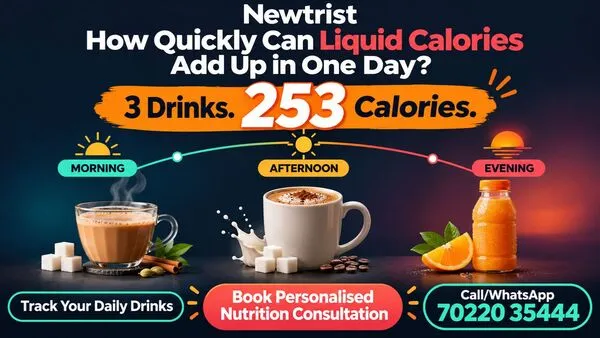
You begin with sweetened chai, enjoy a coffee during the afternoon and have a packaged beverage in the evening.
None of these feels like an additional meal.
But together, they can contribute a meaningful amount of energy.
Example: Calories From Three Everyday Drinks
| Beverage | Example serving | Approximate calories |
| Morning chai | 75 ml milk and 2 teaspoons sugar | 77 kcal |
| Afternoon coffee | 100 ml milk and 1 teaspoon sugar | 76 kcal |
| Evening packaged drink | 250 ml, labelled 40 kcal per 100 ml | 100 kcal |
| Total | Three beverages | 253 kcal |
This example assumes milk provides approximately 60 kcal per 100 ml and a level teaspoon of sugar provides approximately 16 kcal. Brewed tea, coffee and water contribute negligible additional energy.
Actual values depend on the type of milk, brand, preparation and serving quantities.
In this example, the beverages contribute approximately 253 calories in addition to the day’s meals and snacks.
Those calories do not automatically prevent weight loss.
However, they may explain part of the difference between what someone believes they are consuming and their actual daily energy intake.
If you have been adjusting food portions without considering beverages, this is one area worth examining before making further changes.
How to Identify Hidden Calories on Beverage Labels
You pick up a packaged drink and notice that the label says 45 calories.
That sounds like a small amount.
But look again.
Does the label say 45 calories for the entire bottle or for every 100 ml?
Calculate Calories for the Quantity You Drink
Suppose a beverage contains:
- Energy: 45 kcal per 100 ml
- Bottle size: 300 ml
The complete bottle contains:
45 × 3 = 135 kcal
Drinking the entire bottle provides approximately 135 calories.
This simple calculation helps you avoid mistaking the energy value of a small labelled quantity for the contents of the whole container.
Why “No Added Sugar” Does Not Mean Calorie-Free
A beverage can contain calories even when no sugar has been added.
Milk provides energy from naturally occurring carbohydrates, protein and fat.
Fruit-based drinks contain carbohydrates from fruit.
Preparations containing nuts or other energy-rich ingredients can also contribute calories without tasting particularly sweet.
When comparing beverages, check the total energy value alongside the ingredients rather than relying only on a front-of-pack claim.

How to Reduce Liquid Calories Without Giving Up Your Favourite Drinks
You do not have to stop enjoying your morning chai or every milk-based beverage.
The most useful changes are often small adjustments to drinks you already consume.
Adjust the Sugar in Your Regular Tea or Coffee
One level teaspoon of sugar provides approximately 16 calories.
If you usually add two teaspoons to your tea, reducing the amount to one removes approximately 16 calories from that serving.
For someone who drinks three cups a day, consistently making that change removes approximately 48 calories from the daily total.
You can also review whether your café coffee needs additional syrup, cream or sweetened toppings.
The aim is to identify additions that do not contribute much to your enjoyment but noticeably increase the drink’s energy content.
Choose a Serving Size Before Preparing or Ordering
A large glass of juice or a generous milkshake may contain substantially more energy than a smaller portion of the same recipe.
Decide how much you want before preparing the drink.
This is especially useful with homemade beverages, where ingredients are often added without measuring.
When ordering outside, consider whether a smaller serving would satisfy your preference just as well.
Match the Drink to the Occasion
Sometimes you want a beverage because you are thirsty. At other times, you want something enjoyable alongside a meal.
Plain water or water with fresh lemon and mint can quench thirst without meaningfully adding calories.
When you want a traditional Indian accompaniment, unsweetened buttermilk prepared with plain curd, water, roasted cumin and curry leaves is another familiar option.
Buttermilk contributes calories from its dairy ingredients, so its serving quantity still matters.
The goal is not to make every beverage calorie-free. It is to choose intentionally rather than consuming extra energy simply because a drink is available.

Could Your Daily Beverages Be Affecting Your Weight-Loss Progress?
You may remember a large coffee purchased at a café but forget the two small cups of tea you drank at home.
That is why reviewing your actual drinking routine can be more useful than estimating it from memory.
Try a Three-Day Beverage Check
For three typical days, write down every calorie-containing beverage you consume.
| What to record | Example |
| Beverage | Homemade chai |
| Serving size | 150 ml |
| Ingredients | Milk and sugar |
| Frequency | Twice during the day |
| Calories | Calculate using actual ingredient quantities |
Include homemade drinks, beverages purchased outside and packaged products.
After three days, review what you recorded.
Look for the drink you consume most frequently, the one with the highest calorie content and ingredients you regularly add without measuring.
You might discover that your largest source of overlooked calories comes from several small cups of sweetened tea.
For someone else, it may be an occasional large café beverage or a packaged drink consumed regularly.
This exercise gives you something more useful than a generic list of drinks to avoid.
It shows where changes may be relevant to your own routine.

Frequently Asked Questions
1. Does Plain Black Tea or Black Coffee Contain Calories?
Plain brewed black tea and black coffee contain negligible calories when prepared without milk, sugar or other calorie-containing additions.
2. Are Honey and Jaggery Lower in Calories Than Sugar?
Honey and jaggery also contribute energy. Replacing sugar with either ingredient does not automatically reduce a beverage’s calories. The amount used determines its contribution.
3. Does Coconut Water Contain Liquid Calories?
Yes. Coconut water naturally contains carbohydrates that provide energy, even without added sugar. Its calorie contribution depends on the quantity consumed.
4. Does Diluting Fruit Juice With Water Reduce Its Calories?
Adding water reduces the calorie concentration per millilitre. However, drinking the entire diluted preparation still provides the calories from all the original juice used.
5. Do Beverages Consumed Only on Weekends Matter for Weight Loss?
They can. Their contribution depends on the type, quantity and frequency of consumption. Reviewing beverages across the whole week provides a more complete picture of your energy intake.
Are Your Everyday Drinks Working Against Your Weight-Loss Goals?
You may already be doing several things right.
You prepare home-cooked meals, pay attention to portions and try to maintain a consistent eating routine.
But what if your drinks have never been examined with the same care?
Perhaps you enjoy three cups of chai during a demanding workday. Maybe you regularly have fruit juice because you consider it nutritious. Or your afternoon café coffee has become a habit you rarely question.
You can now identify the calories in these drinks.
But there is another question worth asking:
Which beverage changes would actually help your weight-loss goals while still meeting your nutritional needs and fitting your daily routine?
That answer requires more than simply identifying the drink with the highest calorie content.
At Newtrist Nutritionist Dietitian Dietician, Chief Nutritionist Vasanthi Senthilvel provides personalised nutrition guidance based on your food and beverage habits, lifestyle, nutritional requirements and weight-management goals.
A personalised nutrition assessment can help you understand:
- How much energy your regular beverages contribute to your daily intake.
- Whether your drinking habits are making it harder to achieve your weight-loss goals.
- Which portions and ingredient adjustments are appropriate for your nutritional requirements.
- How to accommodate favourite beverages within a practical Indian meal plan.
Bring your usual food routine and a three-day beverage record to your nutrition consultation.
Rather than guessing which drink to eliminate or reducing food portions unnecessarily, you can work towards changes based on what you actually consume.
Your nutrition plan can be built around familiar foods, preferred beverages and everyday habits that are realistic for you to maintain.
You have already started paying attention to what is on your plate. Now discover whether what is in your glass deserves the same attention.
Consult Chief Nutritionist Vasanthi Senthilvel at Newtrist for a personalised weight-loss nutrition plan
Author
Chief Nutritionist Vasanthi Senthilvel leads Newtrist Nutritionist Dietitian Dietician, providing personalised diet plans for weight management and clinical nutrition for children, adolescents, adults and families.
She has 21 years of experience in nutrition and has received professional recognition for her work.
- Pride of Bharat Awards 2026: Outstanding Achievement in Holistic Health & Nutrition Innovation
- Doctor of The Year: Nutritionist 2026: Excellence in Clinical Nutrition and Weight Loss.
Her approach considers age, growth, health history, medical conditions, laboratory reports, medication, body composition, weight history, dietary preferences, regional food habits, family routines, activity, sleep and personal health goals. Recommendations are developed according to individual needs rather than using one standard diet for everyone.
Consultations are available in person at Bangalore HSR Layout, Koramangala, Bellandur, Haralur and Electronic City, as well as online across India.
Independent Medical Review Panel
Newtrist health and nutrition articles undergo medical review, where appropriate, by doctors with relevant specialist expertise. The medical professionals listed below contribute to Newtrist’s review process within their respective specialties.
| Speciality | Doctor |
|---|---|
| Endocrinology | Dr Vinay Prasad MBBS, MD, DM |
| Gastroenterology & Hepatology | Dr Sunil kumar N MBBS, MD, DM |
| Gynaecology | Dr Prathiba G MBBS, DNB, FIRM, FMAS |
| Nephrology | Dr Priyashree R MBBS, MD, DNB, DM |