
Written by: Chief Nutritionist Vasanthi Senthilvel
21 years of experience | Newtrist Nutritionist Dietitian Dietician
Best Nutritionist in Bangalore with multiple awards for excellence in clinical nutrition, weight loss, holistic health and nutrition innovation.
Medically reviewed by: Dr Prathiba G MBBS, DNB, FIRM, FMAS | Dr Sunil kumar N MBBS, MD, DM | Dr Vinay Prasad MBBS, MD, DM
Medical Disclaimer: Nutritional needs vary based on an individual’s profile. The information on this page is for general educational purposes only and is not intended to replace personalised medical or nutrition care.
You’ve been reading about the Mediterranean diet, but your family isn’t going to replace its regular Indian meals with salads, olives and unfamiliar dishes.
Tomorrow’s lunch may already be planned around roti, a vegetable curry and dal.
So, do you need a different menu, or could those same foods work?
The answer depends less on the names of the dishes and more on how your meals come together.
A vegetable curry can be part of Mediterranean-style eating, but adding olive oil to an otherwise unchanged diet doesn’t automatically create that pattern.
The more useful approach is to understand what Mediterranean eating prioritises and how those principles can fit into your everyday Indian meals.
Key Takeaway
The Mediterranean diet for Indians is a predominantly plant-based eating pattern that adapts Mediterranean principles to familiar Indian foods. It emphasises vegetables, fruits, legumes, whole grains, nuts and unsaturated fats, while allowing moderate amounts of dairy, eggs, fish or poultry according to food preferences.
The defining feature is the overall combination and regularity of these foods, not a particular cuisine or a rigid diet chart. Indian meals can reflect this pattern through suitable ingredient choices, cooking methods and meal composition.
Table of Contents

What Is the Mediterranean Diet?
The Mediterranean diet is an eating pattern based on traditional food habits in countries surrounding the Mediterranean Sea.
It is characterised by the regular consumption of minimally processed plant foods, with extra-virgin olive oil as a principal source of dietary fat.
Legumes, vegetables, fruits and whole grains form much of the foundation. Fish, dairy and other animal foods can be included in moderate amounts, while highly refined and heavily processed foods are less prominent.
Unlike a diet that prescribes specific foods for every meal, Mediterranean eating is understood through the pattern followed across days and weeks.
This flexibility is particularly useful in India, where ingredients and cooking traditions differ considerably between regions.

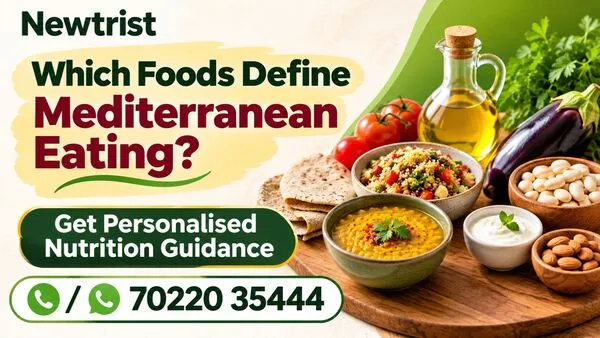
Which Foods Define Mediterranean Eating?
The Mediterranean diet is organised around food groups rather than a compulsory list of recipes.
For Indian households, understanding the role of each food group makes adaptation easier.
| Mediterranean food group | Indian food choices | Practical use |
| Vegetables | Brinjal, tomatoes and seasonal vegetables | Cooked sabzi, roasted vegetables and curries |
| Fruits | Whole seasonal fruits | Regular fruit choices |
| Legumes | White beans (safed rajma), familiar dals and other pulses | Curries, bean preparations and dal-based dishes |
| Whole grains | Whole-wheat roti and minimally processed grain preparations | Main-meal grain components |
| Nuts | Almonds and other suitable nuts | Small snack portions or meal accompaniments |
| Unsaturated fats | Extra-virgin olive oil and suitable locally used unsaturated oils | Cooking and food preparation |
| Dairy | Plain curd and unsweetened yoghurt | Meal accompaniments |
| Fish | Pomfret and other suitable fish | Optional non-vegetarian main dishes |
These foods contribute different nutrients, so the aim is variety rather than relying heavily on one ingredient.
Plant Foods and Grains
Plant foods provide the foundation of Mediterranean eating.
Consider two ingredients already common in Indian kitchens: brinjal and tomato.
Brinjal contributes fibre, while tomatoes provide vitamin C and lycopene, a naturally occurring plant compound.
They can be roasted, lightly sautéed or cooked with familiar spices. There is no need to turn them into a Mediterranean recipe.
Legumes are another important component.
White beans, also known as safed rajma, provide plant protein and dietary fibre. They can be cooked in a tomato-based Indian masala and served as a substantial part of lunch.
Whole grains complement these preparations by supplying energy and other nutrients.
The practical distinction is that grains need not occupy most of the meal simply because they are the familiar staple.
Protein Choices
Mediterranean eating gives particular importance to plant-based protein sources, including beans and other legumes.
For Indian vegetarians, pulse-based dishes can remain central to meals. Suitable dairy foods may contribute additional protein according to individual preferences.
For those who eat non-vegetarian foods, fish provides another option.
Pomfret, for example, can be prepared using Indian spices and served with vegetable and grain accompaniments.
The presence of fish does not replace the plant-focused foundation. Both vegetarian and non-vegetarian Mediterranean-style meals continue to emphasise vegetables, legumes, whole grains and other plant foods.
Dietary Fat Sources
Extra-virgin olive oil is one of the defining ingredients of the traditional Mediterranean diet.
It contains predominantly monounsaturated fats and naturally occurring plant compounds.
For an Indian adaptation, suitable locally used unsaturated oils may also be incorporated into cooking. Their nutritional compositions differ from extra-virgin olive oil, so they should not be considered identical replacements.
The important distinction is between improving the quality of dietary fats and simply adding more oil.
For example, replacing a substantial amount of butter or ghee with an appropriate unsaturated oil changes the fat composition of a preparation. Adding extra oil to the same dish without changing anything else does not provide the same benefit.
Almonds can also contribute unsaturated fats alongside protein and other nutrients.
Can Mediterranean Principles Work With Indian Foods?
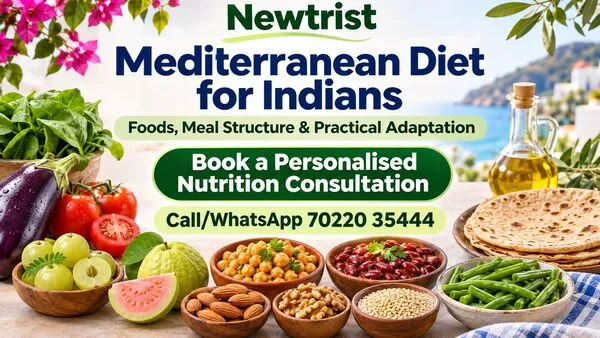
Yes. Mediterranean principles can be followed through Indian meals by prioritising vegetables and legumes, choosing suitable fat sources and considering how grains and protein-rich foods fit into the complete meal.
The approach does not require replacing the dishes your household normally prepares.
The main consideration is whether those dishes collectively reflect the Mediterranean eating pattern.
Vegetarian Adaptation
Consider a familiar North Indian lunch built around phulka, vegetable curry and dal.
If most of the meal consists of phulka and the accompaniments are served in small quantities, vegetables and protein-containing foods may be underrepresented.
A Mediterranean-style adaptation could give the bean or dal preparation a more substantial role, include a generous vegetable dish and retain the whole-grain component.
Here is a practical example using a white-bean and tomato curry.
| Meal component | Mediterranean-style Indian approach |
| Grain | Whole-wheat phulka as one part of the meal |
| Legume | White-bean curry prepared with tomato and Indian spices |
| Vegetable | Roasted brinjal with a seasonal vegetable accompaniment |
| Dietary fat | A measured amount of suitable unsaturated cooking oil |
The meal remains recognisably Indian.
The Mediterranean influence comes from the importance given to plant foods, the choice of dietary fat and the overall combination.
A useful visual approach is to give non-starchy vegetables a substantial share of the plate, with protein-rich foods and grains making up the other main components. Exact proportions depend on the ingredients and individual requirements, rather than a mandatory Mediterranean plate ratio.
Non-Vegetarian Adaptation
A non-vegetarian Indian meal can follow the same principles while incorporating fish.
For example, pomfret can be prepared with tomato, garlic and familiar spices, then served with cooked vegetables and a suitable whole-grain accompaniment.
The cooking method matters.
Fish that is grilled, roasted or lightly cooked with appropriate amounts of oil differs from a preparation that is heavily deep-fried.
Vegetarian and non-vegetarian households can therefore follow the same broad Mediterranean principles without eating identical dishes.
What Could a Mediterranean-Style Indian Day Look Like?
A one-day example can show how Mediterranean eating works through familiar Indian preparations.
The following menu is an illustration of the food pattern, not a fixed daily prescription.
Illustrative One-Day Indian Example
| Meal | Mediterranean-style Indian menu |
| Breakfast | Savoury whole-grain porridge with vegetables and plain curd |
| Mid-morning | Whole seasonal fruit |
| Lunch | Safed rajma masala, roasted brinjal and whole-wheat phulka |
| Evening snack | A small portion of almonds |
| Dinner | Pomfret prepared with a tomato-garlic masala, cooked seasonal vegetables and a suitable whole-grain accompaniment |
For a vegetarian dinner, the fish preparation can be replaced with a suitable legume-based main dish.
The menu illustrates several defining characteristics of Mediterranean eating: plant foods appear throughout the day, legumes play an important role, nuts contribute unsaturated fats and fish remains an optional component.
The specific meals can change according to regional preferences. What matters is maintaining the pattern across regular food choices.
Serving quantities also vary according to individual nutritional requirements, appetite and activity.
Why Has Mediterranean Eating Been Studied So Extensively?
Mediterranean eating has attracted considerable scientific interest because its overall dietary pattern has been associated with favourable cardiovascular and metabolic outcomes.
Research has examined how its combination of plant foods, whole grains, legumes, nuts and predominantly unsaturated fats may support long-term cardiovascular health.
Some studies have reported improvements in cardiovascular risk factors and fewer cardiovascular events among people following Mediterranean-style dietary patterns.
However, these findings do not mean that a single food is responsible for the observed outcomes.
Adding olive oil, almonds or fish to a diet does not automatically reproduce the benefits associated with following the complete Mediterranean eating pattern.
For Indian households, the useful lesson is to consider what is eaten regularly and how different foods work together, rather than concentrating on one supposedly essential ingredient.
What Does the Mediterranean Diet Not Require?
Several common assumptions make Mediterranean eating seem more complicated than necessary.
You do not need imported Mediterranean products. Familiar regional produce, legumes and suitable grain preparations can provide the foundation of an Indian adaptation.
You do not need a separate kitchen menu. Family meals can remain largely unchanged when their combinations and cooking methods are appropriate.
You do not need to abandon Indian flavours. Traditional spices, tomato-based gravies and familiar seasonings can continue to be used.
You do not need every meal to follow an identical formula. A Mediterranean eating pattern is established through consistent food choices over time, not by preparing the same ideal-looking plate at every meal.
The aim is to make Mediterranean principles workable within the foods and cooking practices you already use.
Frequently Asked Questions About the Mediterranean Diet for Indians
Can White Rice Be Included in a Mediterranean-Style Indian Diet?
Yes. White rice can be included occasionally within a Mediterranean-style Indian eating pattern. Whole-grain and less-refined grains are generally preferred more often, but the overall food combination matters more than excluding one familiar grain completely.
Are Idli and Dosa Compatible With Mediterranean Eating?
Yes. Idli and dosa can be incorporated into an Indian adaptation. Their suitability depends on how frequently they are eaten and what accompanies them within the overall eating pattern. They do not need to be excluded simply because they are traditional Indian preparations.
Do I Need to Eat at Fixed Times to Follow the Mediterranean Diet?
No. Mediterranean eating does not require a compulsory number of daily meals or fixed eating hours. Meal timing can follow individual routines, provided the overall food pattern and nutritional intake remain appropriate.
Do Vegetables Have to Be Eaten Raw?
No. Cooked vegetables are an important part of Mediterranean-style eating. Roasting, steaming and sautéing are suitable preparation methods. You can include familiar Indian cooked vegetable dishes without depending on raw salads.
Which Parts Need Individual Adaptation?
Understanding Mediterranean eating principles is a useful starting point.
But consider what happens when you apply them to your regular meals.
You may prepare white-bean curry with tomatoes and serve it with roti. The ingredients fit the pattern, but does the portion of beans contribute adequately to your protein intake? Are vegetables included consistently across your other meals? Does your usual cooking method support the dietary fat balance you are trying to achieve?
These questions become more important when several household members eat the same preparations but have different nutritional requirements.
The challenge is not always finding more suitable foods. It is deciding which changes to your existing food pattern actually deserve priority.
A generic one-day menu cannot establish that for every person.
Personalise Your Indian Diet With Chief Nutritionist Vasanthi Senthilvel
At Newtrist, Chief Nutritionist Vasanthi Senthilvel, with 21 years of experience in nutrition, provides personalised nutrition guidance based on individual nutritional requirements, existing food habits, food preferences and daily routines.
If you want to adopt Mediterranean-style eating, your usual Indian meals can be the starting point for an individual nutrition assessment.
For example, you can discuss a typical day of eating, how your family prepares meals, which foods you prefer and where you are uncertain about the changes to make.
This can help identify whether adjustments to legume portions, vegetable intake, dietary fats, meal combinations or food variety are relevant to your requirements.
Rather than trying to follow a generic Mediterranean menu, you can explore how the eating principles apply to the foods you already enjoy.
You do not need to redesign your entire kitchen. You need clarity about which Mediterranean-style changes are appropriate for your own meals.
Book a personalised nutrition consultation with Chief Nutritionist Vasanthi Senthilvel at Newtrist.
Author
Chief Nutritionist Vasanthi Senthilvel leads Newtrist Nutritionist Dietitian Dietician, providing personalised diet plans for weight management and clinical nutrition for children, adolescents, adults and families.
She has 21 years of experience in nutrition and has received professional recognition for her work.
- Pride of Bharat Awards 2026: Outstanding Achievement in Holistic Health & Nutrition Innovation
- Doctor of The Year: Nutritionist 2026: Excellence in Clinical Nutrition and Weight Loss.
Her approach considers age, growth, health history, medical conditions, laboratory reports, medication, body composition, weight history, dietary preferences, regional food habits, family routines, activity, sleep and personal health goals. Recommendations are developed according to individual needs rather than using one standard diet for everyone.
Consultations are available in person at Bangalore HSR Layout, Koramangala, Bellandur, Haralur and Electronic City, as well as online across India.
Independent Medical Review Panel
Newtrist health and nutrition articles undergo medical review, where appropriate, by doctors with relevant specialist expertise. The medical professionals listed below contribute to Newtrist’s review process within their respective specialties.
| Speciality | Doctor |
|---|---|
| Endocrinology | Dr Vinay Prasad MBBS, MD, DM |
| Gastroenterology & Hepatology | Dr Sunil kumar N MBBS, MD, DM |
| Gynaecology | Dr Prathiba G MBBS, DNB, FIRM, FMAS |
| Nephrology | Dr Priyashree R MBBS, MD, DNB, DM |