
Written by: Chief Nutritionist Vasanthi Senthilvel
21 years of experience | Newtrist Nutritionist Dietitian Dietician
Best Nutritionist in Bangalore with multiple awards for excellence in clinical nutrition, weight loss, holistic health and nutrition innovation.
Medically reviewed by: Dr Prathiba G MBBS, DNB, FIRM, FMAS | Dr Sunil kumar N MBBS, MD, DM | Dr Vinay Prasad MBBS, MD, DM
Medical Disclaimer: Nutritional needs vary based on an individual’s profile. The information on this page is for general educational purposes only and is not intended to replace personalised medical or nutrition care.
You eat before leaving for work, feel hungry again in the middle of the night and reach home in the morning unsure whether you should eat or sleep. That is why finding a healthy diet for night shift workers is not simply about choosing healthy foods. The harder question is when to eat, what to eat at different points in the shift and how much food your routine actually requires.
A useful night-shift diet should fit around your waking time, workload, breaks, hunger and sleep. It should help you get through repeated shifts without depending on constant snacking, random food choices or a rigid diet chart that was never designed for your schedule.
Key Takeaway
A healthy diet for night shift workers usually works best when a balanced main meal is eaten before or near the beginning of work, food during the shift is planned around genuine hunger and available breaks, and eating after work is adjusted according to how soon you intend to sleep. The right quantities and timings vary with activity, appetite, health needs and goals, so there is no single night-shift diet plan that suits everyone.
Table of Contents

Why Does Night Shift Work Make Eating More Difficult?
Night work makes healthy eating harder because waking, working, eating and sleeping no longer follow their usual sequence. You may sleep while your family eats lunch, have your main meal in the evening and remain awake when food choices are limited. This can make an otherwise ordinary eating routine surprisingly difficult to organise.
Hunger may not match your shift timing
Two people working the same overnight hours can experience hunger very differently.
One person may wake several hours before work and eat comfortably at home. Another may wake shortly before leaving and only develop an appetite later.
This is why the working hours alone cannot determine the right diet schedule.
Tiredness can change what you choose
Food decisions often become harder as the night progresses.
If nothing has been planned, whatever is easiest to buy, order or collect from the pantry can become the automatic choice. A practical night-shift routine therefore needs to reduce last-minute decisions rather than rely on willpower when you are tired.

What Should a Healthy Diet for Night Shift Workers Include?
A healthy night-shift diet can use the same familiar foods you normally eat; the key difference is how those foods are distributed around work and sleep. Meals can include protein-rich foods, vegetables and other fibre-rich foods, suitable carbohydrate sources and healthy fats according to individual requirements.
For an Indian eating pattern, this may include:
- rice
- roti
- dal and pulses
- vegetables
- curd
- paneer
- eggs
- fish
- chicken
- fruit
- nuts and seeds
You do not need a separate collection of “night-shift foods”.
Make the main meals satisfying
A meal should leave you comfortably satisfied without making work uncomfortable.
Someone doing physically demanding work through the night may need considerably more food than someone who remains seated for most of the shift.
This is one reason fixed portion advice is rarely useful without knowing the person.
Keep hydration simple
Keep water easily available and drink regularly through the waking period.
Busy shifts, long commutes and air-conditioned workplaces can make it easy to overlook hydration. The best approach is usually the one you can follow consistently.

What Should You Eat Before a Night Shift?
For many night-shift workers, the meal before work is a good place for one of the day’s most substantial balanced meals. Starting the shift adequately fed can make later hunger easier to manage.
Use your regular home food
A normal home meal can work well.
For example, it may include rice or roti with vegetables and dal, pulses, paneer, egg, fish or chicken according to your usual eating pattern.
The goal is to feel satisfied rather than excessively full.
If you wake shortly before work
Your first substantial meal after waking may also become your pre-shift meal.
There is no need to squeeze conventional breakfast, lunch and dinner into a few hours simply because those are familiar meal names.
If you have little appetite before work
Do not force a very large meal.
Instead, observe what happens later. If you repeatedly become extremely hungry a few hours into the shift, the timing, size or composition of the earlier meal may need adjustment.

What Should You Eat During a Night Shift?
During the shift, aim for planned meals rather than continuous eating. If you already had a substantial pre-shift meal, the main overnight meal may be more moderate.
A familiar combination such as chapati with vegetables and a protein-rich accompaniment can work, as can another balanced home-prepared meal that suits your food preferences.
Choose a main eating break
When your work schedule allows it, decide which break will normally be used for the main overnight meal.
This creates a clear eating occasion instead of making every break an automatic opportunity for food.
Make the plan fit the workplace
A nurse, driver, factory worker, security professional and desk-based employee may all work nights but have completely different opportunities to eat.
Consider:
- when breaks actually occur
- how long they last
- whether food can be stored safely
- canteen availability
- commute time
- physical workload
- total length of the shift
A useful diet has to work under real conditions.
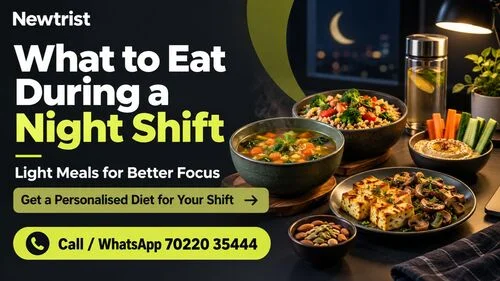
What Are Healthy Snacks for Night Shift Workers?
A healthy night-shift snack should satisfy genuine hunger between meals without becoming another large meal. Practical options may include:
- fruit with curd
- fruit with nuts
- roasted chana
- boiled egg
- paneer
- curd or unsweetened yoghurt
- home-roasted pulses
- a small portion of suitable home-prepared food
Match the snack to the hunger gap
If several hours remain until your next meal, something containing protein and fibre may be more satisfying.
If a meal is approaching soon, a lighter option may be enough.
When frequent snacking becomes a pattern
Wanting food repeatedly throughout the shift does not always mean the answer is to find more snack ideas.
It may reflect:
- inadequate food earlier in the day
- fatigue
- boredom
- stress
- food being constantly visible
- eating automatically during breaks
When the pattern repeats, review the whole shift rather than looking only at individual snacks.

How Should You Use Tea and Coffee During Night Shifts?
Tea and coffee can fit into a night shift, but the later they are consumed relative to your planned sleep, the more relevant timing becomes. It is also worth identifying why you want another cup.
Hunger, normal tiredness after several hours of work and inadequate sleep can all feel like an energy drop, but they are not the same problem.
Using caffeine automatically whenever energy falls can hide a poorly organised eating or sleep pattern rather than solving it.
What Should You Eat After a Night Shift?
Whether you need food after work depends on when you last ate, how hungry you are and how soon you intend to sleep. You do not automatically need a full breakfast simply because the shift finishes in the morning.
If you are comfortable and not hungry
If you ate during the shift, feel satisfied and plan to sleep shortly, another substantial meal may not be necessary.
If you are genuinely hungry
A lighter familiar meal or snack may be more comfortable than deliberately going to bed very hungry.
If you reach home extremely hungry every day
Treat this as a clue rather than simply an after-work problem.
It may mean the previous meal is too small for your needs, the gap between meals is excessive or the main work break does not fit your hunger pattern.
The most useful change may need to happen several hours earlier.

What Is the Best Eating Schedule for Night Shift Workers?
The best eating schedule for a night-shift worker is organised around waking, work breaks and sleep rather than fixed breakfast, lunch and dinner times. Use four anchors:
- Wake-up time
- Start of the shift
- Main work break
- Planned sleep time
Example eating schedule for an 8 pm to 5 am shift
A general sequence could look like this:
- After waking: first balanced meal
- Before starting work: substantial main meal
- Middle of the shift: moderate meal during the main break
- Later in the shift: snack if genuinely hungry
- After work: lighter food only if needed before sleep
The sequence is more important than copying exact clock times.
If your shift begins later
Someone starting at 10 pm or 11 pm may already have eaten a substantial family meal before work. Another full meal soon after arriving may therefore be unnecessary.
If your shift begins earlier
Someone starting at 6 pm may need to move the substantial meal earlier or organise the first work break differently.
The schedule has to start with the individual’s day, not a universal timetable.
How Should You Eat When Your Shifts Rotate?
Rotating-shift workers generally need flexible meal timing rather than identical clock times every day. The useful constant is the order of eating around waking, work and sleep.
When changing from a day shift to a night shift
Move eating occasions along with the new waking period.
Trying to complete an entire daytime eating schedule and then start another full night-time schedule can unnecessarily crowd meals together.
When returning to daytime work
Move meals back towards the new waking period instead of continuing to eat according to the previous night schedule.
On days off
If you sleep at night and remain awake during the day, your eating schedule can move with that change.
The objective is not to protect a particular clock time. It is to maintain a practical and balanced pattern across changing schedules.

Sample 1-Day Diet Plan for a Night Shift Worker
The following sample shows how food may be distributed across one night shift. It is not a personalised diet prescription.
Assume the person wakes during the afternoon and works approximately from 8 pm to 5 am.
| Meal timing | Menu |
| After waking | Idli with sambar and curd, with fruit according to appetite. |
| Before leaving for work | Rice or roti with vegetables and dal, together with paneer, egg, fish or chicken according to preference. |
| During the main work break | Chapati with vegetables and a suitable protein-rich accompaniment such as dal, paneer or egg, or another balanced home-prepared meal. |
| Later in the shift, if hungry | Fruit with curd, roasted chana, boiled egg or paneer. |
| After completing the shift | If hungry before sleep, choose a light familiar meal or snack that feels comfortable. If you remain satisfied and intend to sleep soon, additional food may not be necessary. |
This sample shows meal placement rather than portion size.
The amount of food appropriate for one person may be too little or too much for another because body size, activity, workload, appetite, goals and health needs differ.
Can Night Shift Work Make Weight Management More Difficult?
Night work can make weight management more challenging because sleep, hunger, activity and food availability may all become less predictable at the same time. Common difficulties include:
- irregular sleep
- long sedentary periods
- convenience eating
- large gaps followed by strong hunger
- inconsistent eating between workdays and days off
Successful weight management therefore usually requires looking at the entire pattern rather than blaming one food.
Does eating at night automatically cause weight gain?
No.
Eating during nighttime hours does not by itself determine whether you gain weight. Overall food intake, activity, sleep, eating behaviour and individual factors all matter.
For night workers, the challenge is often maintaining a pattern consistently.
How can night-shift workers manage weight more effectively?
Useful priorities include:
- avoiding repeated episodes of extreme hunger
- defining meals and snacks instead of grazing
- reducing dependence on last-minute convenience food
- keeping food quantities appropriate for individual needs
- coordinating eating with sleep
- choosing a routine that can be repeated across working weeks
Weight management does not require eating as little as possible during the night.
Should you skip meals to lose weight?
Not automatically.
If skipping food repeatedly leads to strong hunger, uncontrolled snacking or a very large meal later, it may make the overall pattern harder to manage.
The better question is: where does your current routine become difficult to control?
That point is often where the useful change needs to begin.
Do you need to avoid rice or roti at night?
No.
Rice, roti and other carbohydrate foods do not become unsuitable simply because they are eaten during nighttime hours.
Their quantity and place in the meal should reflect your overall diet, activity and goals.

Common Night-Shift Eating Mistakes
Several habits can make an otherwise reasonable diet difficult to maintain.
Leaving food decisions until you are extremely hungry
When hunger becomes urgent, convenience usually has more influence over the choice.
Treating every break as a snack break
A break can simply be time to sit down or rest. Food is not required automatically.
Saving most of your food until work is almost over
Waiting until you are exhausted and very hungry can make the final eating occasion disproportionately large.
Having no alternative to whatever is available at work
Workplace food can fit into a healthy diet, but complete dependence on it removes flexibility when suitable choices are limited.
Copying another worker’s diet plan
A colleague may have different sleep, activity, hunger, body size and goals.
A diet that looks healthy is not necessarily suitable for the person copying it.
How Can Indian Night Shift Workers Make Healthy Eating Practical?
A practical Indian night-shift diet should work with normal household food, family meals and workplace realities rather than requiring a completely separate menu.
Use family meals as useful anchors
If your household eats dinner shortly before you leave for work, that meal can become your substantial pre-shift meal.
There is no need to eat a second full dinner simply because colleagues eat later.
Keep familiar regional foods
Healthy night-shift eating can be built around South Indian, North Indian or other regional foods.
The aim is to organise familiar foods well, not replace the cuisine you normally enjoy.
Vegetarian and non-vegetarian patterns can both work
Either approach can provide a balanced diet when meals contain appropriate protein sources, vegetables, carbohydrate foods and sufficient variety.
Plan around practical limitations
Consider:
- travel time
- safe food storage
- break length
- canteen facilities
- workload
- food already prepared at home
A diet that works only under ideal circumstances will usually become difficult after several night shifts.
When Is a Personalised Night-Shift Diet Worth Considering?
Personalised nutrition becomes useful when you know the general rules but still cannot work out how much, when or what you personally should eat. A general article can explain the framework. It cannot accurately determine your portion requirements or how the plan should change for your health, activity and goals.
Personalisation may be particularly useful if:
- you regularly finish shifts extremely hungry
- weight loss, weight gain or weight maintenance is a goal
- you do not know how much food you need
- your roster changes frequently
- workdays and days off are difficult to reconcile
- meal breaks are unpredictable
- you have diabetes, PCOS, thyroid concerns or digestive problems
- family meals conflict with your work hours
- several generic diet charts have already failed to fit your routine
If thyroid-related nutrition is part of your situation, Newtrist’s thyroid nutrition guide addresses those nutrition considerations separately.
At this stage, another generic night-shift diet plan may give you more food ideas without answering the questions that are actually causing difficulty.
Chief Nutritionist Vasanthi Senthilvel can assess your work timings, sleep routine, existing eating pattern, appetite, activity, food preferences, health considerations and goals together.
A personalised nutrition plan can then answer questions such as:
- What quantity of food is appropriate for you?
- Where should your most substantial meal fall?
- How should meals be distributed around your actual breaks?
- Why does hunger repeatedly appear at a particular time?
- What should change between fixed shifts, rotating shifts and days off?
- How can your regular Indian foods fit your weight or clinical nutrition needs?
The objective is not to give you more diet rules. It is to create a pattern that removes unnecessary guesswork and is realistic enough to follow through repeated shifts.
Frequently Asked Questions About Night Shift Nutrition
How many meals should a night-shift worker eat?
There is no fixed number that suits everyone. The appropriate number depends on waking hours, shift duration, hunger, activity and when the person intends to sleep. A few defined eating occasions are generally easier to manage than continuous grazing.
Is it better to carry food from home for a night shift?
Carrying food can make choices more predictable when workplace options are limited, but it is not compulsory. Suitable canteen or workplace meals can also fit when they are practical and balanced.
What should I do if my night shift has no predictable break?
Make the parts of the day you can control more dependable, particularly the meal before work. Carrying suitable food where practical can also provide flexibility when an unexpected opportunity to eat appears.
Can night-shift workers exercise and follow the same meal schedule?
Exercise may change hunger and food requirements, so its timing should be considered alongside the work schedule. Someone exercising before work may need a different distribution from someone exercising after waking or on days off.
Why is my appetite different on days off?
Changes in waking time, sleep and activity can also change when you feel hungry. The eating pattern does not have to remain identical when your daily schedule changes.
Can night shifts affect digestion?
Some people experience digestive discomfort when large meals are eaten at unusual times or close to sleep. Persistent or recurring digestive symptoms deserve individual attention rather than automatically being attributed to the night shift.
Do permanent night workers need the same diet as rotating-shift workers?
Not necessarily. Permanent night workers may be able to establish a more consistent routine, while rotating-shift workers usually need greater flexibility as their waking and sleeping periods change.
When should I get a personalised diet for night-shift work?
Consider personalised nutrition when you understand the basics but still struggle with food quantities, weight goals, repeated hunger, changing shifts or clinical nutrition needs. Those questions depend on your individual routine and cannot be resolved reliably with one standard diet chart.
Author
Chief Nutritionist Vasanthi Senthilvel leads Newtrist Nutritionist Dietitian Dietician, providing personalised diet plans for weight management and clinical nutrition for children, adolescents, adults and families.
She has 21 years of experience in nutrition and has received professional recognition for her work.
- Pride of Bharat Awards 2026: Outstanding Achievement in Holistic Health & Nutrition Innovation
- Doctor of The Year: Nutritionist 2026: Excellence in Clinical Nutrition and Weight Loss.
Her approach considers age, growth, health history, medical conditions, laboratory reports, medication, body composition, weight history, dietary preferences, regional food habits, family routines, activity, sleep and personal health goals. Recommendations are developed according to individual needs rather than using one standard diet for everyone.
Consultations are available in person at Bangalore HSR Layout, Koramangala, Bellandur, Haralur and Electronic City, as well as online across India.
Independent Medical Review Panel
Newtrist health and nutrition articles undergo medical review, where appropriate, by doctors with relevant specialist expertise. The medical professionals listed below contribute to Newtrist’s review process within their respective specialties.
| Speciality | Doctor |
|---|---|
| Endocrinology | Dr Vinay Prasad MBBS, MD, DM |
| Gastroenterology & Hepatology | Dr Sunil kumar N MBBS, MD, DM |
| Gynaecology | Dr Prathiba G MBBS, DNB, FIRM, FMAS |
| Nephrology | Dr Priyashree R MBBS, MD, DNB, DM |