
Written by: Chief Nutritionist Vasanthi Senthilvel
21 years of experience | Newtrist Nutritionist Dietitian Dietician
Best Nutritionist in Bangalore with multiple awards for excellence in clinical nutrition, weight loss, holistic health and nutrition innovation.
Medically reviewed by: Dr Prathiba G MBBS, DNB, FIRM, FMAS | Dr Sunil kumar N MBBS, MD, DM | Dr Vinay Prasad MBBS, MD, DM
Medical Disclaimer: Nutritional needs vary based on an individual’s profile. The information on this page is for general educational purposes only and is not intended to replace personalised medical or nutrition care.
Microgreens contain impressive concentrations of vitamins and plant compounds, yet most people eat them in relatively small amounts. That makes the useful question less about whether microgreens are a “superfood” and more about what they actually add to your diet and whether that is what you need.
For someone who simply enjoys them, the answer may be straightforward. For someone choosing microgreens to lose weight, improve a nutrient deficiency or manage a health condition, the answer becomes much more individual.
Key takeaway: Microgreens are young edible plants that can provide useful vitamins, minerals and protective plant compounds. Some varieties contain concentrated amounts of particular nutrients, but microgreens are not essential for good health, do not replace other vegetables and should not be expected to treat medical conditions. Their value depends on the variety, how much you eat and what your overall diet already provides.
Table of Contents

What Are Microgreens?
Microgreens are young edible seedlings harvested after their first leaves develop but before the plant reaches maturity.
They can be grown from many familiar vegetables, herbs and other edible plants, including:
- mustard
- radish
- broccoli
- amaranth
- beetroot
- fenugreek
- coriander
- basil
- peas
- sunflower
Their flavour varies considerably.
Mustard and radish microgreens can taste peppery. Coriander is aromatic. Pea and sunflower varieties tend to be milder.
This gives them a practical advantage beyond appearance: they can add flavour, texture and colour to food while contributing plant nutrients.
Microgreens vs sprouts: what is the difference?
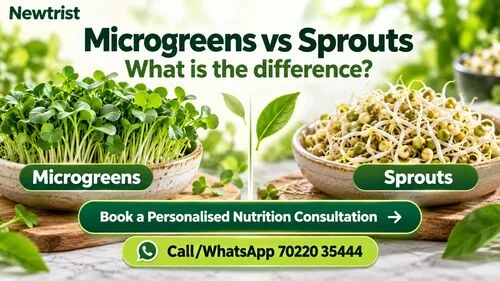
Microgreens and sprouts are not the same food. They are harvested at different stages of plant growth.
| Microgreens | Sprouts |
| Harvested after young leaves develop | Harvested soon after germination |
| Mainly stem and leaves are eaten | Seed, root and shoot are usually eaten |
| Normally grown with light | Commonly germinated in moist conditions |
| Usually cut before eating | Usually eaten as the whole sprout |
| Often have a distinct plant-specific flavour | Usually have a milder sprouted flavour |
Their different growing methods also influence how they are handled and stored.
What Do Microgreens Actually Add to Your Diet?
Microgreens can contribute vitamins, minerals, carotenoids, polyphenols and other naturally occurring plant compounds.
Depending on the variety, these may include nutrients such as:
- vitamin C
- vitamin K
- vitamin E
- folate and other B vitamins
- iron
- zinc
- magnesium
- potassium
- carotenoids
- polyphenols
But “microgreens” is a category, not one nutritionally identical food.
Broccoli, radish, coriander and amaranth microgreens have different nutrient profiles. Seed variety, growing conditions, harvest stage and storage can also influence their composition.
One distinction is especially important when judging nutrition claims.
A microgreen may contain a high concentration of a nutrient per gram, but you may consume only a small amount of it. How much you actually eat matters.
Are Microgreens Healthier Than Mature Vegetables?
Not necessarily. Some microgreens can contain higher concentrations of particular nutrients than the mature plant, but this does not make them a superior replacement for vegetables.
The comparison is often made gram for gram.
Real eating does not work that way.
You may use a small handful of microgreens but eat a much larger amount of beans, gourds, carrots, greens or other vegetables as part of regular meals.
Those mature vegetables can consequently make a substantial contribution to food volume, fibre and nutrient intake.
There is no need to choose one over the other.
Use microgreens because they add something worthwhile, not because you believe ordinary vegetables have become nutritionally inferior.
What Can Microgreens Do, and What Can They Not Do?
Separating realistic benefits from health claims makes microgreens much easier to understand.
| Microgreens can | Microgreens cannot |
| Add vitamins, minerals and plant compounds | Guarantee that your nutrient requirements are met |
| Increase the variety of plant foods you eat | Correct a diagnosed nutrient deficiency by themselves |
| Add flavour, colour and texture | Cause weight loss on their own |
| Complement vegetables and other nutritious foods | Replace the need for a balanced dietary pattern |
| Form part of a health-supportive diet | Treat diabetes, heart disease, cancer or another medical condition |
This distinction matters because nutritional value and therapeutic effect are not the same thing.
A food can be genuinely nutritious without needing exaggerated claims attached to it.
Can Microgreens Help With Weight Management?
Microgreens can fit into a weight-management diet, but they do not directly cause fat loss.
They can add flavour and nutrients without contributing much energy, which may make them useful within an appropriate eating pattern.
But weight regulation depends on considerably more than adding one low-energy food.
Your appetite, usual meals, protein and fibre intake, eating behaviour, sleep, physical activity, medications and medical conditions may all influence progress.
If weight management is why you are investigating microgreens, identifying the “best microgreen for weight loss” is unlikely to solve the real problem.
The more useful question is what needs to change in your complete eating pattern.
How Can You Eat Microgreens in an Indian Diet?
Microgreens do not require a special diet.
The simplest approach is to choose varieties whose flavours work naturally with foods you already enjoy.
Depending on the type, microgreens can complement:
- salads
- sandwiches and wraps
- curd-based dishes
- savoury breakfast foods
- soups
- chaat-style preparations
- dal and other cooked dishes
- foods normally finished with fresh herbs or leafy garnishes
There is no benefit in forcing them into every meal.
If they make familiar foods fresher, more enjoyable or more varied, they are already serving a useful purpose.
Should You Eat Microgreens Raw or Cooked?
Both raw and cooked microgreens can be appropriate.
Raw microgreens retain their crisp texture and may preserve more of certain heat-sensitive nutrients.
Cooking can change the amount of some nutrients and plant compounds, but it does not make microgreens nutritionally worthless.
The better choice depends on the variety, the food being prepared, personal preference and food-safety needs.
Are Microgreens Safe to Eat?
Microgreens can be safely eaten when they are grown, handled and stored hygienically.
Like other fresh produce that may be eaten raw, contamination can occur through seeds, water, equipment, handling or storage.
Useful precautions include:
- choose produce and seeds intended for food consumption
- handle them with clean hands and utensils
- wash fresh produce appropriately
- refrigerate harvested microgreens
- discard produce that becomes mouldy or slimy
- avoid eating microgreens that develop an unusual smell
People who are more vulnerable to serious foodborne infections may require additional caution with raw foods.
Fresh, natural and home-grown do not automatically mean risk-free.
Are Microgreens Worth Buying?
Microgreens can be worth buying if you enjoy them, can comfortably afford them and they add something useful to your diet. They are not a nutritional necessity.
That distinction matters because foods associated with wellness trends often acquire a premium price as well as a premium reputation.
The two are not the same thing.
You can build a highly nutritious diet using familiar vegetables, greens, fruits, pulses, whole grains, nuts, seeds and appropriate protein foods without buying microgreens.
If you enjoy microgreens and they suit your budget, use them.
If they do not, there is no nutritional reason to feel that your diet is incomplete without them.
When the Microgreens Question Is Really a Nutrition Question
This is where general food information reaches its limit.
Consider these questions:
“Can microgreens improve my iron levels?”
“Will they help me lose weight?”
“Should I eat them because my blood test is abnormal?”
“Are they suitable with my medical condition?”
“Can I eat them with my medication?”
These sound like questions about microgreens.
They are actually questions about the person eating them.
The answer may depend on your current food intake, diagnosis, laboratory findings, medication, symptoms, lifestyle and nutritional requirements.
That is why adding increasingly healthy-sounding foods does not always solve a nutritional problem.
Sometimes the missing step is not another ingredient.
It is identifying what your diet actually needs to achieve.
When Personalised Nutrition Becomes More Useful
A personalised nutrition consultation changes the question from:
“Which healthy foods should I add?”
to:
“Which changes should receive priority for me?”
Chief Nutritionist Vasanthi Senthilvel can assess your current eating pattern, health goals, lifestyle and food preferences alongside relevant medical conditions, medications and laboratory findings.
For weight management, this means looking beyond individual “weight-loss foods” and identifying the dietary and lifestyle factors most relevant to your progress.
For clinical nutrition, it means aligning food choices with your diagnosis, medical treatment and individual nutritional requirements rather than applying generic healthy-eating advice.
Microgreens may have a useful place in that approach.
They may also be far less important than another dietary change.
That is the advantage of personalised nutrition: you can focus on what is likely to matter most instead of continually adding foods because they have a healthy reputation.
Frequently Asked Questions
Are microgreens the same as baby greens?
No. Baby greens are harvested later in the plant’s development and are larger and more mature. Microgreens are harvested earlier while the plant is still a young seedling.
Which type of microgreen is the healthiest?
There is no single healthiest microgreen for everyone. Different varieties provide different combinations of nutrients and plant compounds, so the better choice depends on dietary variety, personal preference and any individual nutritional requirements.
Are microgreens a good source of protein?
Microgreens may contain some protein, but the amount normally eaten is too small for them to function as a main protein source. Adequate protein should come from suitable foods across the overall diet.
Are microgreen powders equivalent to fresh microgreens?
Not necessarily. Drying, processing, storage and additional ingredients can change the characteristics of the final product. A powder should therefore be judged by its own ingredients and nutritional composition rather than assumed to be identical to fresh microgreens.
Can children eat microgreens?
Appropriately prepared microgreens can be included among the varied foods offered to children. They should not replace the broad range of foods needed to provide sufficient energy, protein, essential fats and micronutrients for growth and development.
The Bottom Line
Microgreens are nutritious foods, not nutritional shortcuts.
They can add useful micronutrients, plant compounds, flavour and variety to everyday eating. If you enjoy them, there is every reason to include them as one part of a varied diet.
But if you are choosing microgreens because you want to lose weight, correct a deficiency, improve laboratory results or manage a medical condition, the important question is no longer whether microgreens are healthy.
It is whether your complete diet is appropriate for what you are trying to achieve.
A personalised nutrition consultation with Chief Nutritionist Vasanthi Senthilvel can identify those priorities and turn them into an eating approach suited to your health needs, food preferences and everyday routine.
Author
Chief Nutritionist Vasanthi Senthilvel leads Newtrist Nutritionist Dietitian Dietician, providing personalised diet plans for weight management and clinical nutrition for children, adolescents, adults and families.
She has 21 years of experience in nutrition and has received professional recognition for her work.
- Pride of Bharat Awards 2026: Outstanding Achievement in Holistic Health & Nutrition Innovation
- Doctor of The Year: Nutritionist 2026: Excellence in Clinical Nutrition and Weight Loss.
Her approach considers age, growth, health history, medical conditions, laboratory reports, medication, body composition, weight history, dietary preferences, regional food habits, family routines, activity, sleep and personal health goals. Recommendations are developed according to individual needs rather than using one standard diet for everyone.
Consultations are available in person at Bangalore HSR Layout, Koramangala, Bellandur, Haralur and Electronic City, as well as online across India.
Independent Medical Review Panel
Newtrist health and nutrition articles undergo medical review, where appropriate, by doctors with relevant specialist expertise. The medical professionals listed below contribute to Newtrist’s review process within their respective specialties.
| Speciality | Doctor |
|---|---|
| Endocrinology | Dr Vinay Prasad MBBS, MD, DM |
| Gastroenterology & Hepatology | Dr Sunil kumar N MBBS, MD, DM |
| Gynaecology | Dr Prathiba G MBBS, DNB, FIRM, FMAS |