
Written by: Chief Nutritionist Vasanthi Senthilvel
21 years of experience | Newtrist Nutritionist Dietitian Dietician
Best Nutritionist in Bangalore with multiple awards for excellence in clinical nutrition, weight loss, holistic health and nutrition innovation.
Medically reviewed by: Dr Prathiba G MBBS, DNB, FIRM, FMAS | Dr Sunil kumar N MBBS, MD, DM | Dr Vinay Prasad MBBS, MD, DM
Medical Disclaimer: Nutritional needs vary based on an individual’s profile. The information on this page is for general educational purposes only and is not intended to replace personalised medical or nutrition care.
Choosing between a pescatarian diet, Atkins, keto and other low-carb diets can become confusing because the labels appear to describe competing ways to lose weight. But they do not all control the same thing.
Pescatarian eating mainly determines which animal foods are included. Atkins, keto and general low-carb diets mainly change how much carbohydrate the eating pattern contains. That distinction matters because someone can reduce carbohydrate while remaining pescatarian.
The real decision is therefore not simply which diet sounds stricter. It is how much carbohydrate restriction is useful, what food flexibility you are willing to give up, and whether the approach can still work when weight loss becomes a long-term task rather than a short-term experiment.
Key takeaway: A pescatarian diet is primarily a food pattern, while Atkins, keto and low-carb diets are primarily defined by carbohydrate restriction. None automatically guarantees better weight loss. More restrictive approaches may suit some people, but a pescatarian pattern generally allows greater food flexibility. The better individual choice depends on appetite, food preferences, weight-management needs and how realistically the approach can be maintained.
Table of Contents

Pescatarian vs Atkins, Keto and Low-Carb Diets at a Glance
| Factor | Pescatarian Diet | Atkins Diet | Keto Diet | General Low-Carb Diet |
| What mainly defines it | Excludes meat and poultry but includes fish and seafood | Structured carbohydrate restriction | Very strong carbohydrate restriction intended to support ketosis | Eating less carbohydrate than usual |
| Carbohydrate restriction | Not required | Usually substantial, especially initially | Very restrictive | Can range from moderate to substantial |
| Plant foods | Broad range can be included | Selected according to carbohydrate level | More limited by carbohydrate content | Depends on degree of restriction |
| Protein sources | Seafood, pulses and potentially eggs and dairy | Flexible within diet rules | Flexible within diet rules | Flexible |
| Food variety | Generally broad | More restricted | Most restricted of these options | Varies widely |
| Tracking or close monitoring | Not inherently required | Often more structured | Usually requires closer attention to carbohydrate intake | May or may not require tracking |
| Weight-loss approach | Flexible food pattern that can be adjusted | Uses carbohydrate restriction as a central strategy | Uses very low carbohydrate intake as a central strategy | Reduces carbohydrate without one fixed method |
| Indian meal flexibility | Generally high | Moderate to low depending on restriction | Often lower | Depends on how low carbohydrate intake goes |
| Can overlap with pescatarian eating? | Not applicable | Possible | Possible, but much more restrictive | Yes |
What Is the Fundamental Difference?
Pescatarian eating tells you which animal foods are part of the diet. Low-carbohydrate approaches tell you how much carbohydrate the diet permits.
A pescatarian diet excludes meat and poultry while including fish, seafood and plant foods. Eggs and dairy may also be included according to preference.
It does not inherently require rice, roti, fruit, pulses or other carbohydrate-containing foods to be restricted.
Atkins, keto and general low-carb approaches begin from a different question:
How much carbohydrate should be eaten?
That is why these labels can overlap.
Someone can theoretically eat a pescatarian diet that is relatively high in carbohydrate, moderate in carbohydrate or lower in carbohydrate depending on the foods selected.
Understanding this distinction prevents a common mistake: assuming that choosing pescatarian eating means choosing a high-carbohydrate diet.
It does not.
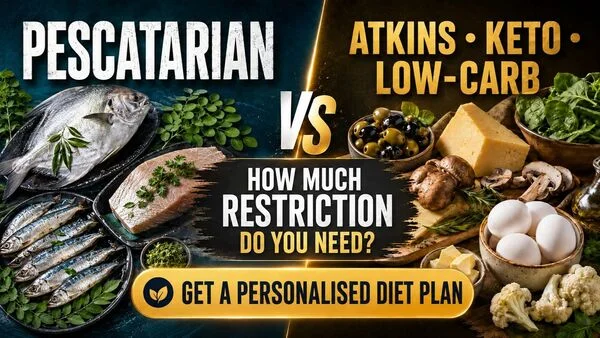
Pescatarian Diet vs Atkins Diet: What Is the Bigger Difference?
The main difference is that Atkins uses carbohydrate restriction as a central strategy, while pescatarian eating does not prescribe a specific carbohydrate level.
Atkins generally begins with a more restricted range of carbohydrate-containing foods and can become more flexible as the approach progresses.
That means many foods that could comfortably fit a pescatarian pattern may be limited at certain stages of Atkins.
The practical difference becomes obvious in everyday meals.
A pescatarian eater may choose from seafood, pulses, vegetables, fruit, grains and other foods according to the person’s needs.
Someone following Atkins has to consider not only whether a food fits their overall food preference but also how it fits the carbohydrate restriction being followed.
This can provide useful structure for someone who specifically wants carbohydrate limits.
But it also creates an additional dietary rule.
That rule only has value if it helps the person eat in a way that supports weight management and can be maintained.
Does Atkins Automatically Cause More Weight Loss?
No. Atkins does not automatically produce greater long-term fat loss than a less restrictive eating pattern.
Carbohydrate restriction can change food choices substantially and may help some people reduce overall intake or manage appetite.
But the eventual result still depends on the complete eating pattern and whether the person can follow it consistently.
A strict plan that repeatedly leads to stopping and restarting may be less useful than a more flexible approach that can be maintained.
Pescatarian Diet vs Keto Diet: How Much More Restrictive Is Keto?
Keto is considerably more restrictive around carbohydrate than a typical pescatarian diet.
The purpose of a ketogenic diet is to keep carbohydrate intake low enough for the body to rely much more heavily on ketone production.
That requirement changes the range of foods available.
Many foods that fit naturally within pescatarian eating can become difficult to include freely when carbohydrate has to remain very low.
The result is a different type of decision.
Pescatarian eating asks: “Which animal foods do I want included in my diet?”
Keto asks: “Can my food choices keep carbohydrate low enough for this metabolic state?”
That additional requirement can make the diet feel clear and structured for some people.
For others, it makes family meals, eating outside and maintaining food variety considerably harder.
Is Keto Simply a Stricter Pescatarian Diet?
No. Keto and pescatarian describe different characteristics of eating.
A person could theoretically combine them, but doing so would mean satisfying both sets of rules at the same time.
That creates a much narrower dietary pattern than ordinary pescatarian eating and should not be assumed to be necessary simply because someone wants to lose weight.
Pescatarian Diet vs a General Low-Carb Diet: Is There a Clear Difference?
Yes, but “low carb” is a broad term rather than one single diet.
Unlike keto, a general low-carb approach does not necessarily aim for ketosis. Unlike Atkins, it does not necessarily follow one defined progression or structure.
One person may simply reduce large amounts of refined carbohydrate while continuing to eat a varied diet.
Another may restrict carbohydrate much more substantially.
Both may describe themselves as eating “low carb”.
This flexibility can make a general low-carb approach easier to adapt, but it also means the label alone tells us very little about the quality of the diet.
The useful question is not whether someone is “low carb”.
It is: What has actually been reduced, what remains in the diet, and has the change solved the problem it was intended to solve?
Which Is Better for Weight Loss?
There is no universal winner between pescatarian, Atkins, keto and low-carb diets for weight loss.
Different approaches may influence hunger, food choice and overall intake in different ways.
A more restrictive carbohydrate approach may help some people because it removes foods they tend to overeat or because the resulting meals feel more satisfying.
Someone else may initially follow the same approach successfully but find that the restrictions become difficult around work, family meals or social situations.
Pescatarian eating provides more freedom, but that freedom can work in either direction.
It can make the diet easier to personalise and sustain.
It can also allow frequent energy-dense choices that do not support weight loss.
So the useful comparison is not: “Which diet removes the most carbohydrate?”
It is: “Which dietary structure helps me control intake without creating restrictions I cannot maintain?”
More Restriction Is Not Automatically More Effective
It is easy to assume that if reducing some carbohydrate helps, reducing even more must work better.
Weight management is not that simple.
A dietary restriction is useful only when it contributes to a workable overall eating pattern.
If someone can maintain a moderately lower-carbohydrate approach but repeatedly abandons a much stricter one, the stricter diet may offer no practical advantage.
The best level of restriction is therefore not necessarily the lowest carbohydrate intake possible.
It is the amount of structure that helps the individual consistently make choices that support the goal.
Which Approach Offers Greater Nutritional Variety?
A standard pescatarian diet generally allows greater nutritional variety because it places fewer restrictions on plant foods.
This is where the difference between food-pattern rules and carbohydrate rules becomes particularly important.
Pulses, fruits, whole grains and several other plant foods can fit easily within pescatarian eating.
As carbohydrate restriction becomes stronger, some of those options become more limited.
That does not mean a lower-carbohydrate diet is automatically nutritionally poor.
It means that the diet needs to achieve adequate variety within a narrower set of food choices.
The more foods that are removed, the more important the remaining food choices become.
For someone who already has several dislikes, cultural restrictions or household limitations, adding substantial carbohydrate restriction can make the available food range much smaller than expected.
Which Is Easier to Maintain in Indian Life?
For many Indian households, a standard pescatarian diet is easier to integrate than Atkins or keto because common family foods do not have to be restricted primarily for their carbohydrate content.
Rice, roti, idli, dosa, pulses and other carbohydrate-containing foods form part of everyday eating in many regions and households.
A person following a strongly carbohydrate-restricted approach may need more changes to ordinary family meals.
This becomes particularly noticeable when:
- one meal is shared by several family members
- vegetarian dishes form a large part of household cooking
- workplace meals offer limited alternatives
- travel changes food availability
- social occasions centre on familiar shared foods
- separate cooking becomes inconvenient
A general lower-carbohydrate approach may be easier to adapt than keto because the degree of restriction can be adjusted.
Pescatarian eating can be more flexible still because carbohydrate reduction is optional rather than built into the definition of the diet.
Practicality matters because weight management rarely happens in isolation from everyday food culture.
Can a Pescatarian Diet Also Be Low in Carbohydrate?
Yes. A pescatarian diet can also be lower in carbohydrate because the two labels describe different aspects of eating.
“Pescatarian” refers mainly to animal-food choices.
“Low carb” refers to the amount or proportion of carbohydrate in the diet.
A person can therefore retain seafood while reducing selected carbohydrate-rich foods if that approach suits their needs.
This does not mean everyone following a pescatarian diet should reduce carbohydrate.
It simply means the choice is available.
The useful question is why carbohydrate is being reduced and how much restriction is actually necessary.
Reducing foods without a clear reason can make a diet harder to follow without improving the outcome.
Which Approach May Suit Different Priorities?
| If your main priority is… | The approach worth considering may be… |
| Keeping a broad food range while excluding meat and poultry | Pescatarian diet |
| Following a structured carbohydrate-reduction system | Atkins |
| Maintaining very low carbohydrate intake | Keto |
| Reducing carbohydrate without following one rigid programme | General low-carb approach |
| Eating pescatarian while reducing selected carbohydrates | Lower-carbohydrate pescatarian approach |
| Losing weight but unsure how much restriction is appropriate | Individualised weight-management planning |
The final row is important.
Sometimes the real decision is not which named diet to choose.
It is determining which parts of the present eating pattern actually need to change.
Pescatarian vs Atkins, Keto and Low-Carb Diets: Final Verdict
For weight loss, pescatarian, Atkins, keto and low-carb diets should not be ranked simply by how much carbohydrate they remove.
Pescatarian eating offers the greatest flexibility because carbohydrate restriction is not built into the pattern. Atkins and general low-carb approaches add varying degrees of carbohydrate control, while keto requires the strongest restriction.
Each can work for some people, but greater restriction does not automatically produce a better long-term result.
The most useful approach is the one that creates enough structure to support the person’s weight goal without making food choices, family meals and everyday life unnecessarily difficult.
Personalised Nutrition Guidance: How Much Restriction Do You Actually Need?
If you are comparing Atkins, keto, low-carb and pescatarian eating because you want to lose weight, choosing the strictest diet may not be the most useful next step.
The better question is:
What in your current eating pattern actually needs to change?
One person may benefit from reducing particular carbohydrate-heavy foods. Another may need a better protein structure, more consistent meals or changes in portions. Someone else may already be restricting too many foods and need a strategy that is easier to sustain.
Chief Nutritionist Vasanthi Senthilvel provides personalised diet planning for weight management based on the individual’s goals, current eating habits, appetite, food preferences, activity and everyday routine.
The aim is not to force everyone into keto, Atkins, low-carb or pescatarian eating. It is to determine what degree of dietary structure is genuinely useful and build a personalised diet plan that can work in real life.
Author
Chief Nutritionist Vasanthi Senthilvel leads Newtrist Nutritionist Dietitian Dietician, providing personalised diet plans for weight management and clinical nutrition for children, adolescents, adults and families.
She has 21 years of experience in nutrition and has received professional recognition for her work.
- Pride of Bharat Awards 2026: Outstanding Achievement in Holistic Health & Nutrition Innovation
- Doctor of The Year: Nutritionist 2026: Excellence in Clinical Nutrition and Weight Loss.
Her approach considers age, growth, health history, medical conditions, laboratory reports, medication, body composition, weight history, dietary preferences, regional food habits, family routines, activity, sleep and personal health goals. Recommendations are developed according to individual needs rather than using one standard diet for everyone.
Consultations are available in person at Bangalore HSR Layout, Koramangala, Bellandur, Haralur and Electronic City, as well as online across India.
Independent Medical Review Panel
Newtrist health and nutrition articles undergo medical review, where appropriate, by doctors with relevant specialist expertise. The medical professionals listed below contribute to Newtrist’s review process within their respective specialties.
| Speciality | Doctor |
|---|---|
| Endocrinology | Dr Vinay Prasad MBBS, MD, DM |
| Gastroenterology & Hepatology | Dr Sunil kumar N MBBS, MD, DM |
| Gynaecology | Dr Prathiba G MBBS, DNB, FIRM, FMAS |
| Nephrology | Dr Priyashree R MBBS, MD, DNB, DM |