
Written by: Chief Nutritionist Vasanthi Senthilvel
21 years of experience | Newtrist Nutritionist Dietitian Dietician
Best Nutritionist in Bangalore with multiple awards for excellence in clinical nutrition, weight loss, holistic health and nutrition innovation.
Medically reviewed by: Dr Prathiba G MBBS, DNB, FIRM, FMAS | Dr Sunil kumar N MBBS, MD, DM | Dr Vinay Prasad MBBS, MD, DM
Medical Disclaimer: Nutritional needs vary based on an individual’s profile. The information on this page is for general educational purposes only and is not intended to replace personalised medical or nutrition care.
A carnivore diet vs pescatarian diet comparison can appear to be a simple choice between two sets of food rules. But for someone trying to lose weight, the real differences often become clearer after the first few weeks.
A rapid drop on the weighing scale may look convincing without representing the same amount of body-fat loss. A diet with more food choices may seem less dramatic, yet give more room to adapt as appetite, routine and progress change. So the useful question is not which diet is stricter. It is which approach makes more sense for weight management, health and life beyond the initial results.
Key takeaway: For most adults, a well-planned pescatarian diet is the stronger general choice for long-term health and sustainable weight management. A carnivore diet may produce a faster early fall in scale weight after carbohydrate intake drops sharply, but some of that change can be water rather than body fat. The most appropriate eating pattern for an individual still depends on nutritional needs, appetite, food preferences and weight-management goals.
Table of Contents

Carnivore Diet vs Pescatarian Diet at a Glance
| Factor | Carnivore Diet | Pescatarian Diet |
|---|---|---|
| What defines it | Almost entirely animal-derived foods | Plant foods combined with fish and seafood |
| Plant foods | Usually excluded | Regularly included |
| Carbohydrate intake | Usually extremely low | Flexible |
| Fibre | Very little or none | Can be naturally fibre-rich |
| Protein sources | Meat, poultry, fish and eggs depending on the version | Fish, seafood, pulses and potentially eggs and dairy |
| Food variety | Narrow | Broad |
| Early scale change | Can be rapid after major carbohydrate reduction | Usually less dramatic |
| Ability to adjust for weight management | Limited by extensive exclusions | Can be modified while remaining pescatarian |
| Nutritional breadth | Relies on a relatively narrow food base | Can combine seafood with diverse plant foods |
| Practicality in Indian households | Often challenging | Generally easier to integrate |
| Long-term evidence | Limited for the carnivore pattern itself | Better aligned with established fish-inclusive, plant-rich eating patterns |
What Is the Main Difference Between Carnivore and Pescatarian Diets?
The biggest difference is not simply meat versus fish. It is whether plant foods are removed or retained.
A carnivore diet generally centres on animal-derived foods such as meat, poultry, fish and eggs, depending on the version followed. Vegetables, fruits, pulses and grains are usually excluded.
A pescatarian diet takes a different approach. It excludes meat and poultry while retaining fish, seafood and plant foods. Eggs and dairy may also be included according to personal preference.
This creates an important structural difference.
Carnivore eating achieves simplicity largely by removing food groups. Pescatarian eating restricts particular animal foods without requiring most of the remaining food supply to disappear.
That distinction determines how much freedom each approach has when nutritional or weight-management needs change. It is therefore more meaningful than simply comparing their protein content.
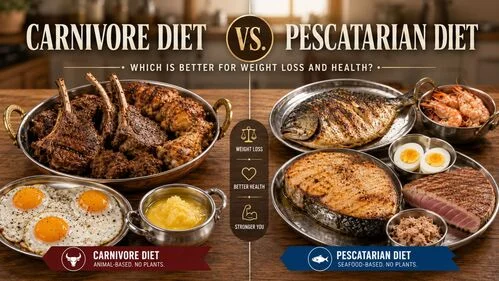
Which Diet Is Better for Weight Loss?
Neither diet guarantees body-fat loss simply because of its name. Sustainable weight reduction still depends on whether the complete eating pattern helps someone maintain an appropriate energy balance consistently.
The two approaches can, however, produce very different experiences at the beginning.
Why a Carnivore Diet May Cause Faster Early Weight Loss
A person changing from a mixed diet to an extremely low-carbohydrate carnivore pattern may notice the weighing scale falling quickly.
Some carbohydrate is stored in the body as glycogen, and glycogen is stored together with water. When carbohydrate intake falls substantially, glycogen stores can decline and some of the associated water is lost.
This means the early scale change can be larger than the amount of body fat actually lost.
Carnivore eating may also reduce spontaneous eating for some people. Protein-rich foods can be filling, while eliminating many commonly eaten snack and convenience foods can reduce the number of eating opportunities.
These effects can make the first stage feel successful.
The harder test comes afterwards.
What Happens When the Initial Phase Is Over?
Long-term weight management depends more on consistency than on the speed of the first result.
Progress may eventually slow. Hunger can change. The amount of food needed may need adjusting. A useful eating approach has to allow these changes without making the entire diet unworkable.
Pescatarian eating provides more room for this.
The balance between seafood, pulses, vegetables, grains and other foods can be adjusted while the person remains pescatarian. The underlying dietary pattern does not have to be abandoned every time the strategy needs modifying.
That flexibility does not make weight loss automatic.
Large portions, frequent fried foods, sweets and other energy-dense choices can still make weight reduction difficult within a pescatarian diet.
The advantage is that there are more ways to adjust the diet while preserving the pattern.
For someone focused on lasting weight management, this can matter more than choosing the approach that gives the most dramatic first-week result.
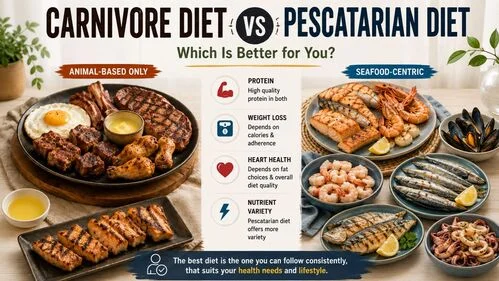
Which Diet Is Better for Overall Health?
For most adults, a well-planned pescatarian diet provides the stronger general foundation for dietary quality because it can combine seafood with a wide range of plant foods.
The difference becomes clearer when we look beyond protein.
Fibre Separates the Two Patterns Clearly
A conventional carnivore diet contains little or no dietary fibre because plant foods, the principal sources of fibre, are excluded.
Pescatarian eating can include vegetables, fruits, pulses and whole grains, allowing fibre to remain part of the usual diet.
Fibre contributes to normal bowel function and represents one of the clearest nutritional consequences of removing versus retaining plant foods.
Nutritional Breadth Matters Too
Animal foods can provide valuable protein and several essential nutrients. The issue with carnivore eating is not that these foods have no nutritional value.
The concern is the narrowing of the total food base when nearly every plant-food group is removed.
A pescatarian diet can obtain nutrition from fish and seafood while also drawing on pulses, vegetables, fruits, nuts, seeds and whole grains.
This gives the diet more food-based routes through which different nutritional needs can be met.
A Pescatarian Label Still Does Not Guarantee a Healthy Diet
Someone can technically follow a pescatarian diet while frequently eating fried seafood, refined foods and highly processed snacks.
Likewise, two carnivore diets can differ substantially according to which animal foods dominate them.
So the label tells us the boundaries of a diet. It does not tell us everything about its quality.
A more useful question is: What does the complete eating pattern actually contain?
That is ultimately more informative than deciding that every food permitted by one dietary label is automatically better or worse than every food permitted by another.

Which Diet Is Easier to Follow in India?
For most Indian households, pescatarian eating is easier to fit into everyday life because many familiar family foods can remain part of the meal.
Rice, roti, pulses, vegetables and other plant foods form part of everyday eating in many households. In families and regions where seafood is familiar, fish can be incorporated without requiring the whole meal to be redesigned around one person’s diet.
Carnivore eating removes most of these shared foods.
- vegetarian dishes are frequently prepared at home
- family members follow different eating preferences
- workplace food options are limited
- travel changes what is available
- social occasions involve shared dishes
- preferred animal foods are expensive or difficult to source
Regional differences also matter. Seafood may be affordable and widely available in some parts of India but less practical in others.
Pescatarian eating does not require fish to dominate every meal, so familiar plant foods can remain part of the household pattern.
This distinction matters because practicality is part of sustainability. If a diet repeatedly requires separate cooking, difficult food arrangements or avoiding ordinary shared meals, maintaining it becomes a different challenge from simply understanding its nutritional rules.
Who May Need More Individualised Nutrition Planning?
A general comparison stops being enough when individual nutritional requirements become more important than the diet label.
This is particularly relevant during childhood and adolescence, pregnancy and breastfeeding, older age, or when someone has existing health concerns, significant digestive problems, several dietary restrictions or a history of highly restrictive eating.
Individualisation can also matter in straightforward weight management.
Two people may want to lose the same amount of weight but respond very differently to the same dietary structure. One may struggle mainly with hunger, another with irregular eating, another with family food arrangements, and another with repeatedly following overly restrictive diets that are difficult to maintain.
At that point, asking “Which diet is better?” is no longer enough.
The more useful question becomes: What eating approach needs to be built around me?
That is the point where a general diet comparison reaches its limit.
Carnivore vs Pescatarian Diet: Final Verdict
For most adults choosing between a carnivore diet and pescatarian diet, a well-planned pescatarian approach has the clearer overall advantage for long-term health and sustainable weight management.
Carnivore eating can produce a noticeable early scale change, but this should not automatically be interpreted as equivalent body-fat loss. Its extensive food exclusions also narrow the range of foods available.
Pescatarian eating retains a broader food base while still allowing protein-rich seafood choices.
The deciding factor should therefore not be which diet appears more dramatic or restrictive. It should be whether the eating pattern can support the person’s nutritional needs and weight goal in a way that can realistically continue.
Personalised Nutrition Guidance: When Comparing Diets Is No Longer Enough
If you have reached the point of comparing carnivore with pescatarian eating because you want to lose weight, the next useful decision may not be choosing another diet label.
It may be understanding what actually needs to change in your present way of eating.
A personalised diet plan can account for where you are starting, what you are trying to achieve, the foods you prefer, how hungry you tend to feel, how active you are and what is realistically possible within your daily life. That allows the strategy to be built around the individual rather than forcing the individual to fit a predefined diet.
Chief Nutritionist Vasanthi Senthilvel provides personalised diet planning for weight management with this individual approach.
The objective is not to place everyone into carnivore, pescatarian or another named diet. It is to develop an eating structure that is appropriate for the person’s needs, practical enough to follow and capable of being adjusted as progress and circumstances change.
Author
Chief Nutritionist Vasanthi Senthilvel leads Newtrist Nutritionist Dietitian Dietician, providing personalised diet plans for weight management and clinical nutrition for children, adolescents, adults and families.
She has 21 years of experience in nutrition and has received professional recognition for her work.
- Pride of Bharat Awards 2026: Outstanding Achievement in Holistic Health & Nutrition Innovation
- Doctor of The Year: Nutritionist 2026: Excellence in Clinical Nutrition and Weight Loss.
Her approach considers age, growth, health history, medical conditions, laboratory reports, medication, body composition, weight history, dietary preferences, regional food habits, family routines, activity, sleep and personal health goals. Recommendations are developed according to individual needs rather than using one standard diet for everyone.
Consultations are available in person at Bangalore HSR Layout, Koramangala, Bellandur, Haralur and Electronic City, as well as online across India.
Independent Medical Review Panel
Newtrist health and nutrition articles undergo medical review, where appropriate, by doctors with relevant specialist expertise. The medical professionals listed below contribute to Newtrist’s review process within their respective specialties.
| Speciality | Doctor |
|---|---|
| Endocrinology | Dr Vinay Prasad MBBS, MD, DM |
| Gastroenterology & Hepatology | Dr Sunil kumar N MBBS, MD, DM |
| Gynaecology | Dr Prathiba G MBBS, DNB, FIRM, FMAS |
| Nephrology | Dr Priyashree R MBBS, MD, DNB, DM |