
Written by: Chief Nutritionist Vasanthi Senthilvel
21 years of experience | Newtrist Nutritionist Dietitian Dietician
Best Nutritionist in Bangalore with multiple awards for excellence in clinical nutrition, weight loss, holistic health and nutrition innovation.
Medically reviewed by: Dr Prathiba G MBBS, DNB, FIRM, FMAS | Dr Sunil kumar N MBBS, MD, DM | Dr Vinay Prasad MBBS, MD, DM
Medical Disclaimer: Nutritional needs vary based on an individual’s profile. The information on this page is for general educational purposes only and is not intended to replace personalised medical or nutrition care.
The nutrition needs for children, teenagers and adults are not identical, even when everyone lives in the same home and eats from the same kitchen. Growth, puberty, body composition, activity, health conditions, medication, appetite and personal goals can all influence nutritional requirements. Understanding these differences helps families avoid applying one standard diet to every member and recognise when general healthy-eating advice is no longer enough.
Key takeaway: The nutrition needs for children, teenagers and adults change with age, growth, activity, body composition and health. Family members may share many familiar foods, but they may not need the same quantities, nutrient priorities, timing or clinical modifications. A personalised assessment may be appropriate when growth, weight management, medication, medical conditions or laboratory findings affect nutritional needs.
Table of Contents

Why does one diet not suit every age?
One diet does not suit every age because the body has different priorities at different stages of life. Childhood and adolescence involve growth and development, while adulthood generally focuses more on maintaining health, supporting daily responsibilities and managing changing medical or lifestyle needs.
Age alone does not determine a suitable diet. Two people of the same age can have different requirements because of their activity, body composition, appetite, sleep, health history, medication, pregnancy, food tolerance or personal goals. This is why a family diet should not be treated as one fixed prescription for everyone.
Healthy dietary principles remain important across life stages, including adequacy, balance, moderation, diversity and food safety. However, the way these principles are applied depends on the individual. A pattern that supports one family member may be inadequate, excessive or clinically unsuitable for another.
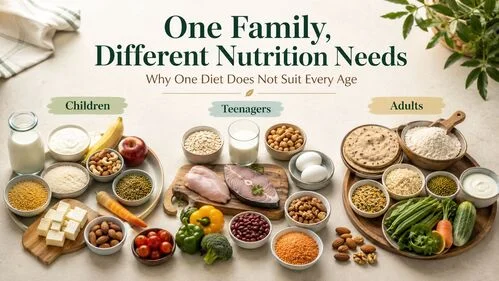
Nutrition needs for children, teenagers and adults
Children, teenagers and adults all need energy, protein, carbohydrates, fats, fibre, vitamins, minerals and hydration. The difference lies in the amount, priority and clinical context of those needs. Growth stage, activity and health status can change how these nutrients should be planned.
Children need nutrition that supports growth and development
Children are not small adults. Their nutritional needs support physical growth, brain development, immunity, activity, learning and the formation of long-term eating habits. Requirements can change quickly during childhood and should be considered alongside growth patterns, appetite, development and health history.
A restrictive adult diet should not be applied to a child simply because a parent is following it. Calorie restriction, prolonged fasting or unnecessary food-group elimination can interfere with nutritional adequacy. Concerns about a child’s weight, growth, selective eating or appetite require context rather than a generic online solution.
Teenagers have changing needs during rapid development
Adolescence is a period of rapid physical, hormonal, cognitive and social change. Growth spurts, puberty, menstruation, sports participation, school pressure and changing independence around food can all affect nutritional priorities.
Teenagers may also be exposed to restrictive diets, body-image pressure and fitness advice from social media. An eating approach designed for an adult may not protect growth, bone health, concentration or emotional well-being in an adolescent. Weight concerns during adolescence should be assessed with attention to growth and development, not body weight alone.
Adults need nutrition that reflects health, lifestyle and goals
Adult nutritional needs may be influenced by work routine, physical activity, sleep, stress, body composition, pregnancy, breastfeeding, medication and medical conditions. One adult may seek weight management, another may need clinical nutrition support, and another may need help preventing unintended weight loss.
Older adults can face additional concerns such as reduced appetite, muscle loss, mobility limitations, chewing or swallowing difficulty, multiple treatments and chronic illness. A diet described as light or healthy may still be nutritionally insufficient when appetite or food intake has declined.
Which factors make nutritional requirements personal?
Nutritional requirements are personal because several biological, medical and practical factors interact. A single factor rarely explains the complete dietary need.
- Age and life stage
- Growth and developmental stage
- Body composition and weight history
- Physical activity and sports participation
- Appetite, hunger and fullness patterns
- Sleep, stress and daily schedule
- Pregnancy, breastfeeding or fertility goals
- Medical conditions and current symptoms
- Laboratory findings and nutritional deficiencies
- Medication and treatment plans
- Food allergies, intolerances and digestive tolerance
- Vegetarian, vegan, egg-based or non-vegetarian preferences
- Regional, cultural and religious food practices
- Food affordability, availability, cooking facilities and storage
These factors may also change over time. A teenager’s needs can change during a growth spurt. An adult’s requirements can change after pregnancy, a new diagnosis, a medication change or a major shift in activity. A useful nutrition plan therefore needs review rather than being treated as a permanent formula.
Which nutritional priorities matter across life stages?
The main nutrient categories matter throughout life, but their significance and appropriate amount depend on the person. General education can explain their roles, but it cannot establish an individual target.
Energy
Energy supports growth, movement, organ function and daily activity. Too little energy can affect growth, recovery and functioning, while regularly consuming more than the body requires can contribute to unwanted weight gain. Exact energy needs depend on age, body composition, activity, health and life stage.
Protein
Protein supports growth, tissue maintenance, enzymes, hormones and immune function. Requirements vary with age, body size, activity, health and clinical conditions. More protein is not automatically better, and a high-protein approach may be unsuitable for some people.
Carbohydrates and fibre
Carbohydrates provide energy, while fibre supports digestive health and dietary quality. The suitable type and amount can vary with activity, appetite, digestive tolerance, blood glucose regulation and medical needs. Rice, roti and other carbohydrate foods should not be labelled universally harmful.
Dietary fats
Dietary fats provide energy, support cell function and help the body absorb certain vitamins. Fat is particularly relevant during growth and development. The type, amount and overall dietary context matter more than treating all fats as one category.
Vitamins and minerals
Vitamins and minerals support blood formation, bones, immunity, metabolism and many other functions. Needs may be influenced by growth, menstruation, pregnancy, dietary restrictions, absorption, medication and medical conditions. Symptoms alone cannot confirm a deficiency.
Hydration
Fluid needs can vary with age, climate, activity, illness and medical conditions. A fixed water target is not suitable for everyone, particularly when a person has a condition requiring individual fluid advice.
How does the Indian family context influence nutrition?
Indian families often share household foods, cultural traditions and cooking practices, but the country has wide regional and dietary diversity. Vegetarian, vegan, egg-based and non-vegetarian patterns can all require thoughtful planning according to the individual.
Familiar foods such as cereals, millets, pulses, dairy foods, eggs, fish, meat, vegetables, fruits, nuts and seeds can contribute different nutrients. Their presence in the kitchen does not automatically prove that every family member receives the right amount or nutritional balance.
School schedules, long commutes, shift work, festivals, fasting practices, food affordability, seasonal availability and access to refrigeration can also affect eating patterns. A personalised plan should work within the family’s actual routine and food culture rather than replacing traditional foods with expensive imported products.
Why can a shared family diet become unsuitable?
A shared family diet becomes unsuitable when identical rules, restrictions or quantities are applied without considering individual needs. The problem is not that family members share foods. The problem is assuming that shared foods create identical nutritional requirements.
- A parent’s weight-loss restriction is applied to a growing child.
- A therapeutic restriction is copied by family members who do not have the same condition.
- A teenager’s increased growth and activity needs are overlooked.
- An older adult with reduced appetite receives food that is insufficiently nutrient-dense.
- One person’s allergy, intolerance or medication is treated as a rule for the whole household.
- Homemade food is assumed to be automatically complete without assessing overall variety and adequacy.
These mismatches may not be obvious immediately. This is one reason family nutrition decisions should be reviewed when there are concerns about growth, energy, concentration, body weight, symptoms, laboratory results or chronic disease.
How should weight management differ across ages?
Weight management should reflect age, growth, health and personal circumstances. It should not mean placing the whole family on the same restrictive diet or treating lower body weight as the only measure of success.
For adults, a personalised weight-management assessment may consider body composition, weight history, appetite, eating patterns, activity, sleep, stress, medication, laboratory findings, medical conditions and previous dieting experiences. Sustainable changes usually require more than simply asking someone to eat less.
For children and teenagers, the priority is appropriate growth, development, nutritional adequacy, activity and long-term habits. Adult calorie restriction, prolonged fasting and rapid weight-loss methods should not be applied to growing children. Weight concerns should be interpreted alongside growth patterns and health, with family involvement where appropriate.
When does clinical nutrition change family dietary needs?
Clinical nutrition becomes relevant when a medical condition, symptom, medication, laboratory finding or treatment affects dietary requirements. The suitable dietary approach may depend on the diagnosis, disease stage, current symptoms, nutritional status and advice from the medical team.
A restriction required for one person may be unnecessary or unsuitable for another. Likewise, advice that is reasonable for general health may need modification when kidney function, blood glucose, digestion, allergies, pregnancy or another clinical factor is involved.
Clinical nutrition supports medical care through nutritional assessment and personalised dietary planning. It does not replace diagnosis, medication or treatment. Coordination with the treating doctor or another qualified healthcare professional may be important when medical conditions or treatment plans are involved.
Common misconceptions about family nutrition
One healthy diet suits everyone
A broadly healthy pattern can support the household, but quantities, priorities and clinical modifications may still differ between individuals.
Children can follow smaller versions of adult diets
Children and teenagers have growth and developmental needs that cannot always be met by simply reducing the amount of an adult diet.
Home-cooked food is automatically nutritionally complete
Home cooking can be valuable, but adequacy depends on overall variety, quantities, nutrient coverage and the needs of the person eating it.
Everyone needs the same amount of protein
Protein requirements vary with age, body size, activity, growth and health. An excessive intake can also be inappropriate for some clinical conditions.
Supplements can correct every nutrition problem
Supplements do not automatically correct an unsuitable dietary pattern and may be unnecessary or inappropriate when medication or medical conditions are involved.
Symptoms can confirm a nutrient deficiency
Fatigue, hair changes, poor concentration and appetite changes can have several causes. Symptoms alone cannot confirm a deficiency.
An online calculator can create a personalised plan
Online tools can provide estimates, but they cannot fully assess growth, body composition, laboratory findings, medication, food tolerance, family routine and clinical needs.
Frequently asked questions
Can the whole family follow the same diet?
Family members may share many foods, but an identical diet may not meet everyone’s requirements. Children, teenagers and adults differ in growth, activity, appetite, body composition and health. Medication, allergies, medical conditions and weight-management goals can create further differences. Individual quantities and dietary modifications may therefore need personalised assessment.
Do children need the same nutrients as adults?
Children and adults need many of the same nutrient categories, but their priorities and suitable amounts differ. Children need nutrition that supports growth, brain development and activity. Applying an adult restriction or weight-loss plan to a child can affect adequacy, so a child’s growth pattern, appetite, development and health should be considered together.
Can teenagers follow an adult weight-loss diet?
Teenagers should not automatically follow an adult weight-loss diet. Adolescence involves growth, puberty, bone development and changes in body composition. Severe restriction, prolonged fasting or food-group elimination may affect nutritional adequacy. Weight concerns in teenagers should be considered alongside growth, health, activity, eating behaviour and emotional well-being.
Is homemade Indian food always nutritionally complete?
Homemade Indian food is not automatically nutritionally complete. Adequacy depends on food variety, quantities, nutrient coverage and the needs of the individual. A household may use familiar, wholesome foods while still overlooking a nutrient priority or applying a quantity that does not suit every family member.
When is clinical nutrition guidance useful?
Clinical nutrition guidance may be useful when a diagnosis, symptom, medication, laboratory result or treatment affects dietary requirements. The suitable approach can depend on disease stage, current symptoms, digestion, food tolerance and other medical conditions. Clinical nutrition should support medical care and should not replace prescribed treatment.
Can an online article determine exact nutrition requirements?
An online article can explain general principles, but it cannot determine exact requirements for one person. Age, growth, body composition, medical history, medication, laboratory findings, appetite, food tolerance, activity and routine may all change an appropriate plan. Personalised assessment is needed when these factors materially affect dietary decisions.
Conclusion
The nutrition needs for children, teenagers and adults cannot be met through one identical diet. Age, growth, activity, body composition, health conditions, medication, food tolerance and personal goals all influence nutritional requirements.
A family can share its food culture and many household foods while recognising that quantities, nutrient priorities and clinical modifications may need individual planning. This becomes especially important when growth, weight management or a medical condition affects dietary needs.
When personalised nutrition guidance may help
General nutrition information can explain the principles relevant to a family’s health or weight concerns, but it cannot determine the exact requirements of every individual. Age, life stage, growth, health history, body composition, laboratory findings, medication, food preferences, activity, sleep and daily routine may all influence an appropriate dietary approach.
Chief Nutritionist Vasanthi Senthilvel may assess these factors to develop a personalised diet plan for weight management, clinical nutrition or both when needs overlap. The purpose is to identify nutritional priorities and develop practical recommendations suited to the individual’s health needs, preferences and routine.
Author
Chief Nutritionist Vasanthi Senthilvel leads Newtrist Nutritionist Dietitian Dietician, providing personalised diet plans for weight management and clinical nutrition for children, adolescents, adults and families.
She has 21 years of experience in nutrition and has received professional recognition for her work.
- Pride of Bharat Awards 2026: Outstanding Achievement in Holistic Health & Nutrition Innovation
- Doctor of The Year: Nutritionist 2026: Excellence in Clinical Nutrition and Weight Loss.
Her approach considers age, growth, health history, medical conditions, laboratory reports, medication, body composition, weight history, dietary preferences, regional food habits, family routines, activity, sleep and personal health goals. Recommendations are developed according to individual needs rather than using one standard diet for everyone.
Consultations are available in person at Bangalore HSR Layout, Koramangala, Bellandur, Haralur and Electronic City, as well as online across India.
Independent Medical Review Panel
Newtrist health and nutrition articles undergo medical review, where appropriate, by doctors with relevant specialist expertise. The medical professionals listed below contribute to Newtrist’s review process within their respective specialties.
| Speciality | Doctor |
|---|---|
| Endocrinology | Dr Vinay Prasad MBBS, MD, DM |
| Gastroenterology & Hepatology | Dr Sunil kumar N MBBS, MD, DM |
| Gynaecology | Dr Prathiba G MBBS, DNB, FIRM, FMAS |
| Nephrology | Dr Priyashree R MBBS, MD, DNB, DM |