
Written by: Chief Nutritionist Vasanthi Senthilvel
21 years of experience | Newtrist Nutritionist Dietitian Dietician
Best Nutritionist in Bangalore with multiple awards for excellence in clinical nutrition, weight loss, holistic health and nutrition innovation.
Medically reviewed by: Dr Prathiba G MBBS, DNB, FIRM, FMAS | Dr Sunil kumar N MBBS, MD, DM | Dr Vinay Prasad MBBS, MD, DM
Medical Disclaimer: Nutritional needs vary based on an individual’s profile. The information on this page is for general educational purposes only and is not intended to replace personalised medical or nutrition care.
The restaurant menu arrives, and your favourite dishes are right there: paneer butter masala, butter naan, biryani and a dessert you have been craving.
You want to enjoy the meal, but another thought keeps interrupting: “Will this affect my weight-loss progress?”
Should you order something different from everyone else? Choose the lowest-calorie-looking dish? Or enjoy your favourite food and worry about it later?
The good news is that eating out does not have to become an all-or-nothing decision.
What matters is how you choose your dishes, what comes with them and how much you actually eat. Once you understand a few practical details, navigating an Indian restaurant menu becomes much easier without turning an enjoyable meal into another set of food rules.
Key Takeaway
You can eat out while losing weight by choosing satisfying Indian restaurant meals, managing portions and considering cooking fats, gravies and accompaniments. Foods such as paneer tikka, tandoori chicken, dal, vegetable sabzi, idli and dosa can fit, depending on their preparation and quantity. You do not need to eliminate rice, roti or favourite dishes. What matters is how restaurant meals contribute to your overall energy intake and whether your eating pattern remains consistent.

Table of Contents
Can You Eat at Indian Restaurants While Losing Weight?
Yes. Eating at restaurants does not prevent weight loss when your overall food intake supports an appropriate energy deficit over time.
A restaurant meal is not fundamentally different from a home-cooked meal. Both provide energy and nutrients.
The difference is that restaurants control the recipe, cooking fats, portion size and presentation.
You may know exactly how much oil goes into your homemade paneer sabzi, but the same dish at a restaurant could contain butter, cream or cashew paste in quantities you cannot easily estimate.
That makes informed ordering more useful than simply deciding whether a dish is allowed.
You can enjoy restaurant food while still making choices that support your nutritional goals.
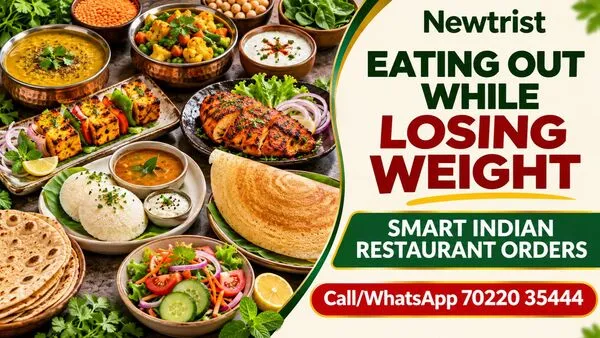
What Makes Indian Restaurant Meals More Challenging for Weight Loss?
A dish may look familiar, but its nutritional composition can change considerably depending on how the restaurant prepares it.
Two details deserve particular attention.
Cooking Fats and Rich Gravies
Oil, butter, ghee, cream and ground nuts are commonly used to create flavour and texture in Indian restaurant dishes.
They can make a meal more energy-dense without noticeably increasing its volume.
Consider paneer tikka and paneer butter masala.
Both contain paneer, but the tikka is commonly grilled or cooked in a tandoor, while butter masala usually contains a richer gravy.
Their calorie content may differ substantially, although the actual preparation and quantity determine the result.
Similarly, a vegetable dish is not automatically light simply because vegetables are its main ingredients.
The amount of cooking fat still matters.
Accompaniments That Change the Complete Meal
Sometimes the main dish is not the biggest challenge.
A starter, additional naan, extra rice, creamy dip or dessert can increase the total amount consumed beyond what you originally intended.
The same happens when several dishes are placed on the table for sharing.
Rather than judging one dish in isolation, consider the complete order.
A satisfying restaurant meal is built from everything you choose to eat, not just the main course.

What Should You Order at an Indian Restaurant for Weight Loss?
The most practical restaurant choices usually combine a protein-containing dish, vegetables and an appropriate portion of rice, roti or another staple.
You can find these combinations on many North Indian and South Indian menus.
North Indian Restaurant Choices
Paneer tikka, chicken tikka, tandoori fish, dal and vegetable preparations can all form part of a satisfying meal.
For example, you could choose paneer tikka with bhindi sabzi and plain roti.
Another option is tandoori chicken with a vegetable dish and rice.
Rich curries can also fit, but their gravy and accompaniments influence the total meal.
South Indian Restaurant Choices
South Indian menus offer familiar combinations such as idli with sambar, plain dosa with sambar, or rice with vegetable preparations and a lentil-based accompaniment.
Sambar contributes lentils and vegetables, while dishes prepared with palak, drumstick, beans or other vegetables can add nutritional variety.
The size of a dosa, quantity of added ghee and portions of accompanying chutneys can change the meal’s energy content.
Practical Indian Restaurant Ordering Guide
| Restaurant situation | Example meal combination | What to pay attention to |
| North Indian vegetarian | Paneer tikka, bhindi sabzi and plain roti | Paneer portion, added oil and number of rotis |
| North Indian non-vegetarian | Tandoori chicken, vegetables and rice | Marinade, added butter and rice portion |
| South Indian breakfast | Idli with sambar | Number of idlis and accompanying dishes |
| South Indian main meal | Plain dosa with sambar | Dosa size, oil or ghee and chutney quantities |
| Dal-based restaurant meal | Dal, methi or palak sabzi and roti | Tadka, gravy richness and portions |
| Restaurant thali | Selected servings of dal, sabzi, rice, roti and curd | Overall quantity and additional servings |
These combinations are examples, not fixed meal prescriptions. Recipes and portions differ across restaurants.
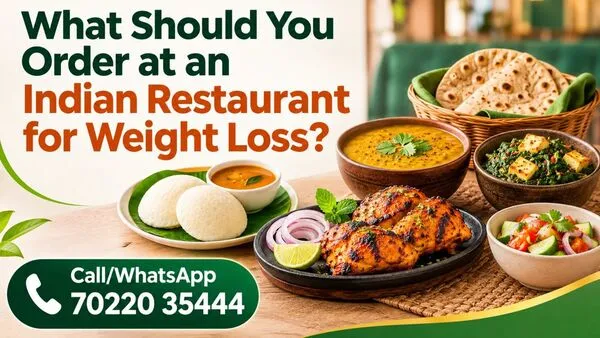
How Can You Make Better Choices From an Indian Restaurant Menu?
You do not need to memorise the calorie content of every Indian dish.
A few practical decisions can make ordering easier.
Choose the Main Dish Before Adding Extras
Start by identifying the dish you genuinely want.
If you are ordering a protein-rich preparation such as paneer tikka, fish or chicken, consider which accompaniments would complete the meal.
If you prefer a dal-based meal, check what vegetables and staples are available.
This approach helps you avoid ordering several dishes simply because they look appealing individually.
Look Beyond Words Such as Grilled, Dry or Healthy
Menu descriptions provide clues, but they do not reveal the complete nutritional composition.
A grilled dish may be finished with butter.
A dry sabzi may contain substantial cooking oil.
A creamy curry may contain cream, butter or ground nuts, while a dish labelled low-fat may still be served in a large portion.
Instead of relying on the description alone, look at how the dish is prepared and what else comes with it.
Ask Simple Questions About Preparation
You can ask whether a dish contains cream, butter or a rich gravy.
You may also request less added butter, have gravy served separately or choose a plain roti rather than one finished with butter.
Restaurants may not always accommodate every request, but a small adjustment can make a difference without changing the entire meal.
The goal is to make informed choices while still enjoying what you order.
How Can You Control Portions Without Giving Up Your Favourite Foods?
Imagine ordering your favourite paneer curry.
You enjoy the first few bites, but the restaurant has served a large bowl, and several pieces of naan are still on the table.
Do you need to finish everything because you ordered it?
No.
Portion management is about deciding how much satisfies you rather than automatically eating the entire serving.
Share Larger Dishes
Sharing a starter, curry or dessert allows you to enjoy different flavours without needing a full serving of every item.
This can be particularly useful when dining with family or friends and ordering several dishes for the table.
Avoid Ordering Everything at Once
Start with the food you expect to enjoy as your main meal.
You can decide whether you want an additional dish after seeing the portions.
Restaurant servings are not always designed around one person’s appetite, so ordering gradually may help avoid unnecessary extras.
Keep the Foods You Enjoy Most
Perhaps butter naan is your favourite part of a North Indian meal.
You do not necessarily need to replace it every time.
You might choose to enjoy the naan with a preferred curry while keeping the rest of the order relatively simple.
Similarly, if dessert is the part of the meal you are most looking forward to, you can decide how it fits into the overall order.
The aim is not to remove enjoyment from restaurant meals. It is to make deliberate choices about what you genuinely want to eat.
How Can You Handle Restaurant Meals With Family, Friends or Colleagues?
Eating out is rarely only about food.
It may be a family celebration, an office lunch, a weekend dinner or an opportunity to spend time with friends.
You may not control the restaurant, the menu or the dishes everyone chooses to share.
That does not mean you have lost control of your own meal.
You can select the foods you prefer, serve yourself according to your appetite and remain flexible when the available choices differ from what you expected.
For example, if your colleagues order biryani and several starters, you can enjoy the dishes you want without feeling obliged to take equal portions of everything.
If the meal is richer than usual, there is no need to skip the next meal or introduce severe restrictions to compensate. Returning to your regular eating pattern is a more practical response.
A restaurant visit should fit into your life rather than make you feel that your weight-loss efforts depend on one perfect order.
What If You Eat at Restaurants Frequently?
Occasional restaurant meals and regularly eating out for work can create different challenges.
If you eat at restaurants once in a while, you may find it relatively easy to make choices based on that occasion.
But if restaurant lunches or dinners are part of your weekly routine, the cumulative pattern becomes more relevant.
Consider someone who eats lunch at restaurants four times a week.
They may consistently choose dishes described as healthy, yet the serving sizes, cooking fats and accompanying foods could differ considerably from their usual home meals.
Another person may eat out less frequently but regularly order several rich dishes in one sitting.
Neither situation can be evaluated using restaurant frequency alone.
How often you eat out matters less than what your restaurant meals consistently contribute to your overall eating pattern.
This is where knowing what to order becomes only part of the decision.
Frequently Asked Questions About Eating Out While Losing Weight
1. Can I Eat Biryani at a Restaurant While Trying to Lose Weight?
Yes. Biryani can fit into a weight-loss eating pattern. Its energy content depends on the quantity of rice, cooking fats, protein ingredients and serving size. The portion and complete meal matter more than treating biryani as a forbidden food.
2. Is a Restaurant Buffet a Poor Choice for Weight Loss?
Not necessarily. A buffet offers flexibility, but the variety can make it tempting to take more food than you intended. Choosing the dishes you genuinely want and serving portions according to your appetite can make the experience more manageable.
3. Is Tandoori Food Always Lower in Calories Than Curry?
No. Tandoori cooking may use less oil than deep-frying, but marinades, additional butter, ingredients and portion size influence the final calorie content. A tandoori label alone does not guarantee a lower-calorie dish.
4. Do I Need to Count Calories Every Time I Eat Out?
Not necessarily. Restaurant calorie values may be unavailable or may differ from the actual preparation. Looking at serving sizes, main ingredients, cooking fats and the complete order can help you make practical decisions without calculating every calorie.
5. Can I Eat Out More Than Once a Week and Still Lose Weight?
Yes. There is no universal limit on the number of restaurant meals permitted during weight loss. The appropriate frequency depends on what you eat, your portions, overall energy intake and individual nutritional requirements.
How Can Personalised Nutrition Help You Eat Out While Losing Weight?
You may now have a clearer idea of what to order at an Indian restaurant.
But there is still one question a general restaurant guide cannot answer.
How do these choices fit your own weight-loss needs when eating out is part of your regular lifestyle?
Perhaps you have business lunches several times a week and rarely know where you will be eating.
You may enjoy family restaurant dinners but struggle to judge the portions of shared dishes.
Or you might already choose grilled food, dal and vegetables, yet remain uncertain whether your overall intake supports your goals.
Following another list of approved restaurant foods may not resolve those questions.
What you need is a way to connect your real eating habits with your individual nutritional requirements.
Personalised Weight-Loss Nutrition With Chief Nutritionist Vasanthi Senthilvel
At Newtrist, Chief Nutritionist Vasanthi Senthilvel provides personalised diet and nutrition guidance based on individual health needs, food preferences, eating patterns, lifestyle and weight-management goals.
A personalised nutrition assessment can help you understand how frequently you can accommodate restaurant meals, which portions suit your needs and how to balance eating out with the foods you enjoy at home.
For someone who frequently eats out for work, the priority may be developing reliable ordering choices across different restaurant menus.
For another person, it may be learning how to include favourite dishes during family dinners without following unnecessarily restrictive rules.
The aim is not to stop you from enjoying restaurants. It is to make restaurant meals part of a realistic eating approach that supports your goals.
Do you eat out regularly and wonder whether your restaurant choices are affecting your weight-loss progress?
Bring your usual restaurant orders, eating-out frequency and food preferences into a personalised nutrition discussion with Chief Nutritionist Vasanthi Senthilvel.
Explore personalised weight-loss nutrition guidance at Newtrist to understand how familiar Indian restaurant meals can fit into an approach designed around your needs.
Author
Chief Nutritionist Vasanthi Senthilvel leads Newtrist Nutritionist Dietitian Dietician, providing personalised diet plans for weight management and clinical nutrition for children, adolescents, adults and families.
She has 21 years of experience in nutrition and has received professional recognition for her work.
- Pride of Bharat Awards 2026: Outstanding Achievement in Holistic Health & Nutrition Innovation
- Doctor of The Year: Nutritionist 2026: Excellence in Clinical Nutrition and Weight Loss.
Her approach considers age, growth, health history, medical conditions, laboratory reports, medication, body composition, weight history, dietary preferences, regional food habits, family routines, activity, sleep and personal health goals. Recommendations are developed according to individual needs rather than using one standard diet for everyone.
Consultations are available in person at Bangalore HSR Layout, Koramangala, Bellandur, Haralur and Electronic City, as well as online across India.
Independent Medical Review Panel
Newtrist health and nutrition articles undergo medical review, where appropriate, by doctors with relevant specialist expertise. The medical professionals listed below contribute to Newtrist’s review process within their respective specialties.
| Speciality | Doctor |
|---|---|
| Endocrinology | Dr Vinay Prasad MBBS, MD, DM |
| Gastroenterology & Hepatology | Dr Sunil kumar N MBBS, MD, DM |
| Gynaecology | Dr Prathiba G MBBS, DNB, FIRM, FMAS |
| Nephrology | Dr Priyashree R MBBS, MD, DNB, DM |