
Written by: Chief Nutritionist Vasanthi Senthilvel
21 years of experience | Newtrist Nutritionist Dietitian Dietician
Best Nutritionist in Bangalore with multiple awards for excellence in clinical nutrition, weight loss, holistic health and nutrition innovation.
Medically reviewed by: Dr Prathiba G MBBS, DNB, FIRM, FMAS | Dr Sunil kumar N MBBS, MD, DM | Dr Vinay Prasad MBBS, MD, DM
Medical Disclaimer: Nutritional needs vary based on an individual’s profile. The information on this page is for general educational purposes only and is not intended to replace personalised medical or nutrition care.
Your kitchen may already contain many foods recommended by the MIND diet. But are you eating them in the right combinations and often enough?
Palak, rajma, whole-wheat roti and walnuts are familiar ingredients in many Indian households. Yet they also belong to an eating pattern that researchers have investigated for its relationship with long-term brain health.
The challenge is not necessarily finding unfamiliar ingredients. It is understanding which foods matter, how frequently they should appear and where traditional Indian meals fit into the original guidelines.
Do you need expensive berries? Can millets count as whole grains? And how can a vegetarian family follow a framework that also includes fish and poultry?
The answers may make the MIND diet more practical than you expect.
Key Takeaway
The MIND diet is a brain-focused eating pattern that emphasises leafy greens, vegetables, whole grains, legumes, nuts, berries and selected other foods while limiting certain food categories. Many principles can be incorporated into Indian meals, but the original serving targets and individual nutritional requirements remain important.
Table of Contents
What Is the MIND Diet?
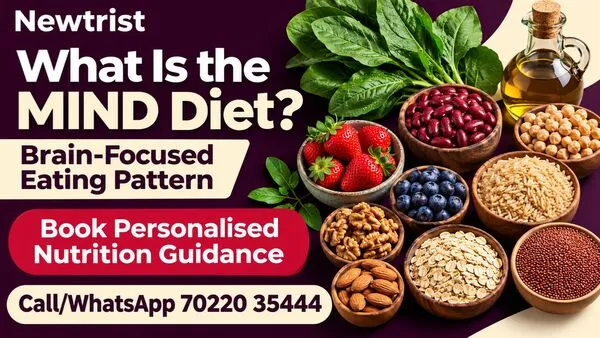
The MIND diet stands for Mediterranean–DASH Intervention for Neurodegenerative Delay.
Developed by researchers at Rush University Medical Center, it combines selected principles of the Mediterranean and DASH dietary patterns, with particular emphasis on foods studied for their relationship with cognitive health.
Unlike a fixed diet chart, the MIND diet uses recommended food groups and consumption frequencies to guide eating habits over time.
What Makes the MIND Diet Different?
The MIND diet gives special attention to green leafy vegetables and berries rather than treating every vegetable and fruit as interchangeable.
It also encourages regular consumption of whole grains, nuts and legumes, alongside specific guidelines for other food groups.
These foods provide combinations of nutrients and plant compounds, including folate, carotenoids, polyphenols, fibre and unsaturated fats.
The approach does not depend on one ingredient that independently improves memory.
Its central principle is to build a consistent eating pattern around particular food groups rather than relying on occasional nutritious meals.
Which Foods Should You Eat on the MIND Diet?
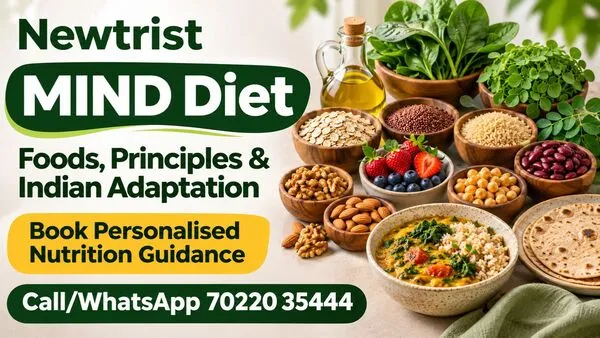
The MIND diet identifies food groups to include regularly.
Some have daily targets, while others are measured across the week. Understanding these frequencies is essential when adapting the pattern to Indian cooking.
MIND Diet Food List and Recommended Servings
| Food group | Original MIND diet target | Practical Indian examples |
| Green leafy vegetables | At least 6 servings weekly | Palak, methi leaves, amaranth leaves, moringa leaves |
| Other vegetables | At least 1 serving daily | Bhindi, carrots, beans, cauliflower, cabbage |
| Whole grains | At least 3 servings daily | Whole-wheat atta, oats, brown rice, whole ragi, jowar, bajra |
| Legumes | More than 3 meals weekly | Moong, masoor, chana, rajma, lobia |
| Nuts | At least 5 servings weekly | Walnuts, almonds, peanuts |
| Berries | At least 2 servings weekly | Strawberries, blueberries and other suitable berries |
| Fish, not fried | At least 1 meal weekly | Sardines, mackerel and other suitable fish |
| Poultry, not fried | At least 2 meals weekly | Home-cooked chicken preparations |
| Olive oil | Main added oil in the original framework | Olive oil used in suitable preparations |
These are the relevant food categories and frequencies from the original MIND framework. Some Indian examples are practical adaptations rather than foods individually evaluated under the original scoring questionnaire.
The targets describe an overall dietary pattern, not a requirement to eat every listed food daily.
For example, consuming leafy vegetables once a week is different from including meaningful servings across six days.
Similarly, eating nuts occasionally does not automatically meet a five-serving weekly target.
Understanding both frequency and serving size helps you assess how closely your usual meals follow the framework.
Which Foods Should You Limit on the MIND Diet?
The MIND diet also identifies five food categories for reduced consumption.
MIND Diet Foods to Limit
| Food category | Original MIND diet guideline | Familiar Indian examples |
| Red and processed meats | Fewer than 4 meals weekly | Mutton, sausages, processed meat products |
| Butter and margarine | Less than 1 tablespoon daily | Butter, margarine-based spreads |
| Cheese | Fewer than 1 serving weekly | Cheese slices, cheese spreads, cheese-rich dishes |
| Pastries and sweets | Fewer than 5 servings weekly | Cakes, biscuits, pastries, mithai |
| Fried and fast foods | Fewer than 1 serving weekly | Deep-fried snacks, fried takeaway meals |
These limits are intended to shape the frequency of food choices across the overall diet.
For example, someone who frequently relies on fried snacks might gradually replace some of those occasions with a suitable serving of nuts.
This can help increase an encouraged food group while reducing a category that the MIND framework limits.
The emphasis is on consistent choices rather than treating one occasional meal as a measure of the entire eating pattern.

How Can You Adapt the MIND Diet to Indian Meals?
The MIND diet can be adapted to Indian food habits without replacing traditional meals with unfamiliar recipes. The practical approach is to identify which food groups already appear in your household’s cooking and where adjustments may be needed.
Three considerations make the adaptation easier.
1. Build Around Your Usual Indian Meals
Start with the meals your family already prepares.
A lunch of whole-wheat rotis, dal and vegetable sabzi can incorporate whole grains, legumes and vegetables without requiring a different cooking style.
Similarly, brown rice with rajma or jowar roti with chana curry can bring together important MIND food groups.
South Indian meals can also be adapted through preparations such as vegetable oats upma or whole-ragi dosa.
The important consideration is the actual composition of the dish.
For example, a preparation made predominantly from whole grains contributes differently from a packaged snack containing only a small quantity of millet flour.
Rather than concentrating on one ingredient, consider which MIND categories the complete meal provides.
2. Recognise Where Indian Substitutions Differ
Some original MIND food categories are less familiar or readily available in certain Indian households.
Berries and olive oil are two examples.
Indian fruits such as amla, jamun and guava can contribute valuable nutrients to a varied diet. However, they have not been established as identical substitutes for the berry component used in the original MIND research.
The original framework also specifies olive oil as the main added oil.
Other oils commonly used in Indian cooking can be considered when adapting meals, but they should not automatically be described as equivalent under the original scoring criteria.
The distinction is important because a practical Indian adaptation can be nutritious without reproducing every component of the original research score.
3. Adapt Vegetarian Meals Without Assuming Identical Scoring
Vegetarian households can incorporate several encouraged MIND food groups through whole grains, leafy greens, vegetables, legumes, nuts and berries.
For example, a meal containing jowar roti, palak dal and mixed vegetable sabzi includes multiple relevant categories.
However, the original MIND framework also includes non-fried fish and poultry.
Legumes provide valuable plant-based nutrition, but they do not count as direct replacements for those particular scoring components.
A vegetarian adaptation should therefore consider both the relevant MIND principles and the nutritional adequacy of the complete diet.
What Does a One-Day Indian MIND Diet Plan Look Like?
Understanding the food categories is useful, but bringing them together across an ordinary day can require more thought.
The following sample illustrates how familiar Indian preparations can include several MIND diet components without relying on an entirely unfamiliar menu.
Sample One-Day Indian MIND Diet Menu
| Meal | Menu | MIND diet food groups |
| Breakfast | Vegetable oats upma with palak and carrots | Whole grains, leafy greens, other vegetables |
| Mid-morning | Fresh strawberries | Berries |
| Lunch | Whole-wheat rotis, rajma curry and beans sabzi | Whole grains, legumes, vegetables |
| Evening snack | Walnuts and almonds | Nuts |
| Dinner | Brown rice, methi sabzi and non-fried sardines | Whole grains, leafy greens, fish |
Vegetarian dinner variation: Brown rice with methi sabzi and masoor dal provides a plant-based option, although the dal does not count towards the original fish category.
This example illustrates meal combinations rather than prescribing identical portions for everyone.
The MIND diet is assessed through food choices made across the week. A single day cannot establish whether all weekly food-group targets have been met.
Individual meal quantities also need to reflect overall nutritional requirements.
What Does Research Say About the MIND Diet and Brain Health?
The MIND diet attracted attention after observational studies found associations between stronger dietary adherence and favourable cognitive outcomes.
In some studies, participants who followed the MIND pattern more closely tended to experience slower cognitive decline.
These findings encouraged further research into whether the dietary pattern could directly influence long-term cognitive health.
What Did the Three-Year MIND Diet Trial Find?
A major randomised clinical trial published in 2023 examined the MIND diet in 604 older adults without cognitive impairment who had a family history of dementia, were overweight and had room to improve their diets.
Participants followed either the MIND diet or a comparison diet for three years. Both groups received dietary guidance and followed a mild calorie-reduction approach.
The researchers found no statistically significant difference in cognitive outcomes between the MIND diet group and the comparison group.
This distinction matters when interpreting claims about the diet.
Observational findings suggest a possible relationship between dietary adherence and cognitive health, but the clinical trial did not establish superior cognitive benefits compared with its control diet.
The MIND diet therefore remains a structured eating pattern with a meaningful research history, rather than a guaranteed method for preventing cognitive decline or improving memory.
Frequently Asked Questions
How Much Counts as One Serving in the MIND Diet?
Serving sizes vary by food group. Common practical examples include:
- Green leafy vegetables: Approximately 1 cup raw or ½ cup cooked.
- Berries: Approximately ½ cup.
- Nuts: Approximately 28 g.
- Cooked whole grains: Approximately ½ cup.
- Cooked legumes: Approximately ½ cup.
These are useful reference portions, while individual grain products and the original research scoring questionnaire may use more specific serving definitions.
Can Frozen Berries Be Included in the MIND Diet?
Yes. Plain, unsweetened frozen berries can be included when fresh varieties are unavailable. They offer a convenient way to incorporate the berry food group without depending entirely on seasonal availability.
Does Paneer Count as Cheese in the MIND Diet?
Paneer is a fresh cheese, but the original MIND research did not separately validate traditional Indian paneer preparations as a distinct scoring category. Paneer should not be treated as one of the specifically encouraged MIND foods simply because it provides protein.
Can Traditional Idli and Dosa Fit the MIND Diet?
Yes, they can form part of an Indian adaptation. However, a conventional rice-based idli or dosa does not automatically count as a whole-grain serving. Its contribution depends on the proportion and type of grains and legumes used in the batter. Preparations using genuine whole grains may contribute towards the whole-grain component.
How Long Does It Take to Notice Brain-Health Benefits?
There is no established time frame in which following the MIND diet guarantees noticeable improvements in memory or cognitive function. Research has examined dietary adherence and cognitive outcomes over several years, with observational and clinical trial findings differing. The MIND diet is best understood as a long-term eating pattern rather than a short-term programme promising immediate cognitive changes.
How Can You Make the MIND Diet Work for Your Individual Needs?
You may already eat many foods recommended by the MIND diet.
What may be less clear is whether your regular meals include those foods often enough, in suitable portions and in combinations that meet your nutritional requirements.
Perhaps your household eats whole grains regularly but rarely includes leafy vegetables. You might follow a vegetarian diet, find berries difficult to obtain or prefer traditional Indian cooking methods.
These differences matter when turning a general food-group framework into a realistic eating pattern.
A sample menu can show what is possible. It cannot determine which changes are appropriate for every person.
Personalised MIND Diet Adaptation With Chief Nutritionist Vasanthi Senthilvel
You do not necessarily need to abandon familiar Indian meals to follow the principles of the MIND diet.
You may need help understanding which parts of your existing diet already fit the framework, which components are missing and how your overall nutritional requirements should be considered.
At Newtrist, Chief Nutritionist Vasanthi Senthilvel provides personalised nutrition guidance based on your current eating habits, food preferences, nutritional requirements and daily routine.
A consultation can help you review your regular meals, assess their nutritional suitability and develop practical adjustments using familiar Indian ingredients.
Whether your family prefers South Indian dishes, North Indian meals or vegetarian cooking, the focus can remain on an eating pattern that fits your individual needs.
You may already have many of the right ingredients in your kitchen. What matters is knowing how to combine them, how often to include them and what portions are appropriate for you.
Book a personalised nutrition consultation with Chief Nutritionist Vasanthi Senthilvel at Newtrist to discuss a practical Indian adaptation suited to your nutritional requirements.
Author
Chief Nutritionist Vasanthi Senthilvel leads Newtrist Nutritionist Dietitian Dietician, providing personalised diet plans for weight management and clinical nutrition for children, adolescents, adults and families.
She has 21 years of experience in nutrition and has received professional recognition for her work.
- Pride of Bharat Awards 2026: Outstanding Achievement in Holistic Health & Nutrition Innovation
- Doctor of The Year: Nutritionist 2026: Excellence in Clinical Nutrition and Weight Loss.
Her approach considers age, growth, health history, medical conditions, laboratory reports, medication, body composition, weight history, dietary preferences, regional food habits, family routines, activity, sleep and personal health goals. Recommendations are developed according to individual needs rather than using one standard diet for everyone.
Consultations are available in person at Bangalore HSR Layout, Koramangala, Bellandur, Haralur and Electronic City, as well as online across India.
Independent Medical Review Panel
Newtrist health and nutrition articles undergo medical review, where appropriate, by doctors with relevant specialist expertise. The medical professionals listed below contribute to Newtrist’s review process within their respective specialties.
| Speciality | Doctor |
|---|---|
| Endocrinology | Dr Vinay Prasad MBBS, MD, DM |
| Gastroenterology & Hepatology | Dr Sunil kumar N MBBS, MD, DM |
| Gynaecology | Dr Prathiba G MBBS, DNB, FIRM, FMAS |
| Nephrology | Dr Priyashree R MBBS, MD, DNB, DM |