
Written by: Chief Nutritionist Vasanthi Senthilvel
21 years of experience | Newtrist Nutritionist Dietitian Dietician
Best Nutritionist in Bangalore with multiple awards for excellence in clinical nutrition, weight loss, holistic health and nutrition innovation.
Medically reviewed by: Dr Prathiba G MBBS, DNB, FIRM, FMAS | Dr Sunil kumar N MBBS, MD, DM | Dr Vinay Prasad MBBS, MD, DM
Medical Disclaimer: Nutritional needs vary based on an individual’s profile. The information on this page is for general educational purposes only and is not intended to replace personalised medical or nutrition care.
A bowl of ragi porridge, two ragi dosas or a serving of ragi mudde may all come from the same grain. But do they provide the same nutrition?
Not necessarily.
Ragi has been part of Indian kitchens for generations, particularly in Karnataka and other southern states. Today, it is gaining attention for its calcium, fibre and mineral content.
Yet knowing that ragi is nutritious does not automatically tell you how much to eat.
Is 30 g enough? Does 100 g of cooked ragi provide the same nutrients as 100 g of raw flour? And should you eat ragi on its own or combine it with other foods?
Understanding these differences can help you make better use of a familiar grain without unnecessarily changing your everyday meals.
Key Takeaway
Ragi, also called finger millet, provides approximately 321 calories, 7.2 g protein, 11.2 g dietary fibre and 364 mg calcium per 100 g of raw grain. Its calcium and fibre make it a valuable addition to Indian meals. However, the nutritional contribution depends on the raw quantity used, how it is prepared and the foods served alongside it.

Table of Contents
What Is Ragi and What Makes It Nutritious?
Ragi, scientifically known as Eleusine coracana, is a cereal grain commonly called finger millet.
It is also known as nachni or mandua in different parts of India.
Unlike some grains used primarily in polished or highly refined forms, ragi is commonly consumed as whole grain or flour made from the grain.
Its nutritional value comes from a combination of carbohydrates, dietary fibre, protein and minerals.
Ragi is particularly notable for its calcium content. It also provides iron, phosphorus and magnesium, nutrients involved in normal body functions.
However, one nutrient-rich ingredient does not automatically make a complete meal nutritionally balanced.
A ragi preparation can provide an important cereal component, while other foods contribute additional protein, vegetables and dietary variety.
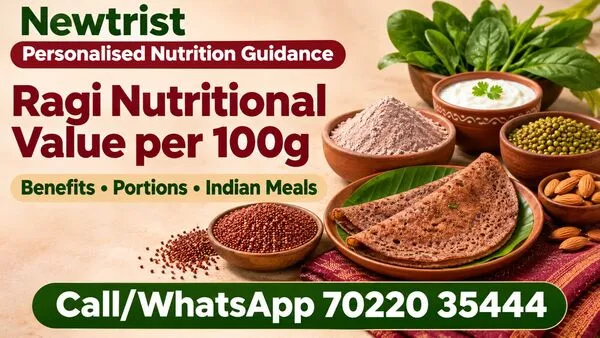
What Is the Nutritional Value of Ragi per 100g?
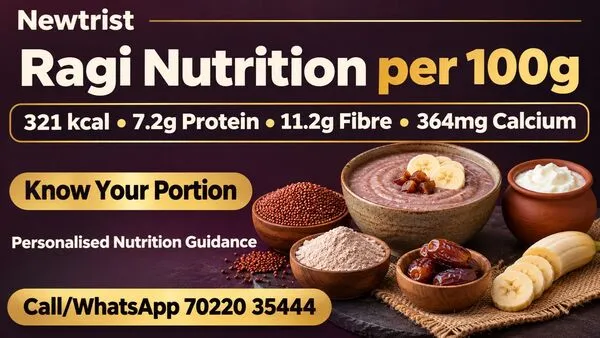
100 g of raw ragi provides approximately 321 kcal, 66.8 g available carbohydrates, 7.2 g protein, 1.9 g fat, 11.2 g dietary fibre and 364 mg calcium.
These values describe the raw edible grain before cooking.
Ragi Nutritional Value per 100g of Raw Grain
| Nutrient | Amount per 100 g |
| Energy | 321 kcal |
| Available carbohydrates | 66.8 g |
| Protein | 7.2 g |
| Total fat | 1.9 g |
| Total dietary fibre | 11.2 g |
| Calcium | 364 mg |
| Iron | 4.6 mg |
| Phosphorus | 210 mg |
| Magnesium | 146 mg |
Values are rounded from Indian food-composition data for raw finger millet. Actual values can vary with the grain variety and processing.
How Many Calories, Carbohydrates and Protein Does Ragi Contain?
Ragi is primarily a carbohydrate-rich cereal.
Its 66.8 g of available carbohydrates per 100 g of raw grain makes it an important source of dietary energy.
However, it is not accurate to describe ragi as a low-calorie grain simply because it is nutritious.
Like rice, wheat and other cereals, its energy contribution depends on the quantity consumed.
Ragi also contains approximately 7.2 g of protein per 100 g. While this contributes to overall protein intake, it does not make ragi a high-protein substitute for foods such as pulses, eggs or dairy products.
For example, ragi dosa served with sambar provides a different nutritional combination from ragi dosa eaten without an accompaniment.
The grain contributes carbohydrates and some protein, while the pulses in sambar contribute additional protein and other nutrients.
How Much Calcium, Iron and Fibre Does Ragi Provide?
The calcium content is one of ragi’s most distinctive nutritional features.
At approximately 364 mg per 100 g of raw grain, ragi contains considerably more calcium than many commonly consumed cereal grains.
It also provides dietary fibre, iron and phosphorus.
However, the mineral content listed in a food-composition table represents the amount present in the grain. The proportion absorbed by the body can vary because factors such as food preparation and naturally occurring compounds affect mineral availability.
This distinction matters when assessing the nutritional contribution of an actual meal rather than relying only on a nutrient label.
What Are the Nutritional Benefits of Ragi?
Ragi offers several nutritional advantages when included as part of a varied Indian eating pattern.
Its most relevant benefits come from the nutrients it contributes, rather than from treating it as a food that independently produces a particular health outcome.
1. Calcium Contributes to Bone and Teeth Nutrition
Calcium is required for maintaining normal bones and teeth. It also contributes to muscle contraction and other physiological functions.
Ragi can contribute meaningfully to dietary calcium intake, particularly in meals where calcium-rich foods are otherwise limited.
For example, combining ragi with curd creates a meal containing calcium from both the grain and a dairy source.
The total contribution depends on the quantities used.
Ragi can therefore form part of a calcium-conscious eating pattern without needing to replace every other calcium-containing food.
2. Dietary Fibre Supports Digestive Function and Fullness
Ragi provides approximately 11.2 g of total dietary fibre per 100 g of raw grain.
Dietary fibre contributes to normal bowel function and can influence how satisfying a meal feels.
However, the fullness experienced after eating ragi also depends on the preparation, portion size and accompaniments.
For example, ragi roti served with vegetable sabzi and dal has a different overall fibre and protein composition from a plain ragi preparation.
Including vegetables and pulses helps create a more varied meal rather than relying on ragi alone for fibre.
3. Ragi Provides Carbohydrates for Daily Energy
Carbohydrates are an important energy source, and ragi contributes them in substantial quantities.
This makes ragi suitable as a cereal component in breakfast, lunch or dinner.
However, replacing another grain with ragi does not automatically reduce the carbohydrate content of a meal.
A preparation made with a large amount of ragi flour may provide more carbohydrate and energy than a smaller serving of another cereal.
The nutritional advantage comes from choosing an appropriate portion and combining it with foods that complement the grain.
How Much Ragi Should You Eat per Serving?
An illustrative ragi portion is 30 to 50 g of raw grain or dry flour used in a preparation. This is a useful range for understanding nutritional quantities, not a fixed recommendation for everyone.
Your actual portion depends on factors such as age, overall cereal intake, physical activity, meal composition and individual nutritional requirements.
What Does a 30g to 50g Raw Ragi Portion Provide?
The following table shows how the nutrients change when different raw quantities are used.
| Nutrient | 30 g raw ragi | 50 g raw ragi |
| Energy | 96 kcal | 161 kcal |
| Available carbohydrates | 20.0 g | 33.4 g |
| Protein | 2.2 g | 3.6 g |
| Dietary fibre | 3.4 g | 5.6 g |
| Calcium | 109 mg | 182 mg |
These values are proportional estimates calculated from the raw-grain composition.
The difference between 30 g and 50 g may appear small when weighing dry flour, but it changes the nutritional contribution of the meal.
This becomes especially relevant when ragi is combined with other grains or included in multiple meals.
Why Are Raw and Cooked Ragi Portions Different?
One of the most common sources of confusion is comparing raw ragi with the final weight of a cooked dish.
Consider a porridge prepared using 40 g of dry ragi flour.
Once cooked, the porridge weighs considerably more because liquid has been added.
However, the amount of ragi originally used remains 40 g.
The nutritional contribution from the grain should therefore be assessed using the original dry quantity, with any additional ingredients counted separately.
The same distinction applies to ragi mudde, dosa and roti.
- Ragi mudde: The final cooked weight includes absorbed water.
- Ragi dosa: The nutritional content depends on how much ragi flour and any other ingredients are used in the batter.
- Ragi roti: The flour quantity provides a more reliable basis for estimating the grain contribution than the cooked roti’s weight.
This is why two ragi dishes of similar cooked weight may provide different amounts of energy, carbohydrate and fibre.
Does the Form of Ragi Affect Its Nutrition?
Ragi can be consumed as whole grain, flour, sprouted grain or fermented preparations.
Although these forms come from the same cereal, processing can affect their composition and the availability of certain nutrients.
Whole Ragi and Ragi Flour
Whole ragi retains the grain’s natural components.
Flour made by grinding the entire grain can retain much of that nutritional composition.
However, flour that has been partially refined or processed to remove parts of the grain may differ in its fibre and mineral content.
This distinction becomes particularly important when evaluating packaged ragi products.
A biscuit or snack containing some ragi flour does not necessarily provide the same nutritional composition as a serving made predominantly from whole ragi.
The amount and form of ragi used determine its contribution.
Sprouted and Fermented Ragi
Sprouting and fermentation can change certain characteristics of ragi.
Research has shown that these processes may reduce some naturally occurring compounds, including phytates, that influence mineral availability.
Such changes may improve the extractability or potential availability of certain minerals, although the extent depends on the processing method.
Traditional fermented ragi dosa batter and preparations using sprouted ragi flour are examples of how these processes can appear in Indian cooking.
Their final nutritional composition still depends on the ingredients and quantities used.
How Can You Include Ragi in Everyday Indian Meals?
Ragi can fit into familiar Indian dishes without requiring a completely different eating pattern.
The most useful approach is to treat it as one cereal option and build a meal around the nutrients it provides.
Ragi Breakfast Options With Balanced Accompaniments
Ragi can be used in dosa, roti and cooked porridge preparations.
The accompaniments can make a meaningful difference to the overall meal.
| Ragi preparation | Suitable accompaniment | What it adds to the meal |
| Ragi dosa | Vegetable sambar | Pulses, vegetables and additional protein |
| Ragi porridge | Milk and a small portion of nuts | Additional protein, calcium and fats |
| Ragi roti | Curd and vegetable sabzi | Protein, vegetables and dietary variety |
These combinations demonstrate why focusing only on the ragi component may not tell you enough about the complete meal.
A ragi preparation may supply the cereal portion, but the other foods help determine the meal’s overall nutritional balance.
Ragi Roti and Mudde for Lunch or Dinner
Ragi is also familiar in traditional main meals, particularly in Karnataka.
Ragi mudde served with soppu saaru or a dal-based vegetable preparation combines the grain with other nutrient-containing foods.
Ragi roti can be accompanied by palak dal, whole moong curry or a mixed vegetable sabzi.
Indian foods such as drumstick leaves, amaranth leaves, green gram and curd can complement these meals by contributing additional vitamins, minerals and protein.
The objective is not to add every nutritious ingredient to one plate. It is to choose combinations that meet the needs of the overall meal.
Sample One-Day Indian Menu Including Ragi
A practical day may include ragi at one meal while retaining a variety of other familiar Indian foods.
| Meal | Menu |
| Breakfast | Ragi dosa prepared using approximately 40 g dry ragi flour, served with vegetable sambar |
| Mid-morning | Guava |
| Lunch | Rice, whole moong dal, palak sabzi and curd |
| Evening snack | A small portion of roasted chana |
| Dinner | Whole-wheat rotis with mixed vegetable curry and paneer |
This example shows how ragi can fit into a varied eating pattern without needing to appear at every meal.
It is an illustration of meal combinations, not a fixed daily prescription. The appropriate quantities of all foods depend on individual requirements.
How Can You Decide Whether Ragi Fits Your Nutritional Needs?
You may already enjoy ragi regularly and feel confident that it is a nutritious choice.
But knowing its nutritional value is only the beginning.
The more individual question is whether the amount you eat and the way you combine it with other foods are appropriate for your needs.
For example, two people may both eat ragi dosa for breakfast.
One prepares it with 30 g of flour, while the other uses 70 g and includes additional ingredients. Their meals can differ considerably in energy and carbohydrate content.
Even if both choose nutritious accompaniments, their individual requirements may not be the same.
This is why a standard instruction to eat a particular quantity of ragi every day may not suit everyone.
Personalised Ragi Portions With Chief Nutritionist Vasanthi Senthilvel
Perhaps you already include ragi in your family’s meals but are unsure how much flour to use, whether it should replace another cereal or what accompaniments would make the meal nutritionally appropriate.
You may not need an entirely new diet.
You may need clarity about how ragi fits into your current eating pattern.
At Newtrist, Chief Nutritionist Vasanthi Senthilvel provides personalised nutrition guidance based on your existing food habits, nutritional requirements, activity, meal preferences and individual goals.
A personalised consultation can help you understand the role of ragi in your meals, assess suitable portions and identify practical combinations using familiar Indian foods.
Instead of following the same serving size as everyone else, you can develop a plan that considers your complete daily intake.
Ragi may already be part of your kitchen. The important next step is knowing how much belongs on your plate and what to serve alongside it.
Book a personalised nutrition consultation with Chief Nutritionist Vasanthi Senthilvel at Newtrist to discuss a nutrition plan tailored to your food preferences and individual requirements.
Frequently Asked Questions
Can You Eat Ragi Every Day?
Yes. Ragi can be included regularly as part of a varied eating pattern. The appropriate frequency and quantity depend on your total cereal intake, meal composition and individual nutritional requirements.
Is Ragi Naturally Gluten-Free?
Yes. Ragi, or finger millet, naturally does not contain gluten. However, ragi products made with wheat or other gluten-containing ingredients have a different composition from pure ragi grain or flour.
Can Ragi Completely Replace Rice or Wheat?
Ragi can replace some cereal servings, but there is no nutritional requirement to eliminate rice or wheat simply to include it. Different cereals contribute varying amounts of nutrients, and dietary variety can remain part of a balanced eating pattern.
Does Adding Jaggery Increase the Nutritional Value of Ragi?
Jaggery adds sugars, energy and small amounts of certain minerals. Adding it changes the overall composition of a ragi preparation, but it does not automatically make the meal more nutritionally balanced. The quantity added matters.
Is Ragi Better at Breakfast or Dinner?
Ragi can be included at either breakfast or dinner. There is no universally preferred time for consuming it. The raw quantity used, preparation, accompaniments and overall daily intake are more important than the time of day.
Author
Chief Nutritionist Vasanthi Senthilvel leads Newtrist Nutritionist Dietitian Dietician, providing personalised diet plans for weight management and clinical nutrition for children, adolescents, adults and families.
She has 21 years of experience in nutrition and has received professional recognition for her work.
- Pride of Bharat Awards 2026: Outstanding Achievement in Holistic Health & Nutrition Innovation
- Doctor of The Year: Nutritionist 2026: Excellence in Clinical Nutrition and Weight Loss.
Her approach considers age, growth, health history, medical conditions, laboratory reports, medication, body composition, weight history, dietary preferences, regional food habits, family routines, activity, sleep and personal health goals. Recommendations are developed according to individual needs rather than using one standard diet for everyone.
Consultations are available in person at Bangalore HSR Layout, Koramangala, Bellandur, Haralur and Electronic City, as well as online across India.
Independent Medical Review Panel
Newtrist health and nutrition articles undergo medical review, where appropriate, by doctors with relevant specialist expertise. The medical professionals listed below contribute to Newtrist’s review process within their respective specialties.
| Speciality | Doctor |
|---|---|
| Endocrinology | Dr Vinay Prasad MBBS, MD, DM |
| Gastroenterology & Hepatology | Dr Sunil kumar N MBBS, MD, DM |
| Gynaecology | Dr Prathiba G MBBS, DNB, FIRM, FMAS |
| Nephrology | Dr Priyashree R MBBS, MD, DNB, DM |