
Written by: Chief Nutritionist Vasanthi Senthilvel
21 years of experience | Newtrist Nutritionist Dietitian Dietician
Best Nutritionist in Bangalore with multiple awards for excellence in clinical nutrition, weight loss, holistic health and nutrition innovation.
Medically reviewed by: Dr Prathiba G MBBS, DNB, FIRM, FMAS | Dr Sunil kumar N MBBS, MD, DM | Dr Vinay Prasad MBBS, MD, DM
Medical Disclaimer: Nutritional needs vary based on an individual’s profile. The information on this page is for general educational purposes only and is not intended to replace personalised medical or nutrition care.
You have prepared paneer bhurji and served yourself a generous portion. But was that 50g of paneer or closer to 150g?
Once paneer is crumbled or mixed into a dish, the difference is difficult to judge. Even when you use exactly 100g, the nutritional value can vary depending on the paneer you buy.
That is why understanding paneer nutrition starts with two details: the type of paneer and the quantity you actually eat.
Key Takeaway
100g of Amul Fresh Paneer provides approximately 20g protein, 312 calories, 24g fat and 480mg calcium. These are reference values for one regular full-fat paneer product, not universal values for every paneer variety.
For accurate nutrition calculations, use the nutritional information of your chosen paneer and the weight of your serving.
Table of Contents

Paneer Nutrition per 100g: Complete Nutritional Value
Paneer provides concentrated milk protein, fat, calcium and relatively small amounts of carbohydrates.
The following nutritional information is based on Amul Fresh Paneer.
| Nutrient | Amount per 100g |
| Calories | 312 kcal |
| Protein | 20g |
| Total fat | 24g |
| Saturated fat | 14.4g |
| Carbohydrates | 4g |
| Calcium | 480mg |
| Sodium | 24mg |
| Cholesterol | 70mg |
These values are approximate and specific to Amul Fresh Paneer. Other brands and homemade preparations may differ.
What Does Paneer’s Nutritional Profile Tell You?
Paneer contains milk protein, predominantly casein, which contributes to normal tissue maintenance and repair, including muscle maintenance.
It also supplies calcium, which supports bone and tooth maintenance, muscle function and nerve signalling.
Regular full-fat paneer contains substantial fat, including saturated fat. Since fat provides approximately 9 calories per gram, it contributes a significant share of paneer’s total energy.
Consequently, paneer’s nutritional contribution is best understood through its complete nutrient composition rather than protein content alone.
Paneer Protein, Calories and Fat by Portion Size: 50g to 250g
The amount of protein, calories and fat you obtain from a particular paneer product depends on the weight of your serving.
| Paneer quantity | Protein | Calories | Total fat |
| 50g | 10g | 156 kcal | 12g |
| 100g | 20g | 312 kcal | 24g |
| 150g | 30g | 468 kcal | 36g |
| 200g | 40g | 624 kcal | 48g |
| 250g | 50g | 780 kcal | 60g |
Values are calculated from the Amul Fresh Paneer reference above. They represent plain paneer without additional cooking ingredients.
What Do These Portion Differences Mean?
Imagine preparing paneer bhurji from a 200g block.
If you share the preparation equally between two people, each receives approximately 100g of paneer, provided it is distributed evenly.
If you eat the entire preparation yourself, you receive the nutritional contribution of the full block.
Knowing the original weight is therefore more dependable than estimating the serving from how much food appears on your plate.

How to Calculate Nutrition for Your Actual Paneer Serving
Your portion may not always weigh exactly 50g or 100g.
Perhaps you use 75g of paneer at breakfast or divide a larger block between several family members.
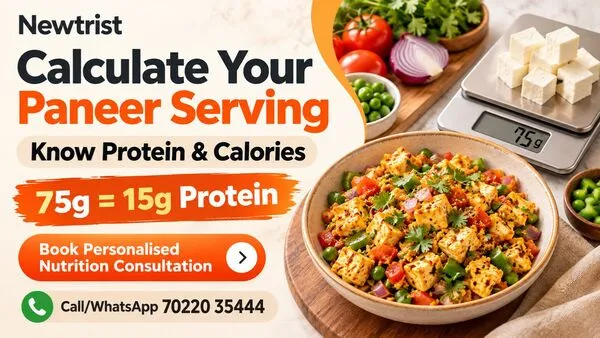
You can calculate the nutritional contribution of any quantity using the product’s values per 100g.
Nutrient in your portion = Nutrient per 100g × Portion weight ÷ 100
For example, a 75g serving of the regular full-fat paneer used in this article provides approximately:
| Nutrient | Amount in 75g |
| Protein | 15g |
| Calories | 234 kcal |
| Total fat | 18g |
Use the same calculation for other portion sizes, substituting the nutritional values of your own paneer.
How Much Does One Paneer Cube Weigh?
There is no universal weight for a paneer cube.
A small cube used in a vegetable preparation may weigh considerably less than a thick piece prepared for paneer tikka.
Counting cubes can therefore lead to inaccurate nutrition estimates.
A kitchen scale provides a more reliable measurement. You can also divide a packaged paneer block into equal portions based on its declared weight.
For instance, dividing a 200g block into four equal parts gives approximately 50g in each portion.
Should You Weigh Paneer Before or After Cooking?
Weighing plain paneer before cooking is generally the simplest method when using nutritional information from its package.
Heating can change paneer’s moisture content and final weight without creating additional protein.
The other ingredients in the preparation also influence its nutritional value.
For example, palak paneer includes spinach, while methi paneer contains fenugreek leaves. Added cooking fat and other ingredients also contribute to the nutritional composition of the completed dish.
To calculate the protein supplied specifically by paneer, measure the plain paneer separately from the other ingredients.
Why Does Paneer Protein Content Vary Between Products?
You may notice that one paneer packet declares 18g protein per 100g, while another declares 20g or more.
Both values can be valid because paneer’s nutritional composition depends on its preparation.
Milk Composition
Paneer may be prepared using whole milk or milk with reduced fat content.
Cow’s milk and buffalo’s milk also differ naturally in composition, influencing the nutrients retained in the finished paneer.
Moisture Content
Water contributes to paneer’s weight without providing protein or calories.
A softer paneer with more retained moisture may therefore contain less protein per 100g than a firmer, more thoroughly pressed paneer.
Homemade Paneer
The nutritional composition of homemade paneer depends on the milk used, how thoroughly the curds are drained and the final quantity produced.
The values printed on a packaged paneer product should not automatically be applied to homemade preparations.
If you regularly make paneer at home, the milk composition and final paneer yield are useful details for estimating its nutritional value.

How Much Paneer Should You Actually Eat in a Meal?
Suppose you regularly include paneer in lunch.
You may be eating 100g because it is convenient, increasing the quantity because you want more protein or considering low-fat paneer to reduce calorie intake.
But is changing your current portion necessary?
That depends on your individual nutritional requirements and what your other meals already provide.
Consider three factors before making a change.
Your current protein intake: How much protein are you obtaining from your usual meals?
Your energy requirements: Does the calorie contribution of your paneer serving fit your nutritional needs?
Your choice of paneer: Would a different paneer variety provide a more appropriate balance of protein and fat?
Age, body size, activity level, health considerations and everyday food habits can influence these decisions.
For someone who enjoys paneer bhurji, palak paneer or other familiar preparations, the solution may not involve replacing those foods.
It may simply involve choosing an appropriate portion or paneer variety.
There is no universal serving size that works equally well for everyone.

Frequently Asked Questions About Paneer Nutrition
Is Paneer a Complete Protein?
Yes. Paneer contains all nine essential amino acids that the human body cannot produce on its own. It is therefore considered a complete protein source.
Is Paneer Completely Lactose-Free?
No. Paneer generally contains less lactose than milk because some lactose is removed with the whey during preparation. However, residual lactose may remain, and individual tolerance varies.
Does Paneer Contain Dietary Fibre?
Plain paneer contains negligible dietary fibre because it is made from milk. It is not a meaningful source of dietary fibre.
What Does Drained Weight Mean on a Paneer Tin?
Some paneer varieties are packaged in liquid or brine.
Drained weight refers to the weight of the paneer after the packing liquid has been removed. For accurate portion calculations, check whether the package specifies both net weight and drained weight and follow the nutritional serving information.
You Know What Your Paneer Contains. Is Your Portion Right for You?
You now know how to calculate the protein, calories and fat in your usual paneer serving.
But what if you are still uncertain whether that quantity is appropriate for your nutritional requirements?
Perhaps you regularly eat paneer but do not know whether your total protein intake is adequate. You may have increased your serving without knowing whether the additional calories are necessary.
Or you may have switched to a different paneer variety without being certain that the change is appropriate for your meals.
Those decisions become clearer when your everyday dietary intake is considered as a whole.
Get Personalised Nutrition Guidance With Chief Nutritionist Vasanthi Senthilvel
At Newtrist Nutritionist Dietitian Dietician, Chief Nutritionist Vasanthi Senthilvel provides personalised nutrition guidance based on individual nutritional requirements, food habits, health considerations and daily routines.
A personalised assessment can help you understand how the paneer you already eat contributes to your overall protein and energy intake.
For a more useful consultation, bring a photograph of your regular paneer’s nutrition label, an estimate of your usual serving size and details of your typical daily meals.
These details can help Vasanthi assess your existing intake and identify whether adjusting your paneer portions or choosing a different variety would be beneficial.
You may discover that the amount you currently eat already suits your needs, or that a practical adjustment would be more appropriate.
The objective is not to prescribe the same paneer quantity to everyone. It is to provide personalised dietary guidance that fits the foods you enjoy and your individual nutritional requirements.
If you know what your paneer serving contains but are uncertain whether the quantity is right for you, arrange a personalised nutrition consultation with Chief Nutritionist Vasanthi Senthilvel.
Enquire About a Personalised Nutrition Consultation With Chief Nutritionist Vasanthi Senthilvel
Consultations are available in person in Bangalore and online across India.
Author
Chief Nutritionist Vasanthi Senthilvel leads Newtrist Nutritionist Dietitian Dietician, providing personalised diet plans for weight management and clinical nutrition for children, adolescents, adults and families.
She has 21 years of experience in nutrition and has received professional recognition for her work.
- Pride of Bharat Awards 2026: Outstanding Achievement in Holistic Health & Nutrition Innovation
- Doctor of The Year: Nutritionist 2026: Excellence in Clinical Nutrition and Weight Loss.
Her approach considers age, growth, health history, medical conditions, laboratory reports, medication, body composition, weight history, dietary preferences, regional food habits, family routines, activity, sleep and personal health goals. Recommendations are developed according to individual needs rather than using one standard diet for everyone.
Consultations are available in person at Bangalore HSR Layout, Koramangala, Bellandur, Haralur and Electronic City, as well as online across India.
Independent Medical Review Panel
Newtrist health and nutrition articles undergo medical review, where appropriate, by doctors with relevant specialist expertise. The medical professionals listed below contribute to Newtrist’s review process within their respective specialties.
| Speciality | Doctor |
|---|---|
| Endocrinology | Dr Vinay Prasad MBBS, MD, DM |
| Gastroenterology & Hepatology | Dr Sunil kumar N MBBS, MD, DM |
| Gynaecology | Dr Prathiba G MBBS, DNB, FIRM, FMAS |
| Nephrology | Dr Priyashree R MBBS, MD, DNB, DM |