
Written by: Chief Nutritionist Vasanthi Senthilvel
21 years of experience | Newtrist Nutritionist Dietitian Dietician
Best Nutritionist in Bangalore with multiple awards for excellence in clinical nutrition, weight loss, holistic health and nutrition innovation.
Medically reviewed by: Dr Prathiba G MBBS, DNB, FIRM, FMAS | Dr Sunil kumar N MBBS, MD, DM | Dr Vinay Prasad MBBS, MD, DM
Medical Disclaimer: Nutritional needs vary based on an individual’s profile. The information on this page is for general educational purposes only and is not intended to replace personalised medical or nutrition care.
Having PCOS and hypothyroidism together can make diet advice harder to use, not because there is too little information, but because there is too much of it.
One recommendation tells you to change your carbohydrates. Another makes you question a familiar food. A third gives you a completely different diet chart. Soon, you may be following rules from several places without knowing which ones actually matter for you.
A diet for PCOS and hypothyroidism should make this simpler.
The goal is not to combine every PCOS recommendation with every hypothyroidism recommendation. It is to decide which nutrition priorities matter when both conditions are part of the same picture and then organise your food around those priorities.
Key takeaway: A diet for PCOS and hypothyroidism should be one coordinated eating approach, not two separate diets followed together. The most useful plan identifies the priorities relevant to your current eating pattern, weight goals and routine, then adjusts meals without adding restrictions that have no clear purpose.
Table of Contents
What Changes When You Have PCOS and Hypothyroidism Together?
The biggest change is not the food list. It is how decisions need to be made.
When dietary advice is considered separately for each condition, several recommendations can appear equally important. But in everyday life, you cannot give the same attention to everything at once.
Suppose you are dealing with evening hunger, trying to manage weight and also wondering whether several familiar foods need to be avoided.
Those are three different concerns.
Trying to solve all three by following a stricter diet may make eating more difficult without identifying what is actually causing the problem.
A combined approach therefore starts by establishing a hierarchy.
- What is causing the greatest difficulty now?
- Is the problem related to meal structure, quantity, food choice or consistency?
- Is advice from the two conditions overlapping?
- Is a restriction solving a real problem or simply adding another rule?
That is the central difference between managing the conditions together and following two separate diet charts.
Newtrist covers condition-specific nutrition separately in its PCOS diet plan and hypothyroidism diet guide. This page focuses only on the decisions that arise when both need to be considered at the same time.
How Do You Decide Which Diet Advice Actually Applies to You?
Use the purpose of the recommendation rather than the diagnosis as your starting point.
A simple four-step process can help.
1. Identify the problem the advice is meant to address
Before changing a food, ask what the recommendation is supposed to achieve.
Is it intended to:
- make a meal more satisfying?
- improve the quality of the overall diet?
- address excessive intake?
- make eating more consistent?
- support a weight-management goal?
- solve an individual food-related concern?
Once the purpose is clear, you can judge whether the recommendation is relevant to your situation.
2. Check whether the same goal is already being addressed elsewhere
Two recommendations can sound different while trying to accomplish the same thing.
You may not need two separate dietary changes if one practical adjustment already addresses the underlying issue.
This is where combining the thinking, rather than combining two diet charts, becomes useful.
3. Look at what the change would do to the rest of your diet
Food decisions do not happen in isolation.
Removing one familiar food may affect meal variety, convenience, family cooking or how satisfying the meal becomes.
The whole diet therefore matters more than whether an individual food appears on a general list.
4. Decide whether the question can actually be answered generally
Some decisions cannot be made from a diagnosis alone.
The appropriate quantity of food, distribution across the day and the best adjustment for a particular eating pattern depend on the individual.
That is where general advice ends and personalisation begins.
Do You Need More Food Restrictions When You Have Both Conditions?
No. PCOS and hypothyroidism occurring together do not automatically require more foods to be removed.
This is important because restrictions can accumulate without anyone deliberately designing the final diet.
You may remove one food after reading about PCOS, another after reading about hypothyroidism and eventually discover that normal meals have become difficult to organise.
Before excluding a food, ask one question:
What specific problem will removing this food solve for me?
If the answer is unclear, the restriction deserves closer examination.
Rice, roti, fruit, dairy foods and other familiar foods should not automatically become unsuitable simply because you have both conditions.
A combined diet should become more purposeful, not more restrictive.
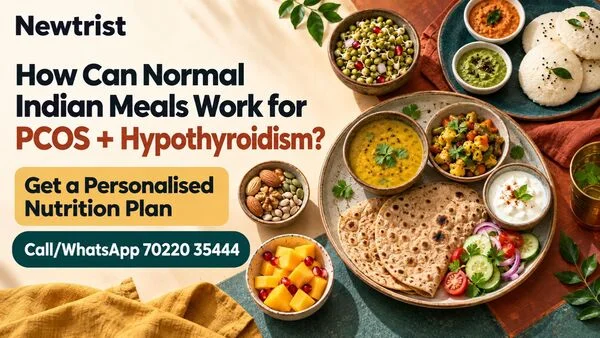
How Can Normal Indian Meals Work for PCOS and Hypothyroidism Together?
Start with the meal you already eat and assess how well it works.
You do not need separate “PCOS foods” and “thyroid foods” on the plate.
Take a familiar rice-based lunch.
Instead of immediately replacing the rice, consider the entire meal.
- Does it include a suitable protein-containing food?
- Are vegetables part of the meal?
- Is the quantity appropriate for the person eating it?
- Does the meal leave you reasonably satisfied?
- Does it fit with what you eat during the rest of the day?
The same approach can be applied to roti, dosa, idli, millet preparations and regional staples.
This matters for another reason: most people do not eat independently of their family, work schedule or culture.
A diet is much easier to sustain when familiar meals can be adapted instead of replaced unnecessarily.
What Can a 1-Day Diet for PCOS and Hypothyroidism Look Like?
The following sample shows how familiar Indian foods could be arranged within one day.
It illustrates a meal pattern. It does not prescribe the correct portions, timing or foods for every person.
Sample 1-Day Diet Plan
| Meal | Menu |
|---|---|
| Breakfast | Moong dal chilla with vegetable filling and plain curd |
| Mid-morning | Seasonal whole fruit |
| Lunch | Rice with sambar, vegetable poriyal and an additional protein food according to preference |
| Evening snack | Roasted chana with cucumber and tomato |
| Dinner | Chapati with mixed vegetables and paneer, egg, fish, chicken or another suitable protein choice |
The value of this example is its simplicity.
There is no separate breakfast for PCOS and another for hypothyroidism. The foods remain recognisable, and the day is organised as one eating pattern.
However, the sample cannot answer the questions that often matter most:
How much should you eat?
Do you need all five eating occasions?
Should breakfast be larger for your schedule?
How should portions change if weight management is a goal?
What should replace a food you do not eat?
How should the plan work on office days, travel days or weekends?
Those answers depend on the person, not on the name of the diet.
What If Weight Management Is Your Main Goal?
If weight management is appropriate for you, the first step is not automatically to reduce every meal.
Instead, identify where the current eating pattern is creating the greatest opportunity for improvement.
Large portions: The structure of the meals may already be reasonable, while quantities need closer attention.
Frequent unplanned eating: The issue may be what happens between planned meals rather than the meals themselves.
Strong evening hunger: Earlier eating may need attention before trying to restrict dinner further.
Different weekday and weekend patterns: Consistency may matter more than introducing new foods.
These situations require different solutions.
This is why weight management with PCOS and hypothyroidism is better approached through the individual’s actual eating behaviour than through a standard “PCOS thyroid weight-loss diet”.
What Should You Do When PCOS and Thyroid Diet Advice Conflicts?
When two recommendations appear to disagree, do not automatically follow the stricter one.
Instead, compare their purpose.
Ask:
What is each recommendation trying to achieve?
Then ask:
Is that goal relevant to me?
If both recommendations address the same underlying issue, one practical change may be enough.
If one recommendation creates significant restriction, consider whether there is a clear individual reason for it.
And if resolving the conflict depends on your quantities, eating pattern, goals or wider nutritional situation, the answer is no longer something a general food list can reliably provide.
This approach prevents conflicting information from turning into conflicting meals.
When Has a Generic PCOS Thyroid Diet Plan Reached Its Limit?
A general article or sample chart is useful when your question is:
“What could eating with both conditions look like?”
It reaches its limit when your questions become:
“How much should I eat?”
“Which issue should I address first?”
“Why am I hungry despite following the plan?”
“Which food restriction is actually necessary for me?”
“How should my meals change for my weight goal?”
“How can I make this work with the food cooked at home?”
At this point, you do not necessarily need more general information.
You need the information you already have to be applied to your situation.
What Does a Personalised Diet Add?
A generic diet chart gives examples of meals.
A personalised diet answers the decisions the chart cannot make.
Chief Nutritionist Vasanthi Senthilvel can assess your current eating pattern, appetite, usual foods, dietary preferences, work routine, weight history, goals and relevant clinical nutrition context together.
This can help determine:
- where your diet actually needs attention
- appropriate quantities for your needs
- how food should be distributed through your day
- which existing meals can continue
- which changes are worth prioritising
- how familiar Indian food can be adapted
- whether some restrictions are unnecessary
- how weight management should be incorporated when relevant
The purpose of personalisation is not to produce a more complicated diet.
It is to remove guesswork from the decisions that matter.
If you need this level of individual planning, you can explore Newtrist’s personalised clinical nutrition service.
Frequently Asked Questions
Can a vegetarian diet work when I have both PCOS and hypothyroidism?
Yes. A vegetarian diet can be planned around both conditions. What matters is whether the overall eating pattern meets the person’s nutritional requirements and food preferences rather than whether the diet contains non-vegetarian foods.
Do I need fixed meal timings every day?
Not necessarily. Meal timing should provide enough structure to work for you without becoming unrealistic. Someone with predictable working hours may use a different pattern from someone working shifts or travelling frequently.
Can I eat outside the home while following this type of diet?
Yes. An appropriate eating pattern should be able to accommodate occasional meals outside the home. The useful skill is knowing how to make a reasonable choice when the usual home meal is unavailable rather than trying to reproduce a diet chart exactly.
Does having PCOS and hypothyroidism mean I should lose weight?
No. Weight loss is not automatically the appropriate goal for everyone with both conditions. The nutrition goal should be based on the individual’s needs rather than assumed from the diagnoses.
Can my diet change even though I still have the same two conditions?
Yes. Your eating plan may need adjustment when your routine, appetite, activity, food preferences, weight goals or nutritional needs change. The diagnoses can remain the same while the practical diet that suits you changes.
Need a Diet Planned Around PCOS and Hypothyroidism Together?
You can find endless lists telling you what somebody with PCOS or hypothyroidism should eat.
What those lists cannot tell you is what you should change first.
That depends on how you currently eat, where you struggle, what your goals are and which advice is actually relevant to you.
Chief Nutritionist Vasanthi Senthilvel can assess those factors together and develop a personalised diet plan around both PCOS and hypothyroidism.
Instead of adding another set of food rules, the aim is to give you clarity about your own diet: what needs adjusting, how much, and how it can fit into your everyday life.
Author
Chief Nutritionist Vasanthi Senthilvel leads Newtrist Nutritionist Dietitian Dietician, providing personalised diet plans for weight management and clinical nutrition for children, adolescents, adults and families.
She has 21 years of experience in nutrition and has received professional recognition for her work.
- Pride of Bharat Awards 2026: Outstanding Achievement in Holistic Health & Nutrition Innovation
- Doctor of The Year: Nutritionist 2026: Excellence in Clinical Nutrition and Weight Loss.
Her approach considers age, growth, health history, medical conditions, laboratory reports, medication, body composition, weight history, dietary preferences, regional food habits, family routines, activity, sleep and personal health goals. Recommendations are developed according to individual needs rather than using one standard diet for everyone.
Consultations are available in person at Bangalore HSR Layout, Koramangala, Bellandur, Haralur and Electronic City, as well as online across India.
Independent Medical Review Panel
Newtrist health and nutrition articles undergo medical review, where appropriate, by doctors with relevant specialist expertise. The medical professionals listed below contribute to Newtrist’s review process within their respective specialties.
| Speciality | Doctor |
|---|---|
| Endocrinology | Dr Vinay Prasad MBBS, MD, DM |
| Gastroenterology & Hepatology | Dr Sunil kumar N MBBS, MD, DM |
| Gynaecology | Dr Prathiba G MBBS, DNB, FIRM, FMAS |
| Nephrology | Dr Priyashree R MBBS, MD, DNB, DM |