
Written by: Chief Nutritionist Vasanthi Senthilvel
21 years of experience | Newtrist Nutritionist Dietitian Dietician
Best Nutritionist in Bangalore with multiple awards for excellence in clinical nutrition, weight loss, holistic health and nutrition innovation.
Medically reviewed by: Dr Prathiba G MBBS, DNB, FIRM, FMAS | Dr Sunil kumar N MBBS, MD, DM | Dr Vinay Prasad MBBS, MD, DM
Medical Disclaimer: Nutritional needs vary based on an individual’s profile. The information on this page is for general educational purposes only and is not intended to replace personalised medical or nutrition care.
A low purine diet for gout becomes confusing when every food containing purines is treated as a problem. One list warns against meat and seafood, another adds dal and beans, and another tells you to avoid vegetables such as spinach or cauliflower.
The result is often more restriction, not more clarity.
A better gout diet starts by separating foods that contribute a high purine load from foods that can still form part of balanced everyday meals. Once that distinction is clear, eating becomes much easier to manage without cutting out nutritious foods unnecessarily.
Key takeaway: A low purine diet for gout mainly limits concentrated sources of purines while keeping a varied intake of vegetables, fruits, grains, dairy and suitable protein foods. Dal and certain vegetables do not need to be treated like high-purine animal foods. The exact foods and quantities should still fit the person’s usual diet, nutritional needs and other health conditions.
Table of Contents

What Is a Low Purine Diet for Gout?
A low purine diet reduces foods that contribute a relatively large amount of purines rather than trying to eliminate purines completely.
Purines are natural substances present in the body and in many foods. When they are broken down, uric acid is produced. In people susceptible to gout, urate crystals can accumulate around joints and contribute to painful inflammation.
What matters nutritionally is that purine content and purine source are not the same across foods.
This is why organ meat, dal and spinach should not all be treated as equivalent simply because each contains purines.
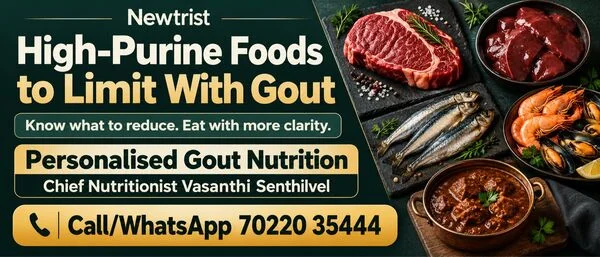
Which High-Purine Foods Should Be Limited With Gout?
The foods that deserve the greatest attention are concentrated sources of purines, particularly certain animal foods.
| Food category | Examples | Practical approach |
| Organ meats | Liver, kidney and other organ meats | Generally avoid as regular foods |
| Concentrated meat products | Meat extracts and rich meat gravies | Keep out of the regular diet |
| Red meat | Mutton, lamb, beef and pork | Limit quantity and frequency |
| Poultry | Chicken and similar meats | Include selectively rather than freely |
| Higher-purine fish | Sardines, anchovies and certain other fish | Limit higher-purine varieties |
| Certain shellfish | Mussels, scallops and some other seafood | Limit higher-purine choices |
The degree of restriction should reflect what the person actually eats.
Someone having meat several times a day has a very different starting point from someone who eats non-vegetarian food once or twice a week. A useful diet therefore changes the foods making the greatest contribution rather than applying the same restrictions to everyone.
Why organ meats need particular attention
Organ meats are among the most concentrated dietary sources of purines.
Because protein and micronutrients can be obtained from many other foods, there is little reason to make organ meats a routine part of a gout-focused diet.
Can chicken be eaten with gout?
Chicken can be included by many people with gout, but it should not be considered an unlimited replacement for red meat.
Its place in the diet depends on quantity, frequency and what other protein foods are eaten during the day.
Can fish and seafood be included?
Some fish and seafood are considerably higher in purines than others.
If fish forms an important part of the person’s normal diet, choosing appropriate varieties and frequency is more practical than eliminating every type of fish.
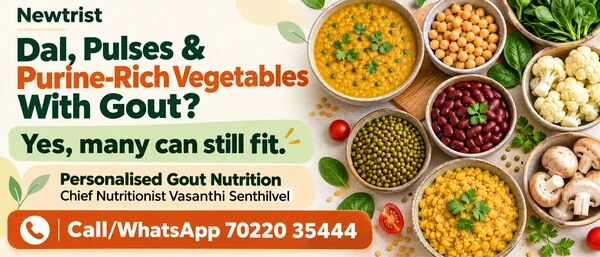
Can You Eat Dal, Pulses and Purine-Rich Vegetables With Gout?
Yes, these foods can often remain in the diet. Plant purines do not need to be managed in exactly the same way as concentrated animal purines.
This distinction is particularly useful in Indian diets, where pulses and vegetables may provide a large share of daily nutrition.
Dal, chickpeas, rajma and other pulses
Dal, chickpeas, rajma and other legumes contain purines, but they also provide plant protein, fibre, iron and other nutrients.
For vegetarians, removing them indiscriminately can make meal planning much more difficult.
The useful question is not simply whether a pulse contains purines. It is how much is eaten, what other protein foods are present and whether the total diet remains nutritionally balanced.
Spinach, cauliflower, mushrooms and other vegetables
Some vegetables appear on lists of purine-containing foods, which can make people reluctant to eat them.
They still contribute fibre, vitamins, minerals and a wide range of beneficial plant compounds. For most people with gout, routinely removing these vegetables provides little practical advantage and can unnecessarily reduce dietary variety.
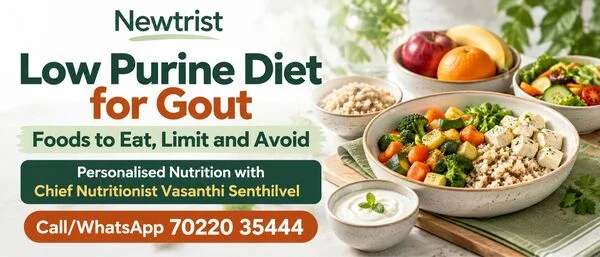
What Foods Can You Eat on a Low Purine Diet?
A low purine diet can still be built around familiar, everyday foods.
The goal is to create meals with enough variety, protein and fibre while keeping the higher-purine choices under control.
Vegetables and fruits
A wide range of vegetables can be used across meals, including bottle gourd, ridge gourd, carrot, capsicum, cucumber, brinjal, cabbage, beans and leafy vegetables.
Whole fruits such as guava, apple, orange, papaya, pear and other seasonal fruits can also be included according to individual requirements.
There is no need to depend heavily on one particular fruit because it is promoted as being “good for gout”.
Rice, chapati, oats and other grains
Rice, wheat, oats, millets and similar grain foods can form part of a gout diet.
Having gout does not automatically mean rice or chapati needs to be removed.
The suitable quantity depends on the person’s overall diet and nutritional goals rather than purine content alone.
Milk and curd
Milk and curd are low in purines and can provide protein, calcium and other nutrients.
They are especially useful when someone is reducing higher-purine animal protein foods and needs other practical protein choices.
Eggs
Eggs are low in purines and can be included by people who eat them.
They can help add protein variety without depending heavily on meat or seafood.
Nuts and seeds
Nuts and seeds contribute healthy fats, protein and micronutrients.
They can be included according to nutritional requirements, but they should be viewed as ordinary nutritious foods rather than as a treatment for gout.

Sample 1-Day Low Purine Diet for Gout
This sample shows how common Indian foods can fit together in a lower-purine eating pattern.
It is an example of meal structure, not a personalised diet prescription.
| Meal | Menu |
| Breakfast | Vegetable oats upma with plain curd |
| Mid-morning | Guava or another seasonal whole fruit |
| Lunch | Rice or chapati with bottle gourd or bhindi sabzi, moong dal and curd |
| Evening | Unsalted nuts with a whole fruit |
| Dinner | Chapati with mixed vegetables and paneer |
The important point is not to copy these exact foods every day.
The sample shows that a gout diet can still contain grains, dal, vegetables, dairy, fruit and protein without becoming excessively restrictive.
What a generic example cannot tell you is how much of each food you need.
Those quantities depend on body size, activity, appetite, food preferences, nutritional goals and other health conditions.
How Do You Turn Low-Purine Advice Into Normal Meals?
Knowing individual foods is only the first step. The harder part is building meals that work throughout the day.
For example, reducing meat may be sensible, but simply removing it can leave lunch or dinner with very little protein. A vegetarian who cuts out several pulses may face the same problem.
A practical diet therefore needs to answer four questions:
- What should be reduced?
- What will replace it nutritionally?
- How should protein be distributed across meals?
- Can the resulting pattern work with normal home and family food?
This is where a generic list of foods to avoid with gout has limited value.
The diet needs to work as a complete eating pattern, not as a collection of isolated “allowed” and “not allowed” foods.
When Does a Gout Diet Need to Be Personalised?
A food list can tell you which categories usually need attention. It cannot tell you what should change in your meals.
Personalised planning becomes more useful when gout exists alongside kidney-related dietary restrictions, diabetes, digestive concerns, vegetarian or vegan eating, weight-related goals, difficulty meeting protein needs or multiple existing food restrictions.
It is also valuable when a person has already stopped several foods but remains uncertain about whether those restrictions are necessary.
Chief Nutritionist Vasanthi Senthilvel can provide personalised clinical nutrition by reviewing the person’s existing meals, protein sources, food preferences, restrictions and nutritional requirements before developing a personalised diet plan.
The aim is to answer questions that a standard gout chart cannot resolve:
- Which foods do I actually need to limit?
- Which can I continue eating?
- What should replace the foods I reduce?
- What quantities are appropriate for me?
That makes personalised nutrition useful not because the person needs more restrictions, but because they need fewer assumptions and more precise decisions.
Frequently Asked Questions
Are tomatoes bad for gout?
Tomatoes do not need to be routinely removed from a gout diet. If someone consistently notices a personal association with a particular food, it can be reviewed within the context of their complete eating pattern rather than assumed to apply to everyone.
Can I eat idli and dosa if I have gout?
Yes. Idli and dosa can generally fit into a gout diet. What matters more is the complete meal, including accompaniments and protein balance, rather than treating the basic food itself as unsuitable.
Can tofu and soy foods be included in a low purine diet?
Soy foods contain plant purines, but they do not need to be managed like concentrated high-purine animal foods. They can be useful protein options, especially in vegetarian diets, when incorporated appropriately.
Do Indian spices need to be restricted for gout?
Common culinary spices do not need to be avoided simply because someone has gout. Normal seasoning can help make the diet enjoyable and sustainable without creating a bland or unnecessarily restricted meal pattern.
Can I eat restaurant food if I have gout?
Yes, but restaurant dishes can make the quantity of meat, seafood and concentrated gravies harder to judge. Choosing simpler dishes and understanding which food categories need greater attention is more practical than avoiding restaurant meals altogether.
Does everyone in the family need to eat a separate gout diet?
Usually not. Many family meals can remain the same, with specific protein choices or individual portions adjusted where necessary. A practical gout diet should fit household eating as far as possible instead of requiring a completely separate menu every day.
Author
Chief Nutritionist Vasanthi Senthilvel leads Newtrist Nutritionist Dietitian Dietician, providing personalised diet plans for weight management and clinical nutrition for children, adolescents, adults and families.
She has 21 years of experience in nutrition and has received professional recognition for her work.
- Pride of Bharat Awards 2026: Outstanding Achievement in Holistic Health & Nutrition Innovation
- Doctor of The Year: Nutritionist 2026: Excellence in Clinical Nutrition and Weight Loss.
Her approach considers age, growth, health history, medical conditions, laboratory reports, medication, body composition, weight history, dietary preferences, regional food habits, family routines, activity, sleep and personal health goals. Recommendations are developed according to individual needs rather than using one standard diet for everyone.
Consultations are available in person at Bangalore HSR Layout, Koramangala, Bellandur, Haralur and Electronic City, as well as online across India.
Independent Medical Review Panel
Newtrist health and nutrition articles undergo medical review, where appropriate, by doctors with relevant specialist expertise. The medical professionals listed below contribute to Newtrist’s review process within their respective specialties.
| Speciality | Doctor |
|---|---|
| Endocrinology | Dr Vinay Prasad MBBS, MD, DM |
| Gastroenterology & Hepatology | Dr Sunil kumar N MBBS, MD, DM |
| Gynaecology | Dr Prathiba G MBBS, DNB, FIRM, FMAS |
| Nephrology | Dr Priyashree R MBBS, MD, DNB, DM |