
Written by: Chief Nutritionist Vasanthi Senthilvel
21 years of experience | Newtrist Nutritionist Dietitian Dietician
Best Nutritionist in Bangalore with multiple awards for excellence in clinical nutrition, weight loss, holistic health and nutrition innovation.
Medically reviewed by: Dr Prathiba G MBBS, DNB, FIRM, FMAS | Dr Sunil kumar N MBBS, MD, DM | Dr Vinay Prasad MBBS, MD, DM
Medical Disclaimer: Nutritional needs vary based on an individual’s profile. The information on this page is for general educational purposes only and is not intended to replace personalised medical or nutrition care.
Ragi for calcium. Bajra for minerals. Foxtail millet for protein and fibre. Kodo millet for another grain choice. When every millet comes with a different nutritional reason to eat it, choosing one can quickly become more complicated than it needs to be.
Understanding the different types of millets in India is more useful than searching for one universally “healthiest” millet. Each grain has its own nutritional characteristics, but the right choice ultimately depends on what your current diet provides, what foods you enjoy and what you are actually trying to improve.
Key takeaway: There is no single millet that is best for everyone. Different millets provide different combinations of carbohydrates, plant protein, fibre and micronutrients. The most useful millet is one that complements your existing diet, nutritional priorities, food preferences and individual requirements.
Table of Contents

What Are Millets?
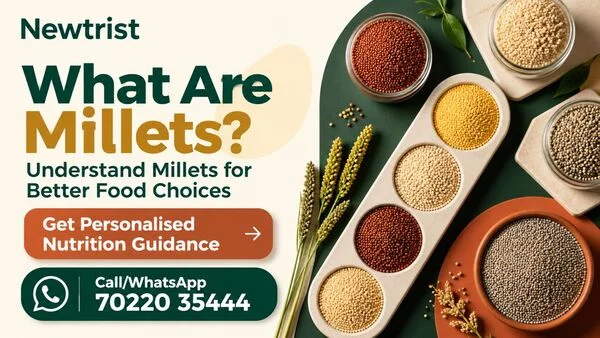
Millets are a group of cereal grains, not one individual grain.
Pearl millet, finger millet, foxtail millet, kodo millet, little millet, barnyard millet and proso millet are different grains with their own nutritional profiles and culinary uses.
This distinction matters because the advice to simply “eat millet” does not tell you very much.
Knowing which millet you are choosing, why you are choosing it and how it fits into the rest of your meal makes that decision far more useful.
What Are the Different Types of Millets in India?
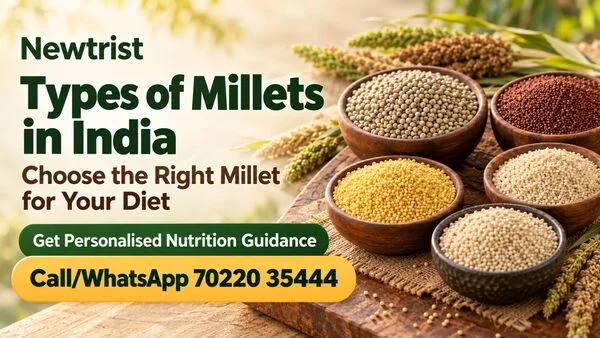
India has several millet varieties, and their names, popularity and traditional uses vary across regions.
| Millet | Common Indian Name | Nutritional Characteristic to Know | Common Culinary Form |
| Pearl millet | Bajra | Notable for plant protein and minerals including iron and zinc | Flour, roti, bhakri and grain preparations |
| Finger millet | Ragi | Particularly recognised for its calcium content | Flour, dosa, roti, porridge and traditional preparations |
| Foxtail millet | Kangni, Kakum, Thinai | Provides cereal carbohydrates together with protein and fibre | Cooked grain and millet-based foods |
| Kodo millet | Kodon, Kodra, Varagu | Fibre-containing small millet with a distinct grain profile | Cooked grain and regional preparations |
| Little millet | Kutki, Samai | Provides carbohydrate, fibre and naturally occurring micronutrients | Cooked grain and mixed dishes |
| Barnyard millet | Sanwa, Samak, Kuthiraivali | Small millet with its own nutrient profile and culinary uses | Cooked grain and traditional preparations |
| Proso millet | Cheena, Barri | Provides energy together with plant protein and other nutrients | Whole grain and flour-based foods |
| Sorghum | Jowar | A cereal commonly grouped with millets in Indian food use | Roti, bhakri and flour-based foods |
Jowar or sorghum is commonly discussed alongside millets in Indian food and nutrition, although it is distinct from the group referred to as small millets.
This table is intended to help identify the grains, not rank them. A nutritional strength does not automatically make one millet superior to all others.
Are All Millets Nutritionally the Same?
No. Different millets have different nutritional profiles.
Their proportions of carbohydrate, protein, fibre and fat differ, as do their vitamin and mineral profiles. Variety, cultivation and processing can also influence the final nutritional composition.
This means two foods described simply as “millet” are not necessarily nutritionally interchangeable.
Why One Nutrient Should Not Decide the Choice
A nutrient comparison can be useful, but it becomes misleading when it is the only factor considered.
Imagine choosing a grain purely because it contains more protein. Whether that choice meaningfully improves your nutrition depends on how much protein you already obtain from dals, beans, dairy foods, tofu, eggs, fish, chicken or other foods.
The same principle applies to fibre, calcium, iron and other nutrients.
A food-composition table can tell you what is present in the grain. It cannot tell you what is missing from your diet.
That difference becomes important when choosing between millets.
Which Millet Is Best for You?
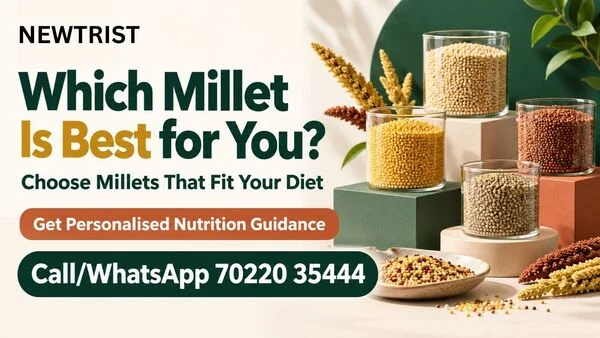
There is no single best millet for everyone. A practical choice can be made by looking at your current eating pattern, your reason for introducing millet and how realistically the grain fits into your routine.
Start With What You Already Eat
Before adding a new grain, look at your usual staples.
Does most of your grain intake come from rice? Do you eat wheat-based foods frequently? Is bajra, ragi or jowar already common at home?
Someone whose diet already contains several grains is starting from a different place from someone who relies almost entirely on one cereal.
You do not need to remove a familiar staple merely to make room for millet.
Be Clear About Why You Want to Add Millet
The goal helps determine whether the change is useful.
• broaden the range of plant foods you eat
• include another source of dietary fibre
• explore different micronutrient sources
• vary the grains used at home
• find a grain that works better with particular meals
Starting with the purpose makes more sense than choosing whichever millet currently has the strongest health reputation.
Consider What Will Accompany the Grain
A millet is only one part of a meal.
The same grain served with vegetables, dal and curd creates a different nutritional combination from the grain eaten with very few complementary foods.
So after asking: “Which millet should I choose?”
ask: “What will I eat with it?”
That second question often has a greater effect on the nutritional quality of the complete meal.
Choose Something You Can Actually Use
Nutrition has to work outside a food-composition table.
Taste, texture, regional food preferences, family acceptance, cooking time, availability and cost all influence whether a food becomes a realistic part of the diet.
A millet that fits naturally into familiar meals may be more useful than one chosen because of an impressive nutrient claim but rarely eaten.
What Nutrition Do Millets Provide?
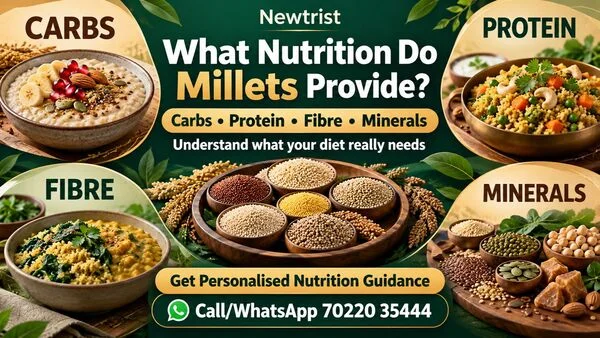
Although their exact composition differs, millets are cereal grains that generally provide carbohydrates together with varying amounts of plant protein, dietary fibre, fat, vitamins and minerals.
Carbohydrates
Carbohydrates provide much of the energy in millet grains, as they do in rice, wheat and other cereals.
The presence of carbohydrates does not determine whether a grain is nutritious. The complete food and the rest of the meal provide the more meaningful picture.
Plant Protein
Millets contribute some plant-based protein.
They are usually one contributor to total dietary protein rather than the only protein source. Other foods eaten across the day determine whether overall protein requirements are met.
Dietary Fibre
Many millets contribute dietary fibre.
However, fibre intake also comes from pulses, vegetables, fruits, nuts, seeds and other plant foods. Choosing a millet should therefore be considered within the complete diet rather than as a standalone way to obtain fibre.
Vitamins and Minerals
This is one area where millet varieties can differ noticeably.
Finger millet is particularly recognised for calcium, while pearl millet is notable for minerals including iron and zinc. Other millet varieties provide their own combinations of naturally occurring micronutrients.
Rather than memorising which millet ranks highest for every nutrient, it is more useful to understand that different grains make different nutritional contributions.
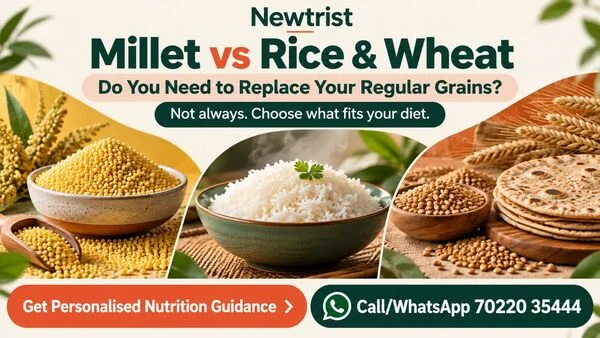
Millet vs Rice and Wheat: Do You Need to Replace Your Regular Grains?
No. Including millet does not mean you need to stop eating rice or wheat.
Rice, wheat and millets are all cereal foods, but their nutritional composition, taste and culinary uses differ.
For many people, millet can simply become another grain option.
Rice might suit one meal, wheat another and millet another. The appropriate combination depends on food preferences, household habits and individual nutritional requirements.
This is usually more practical than turning the decision into millet versus rice or millet versus wheat.
Healthy eating does not require proving that one grain is universally better before you are allowed to eat it.
Does the Form of Millet Change What You Are Eating?
Yes. Whole millet, millet flour and a packaged food containing millet are not automatically nutritionally identical.
Processing changes the physical form of the grain, while packaged foods may combine millet with several other ingredients.
Whole Millet
Whole millet can be cooked directly and used as the cereal component of a meal.
Its nutritional contribution then becomes part of whatever vegetables, protein foods and other ingredients accompany it.
Millet Flour
Grinding millet into flour allows it to be used in rotis, dosas and other flour-based preparations.
The finished dish should still be considered as a complete food. What is added to the flour and what accompanies the preparation also influence the meal.
Millet-Based Packaged Foods
Millets are increasingly used in noodles, pasta, breakfast foods and other convenient products.
The word “millet” on the front of the pack tells you something about an ingredient. It does not tell you everything about the finished food.
If millet is one reason for choosing the product, check:
• which grains are included
• where millet appears in the ingredient list
• the protein content
• the dietary fibre
• the rest of the main ingredients
Instead of asking only: “Does it contain millet?”
ask: “What does the finished food contribute to my meal?”
How Can Millets Fit Into a Balanced Indian Diet?
Millet can simply take the grain position in a balanced meal.
The rest of the meal can then provide complementary nutrition.
Vegetables contribute fibre and micronutrients. Dal, beans, curd, paneer, tofu, eggs, fish or chicken can contribute additional protein depending on dietary preference. Fruits, nuts and seeds can add other nutrients elsewhere in the day.
Millet does not need to become the centre of every meal to be useful.
That is an important point because a diet containing large amounts of millet is not automatically balanced if other food groups are poorly represented.
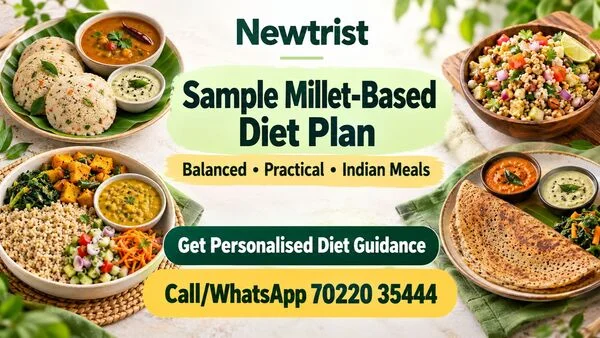
Sample Millet-Based Diet Plan
The following example shows how one millet-containing meal can fit into an otherwise familiar Indian eating pattern.
| Meal | Sample Food Choice | Main Nutrition Focus |
| Breakfast | Vegetable besan chilla with curd and seasonal fruit | Protein, vegetables and fruit |
| Mid-morning | Seasonal fruit with nuts | Fruit and healthy fats |
| Lunch | Little millet with dal, cooked vegetables and curd | Grain, protein, vegetables and dairy |
| Evening | Roasted chana with fruit | Plant protein and fibre-containing foods |
| Dinner | Chapati with paneer, tofu, egg or chicken preparation and vegetables | Grain, protein and vegetables |
Millet appears only once in this example.
That is deliberate.
Including millet does not require eating it at every meal, removing all other cereals or building the entire day’s food around one grain.
This is an educational example, not a personalised diet plan. Suitable foods and quantities differ according to age, activity, appetite, nutritional status, food preferences, health considerations and individual goals.
When Does Choosing a Millet Become a Personal Nutrition Question?
For general healthy eating, choosing a millet can remain fairly simple.
It becomes a more individual question when someone expects the grain choice to help achieve a specific nutritional outcome.
When Your Goal Is Weight Management
Millet is not automatically a weight-loss food.
A weight-management diet has to consider food quantities, overall energy intake, protein, fibre, appetite, activity and the person’s existing eating pattern.
Changing rice to millet while ignoring the rest of the diet may therefore address the wrong part of the problem.
For people working towards a specific weight goal, Newtrist’s personalised weight management nutrition considers the complete eating pattern rather than making one grain responsible for progress.
When You Have Clinical Nutrition Requirements
A health condition can change which nutritional issues deserve priority.
The relevant food choices may depend on current dietary intake, symptoms, clinical findings and the person’s broader nutritional requirements.
Newtrist’s clinical nutrition service considers these factors together instead of applying the same millet recommendation to everyone.
When Age or Life Stage Changes Nutritional Priorities
Children, adults, older adults, pregnant women and breastfeeding mothers can have different energy and nutrient requirements.
The question is therefore not simply whether millet can be eaten.
The more useful question is whether the complete diet is appropriate for that stage of life.
For children and adolescents in particular, adequate nutrition for growth and development should take priority over unnecessary restriction or food substitution.
When General Millet Advice Is No Longer Enough
Most people do not need a “millet prescription”.
But if you are choosing foods to address a specific goal, knowing which millet contains more fibre, calcium, iron or protein is only the beginning.
Is protein actually low in my current diet?
Am I eating enough vegetables and other fibre-containing foods?
Should I change the grain, the foods accompanying it or the quantity of the meal?
Does the change work with my family meals and daily routine?
Which part of my diet deserves attention first?
These questions cannot be answered by a list ranking different millets.
Chief Nutritionist Vasanthi Senthilvel approaches personalised nutrition by first understanding the individual’s current eating pattern, nutritional requirements, health goals, food preferences and practical routine.
The result is not simply advice about whether to choose ragi, bajra or foxtail millet. It is a personalised nutrition plan that considers how grains, protein foods, vegetables, fruits and other foods need to work together.
For one person, introducing millet may be a useful change. For another, improving protein intake, meal composition or another part of the diet may deserve attention first.
If you want to know which changes are actually relevant to your own diet, you can consult Chief Nutritionist Vasanthi Senthilvel at Newtrist.
Frequently Asked Questions About Millets
What is the difference between small millets and millets such as bajra and ragi?
“Small millets” commonly refers to grains such as foxtail millet, kodo millet, little millet, barnyard millet and proso millet. Pearl millet and finger millet are generally discussed separately, although all are commonly grouped under the broader millet category in food and nutrition conversations.
Are millet grains naturally gluten-free?
Millet grains are naturally gluten-free. When strict gluten avoidance is required, packaged foods should also be checked for other ingredients and appropriate manufacturing information.
Why does the same millet have different names in India?
Millets have long histories in different regional food cultures, so the same grain may have different names across Indian languages and states. Checking the grain’s commonly accepted English name can help when regional names are unfamiliar.
Can different millet flours be combined with other flours?
Yes. Millet flours may be used alone or blended with other suitable flours depending on the food being prepared. The nutritional composition of the finished food depends on the proportions and other ingredients used.
Does a more expensive millet mean it is more nutritious?
No. Price can be influenced by availability, processing, packaging, demand and distribution. It should not be used as a measure of nutritional superiority.
Do I need to include millet every day to get its benefits?
No fixed daily millet frequency is necessary for everyone. Millet can be one of several nutritious grain choices, and the quality of the complete diet matters more than eating a particular grain every day.
Choosing Millet Without Overcomplicating Your Diet
The different types of millets in India give you more choices, not another set of rigid food rules.
Ragi, bajra, foxtail millet, kodo millet and other grains each have their own nutritional characteristics. Understanding those differences can help you make a more informed choice, but there is no universal millet ranking that applies to every person.
For general healthy eating, the decision can be simple: choose a grain you enjoy, use it in a meal that contains complementary foods and allow room for other cereals too.
When the goal is more specific, the question changes from: “Which millet is healthiest?”
to: “What does my diet actually need?”
That is where personalised nutrition becomes useful. It focuses less on chasing individual healthy foods and more on identifying the dietary changes that matter for the person eating them.
Author
Chief Nutritionist Vasanthi Senthilvel leads Newtrist Nutritionist Dietitian Dietician, providing personalised diet plans for weight management and clinical nutrition for children, adolescents, adults and families.
She has 21 years of experience in nutrition and has received professional recognition for her work.
- Pride of Bharat Awards 2026: Outstanding Achievement in Holistic Health & Nutrition Innovation
- Doctor of The Year: Nutritionist 2026: Excellence in Clinical Nutrition and Weight Loss.
Her approach considers age, growth, health history, medical conditions, laboratory reports, medication, body composition, weight history, dietary preferences, regional food habits, family routines, activity, sleep and personal health goals. Recommendations are developed according to individual needs rather than using one standard diet for everyone.
Consultations are available in person at Bangalore HSR Layout, Koramangala, Bellandur, Haralur and Electronic City, as well as online across India.
Independent Medical Review Panel
Newtrist health and nutrition articles undergo medical review, where appropriate, by doctors with relevant specialist expertise. The medical professionals listed below contribute to Newtrist’s review process within their respective specialties.
| Speciality | Doctor |
|---|---|
| Endocrinology | Dr Vinay Prasad MBBS, MD, DM |
| Gastroenterology & Hepatology | Dr Sunil kumar N MBBS, MD, DM |
| Gynaecology | Dr Prathiba G MBBS, DNB, FIRM, FMAS |