
Written by: Chief Nutritionist Vasanthi Senthilvel
21 years of experience | Newtrist Nutritionist Dietitian Dietician
Best Nutritionist in Bangalore with multiple awards for excellence in clinical nutrition, weight loss, holistic health and nutrition innovation.
Medically reviewed by: Dr Prathiba G MBBS, DNB, FIRM, FMAS | Dr Sunil kumar N MBBS, MD, DM | Dr Vinay Prasad MBBS, MD, DM
Medical Disclaimer: Nutritional needs vary based on an individual’s profile. The information on this page is for general educational purposes only and is not intended to replace personalised medical or nutrition care.
Once a food allergy is identified, the obvious advice is to avoid that food. Everyday eating is rarely that simple.
The ingredient may appear in foods where you do not expect it. Removing it may also take away a regular breakfast, snack, protein source or household staple. Before long, the question changes from “What should I avoid?” to “What can I actually eat without making my diet too limited?”
A well-planned food allergy diet answers both questions. It helps you avoid the relevant allergen while keeping suitable familiar foods and replacing what the excluded food previously contributed to your diet.
Key takeaway: A food allergy diet excludes the specific allergen and foods containing it while keeping the rest of the diet as nutritionally complete and practical as possible. There is no universal food-allergy menu because the foods that need avoiding, and the foods needed as replacements, differ from person to person.
Table of Contents

What Can You Eat on a Food Allergy Diet?
You can generally continue eating foods that do not contain your particular allergen and are otherwise suitable for you.
For many people, that means much of the existing diet can remain.
- rice and suitable grains
- dal, pulses and legumes
- vegetables
- fruits
- dairy foods or appropriate alternatives, where suitable
- eggs, where suitable
- nuts and seeds, where suitable
- fish, chicken and other familiar protein foods, where suitable
The phrase “where suitable” matters.
Peanuts may need complete avoidance for one person while remaining an ordinary food for someone with a completely different allergy. The same applies to milk, wheat, egg, soy, fish, tree nuts and other foods.
So rather than starting with a long generic list of “safe foods”, start with the foods that remain suitable for the allergy you actually need to manage.
Keep familiar foods that do not need changing
Food allergy management does not require replacing every familiar meal.
If rice, dal, vegetables, fruits or household recipes remain suitable, keeping them can make the diet easier to manage.
This is particularly useful with Indian meals, where several separate components may be served together. Sometimes one ingredient or one dish needs changing rather than the entire meal.

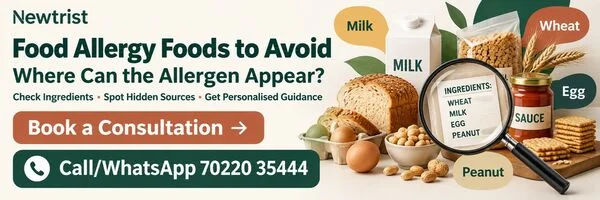
Food Allergy Foods to Avoid: Where Can the Allergen Appear?
Food allergy foods to avoid include the allergen itself and foods containing that allergen as an ingredient.
Recognising the food in its obvious form is usually the easier part. Identifying it inside mixed or prepared foods can require more attention.
Obvious sources are only the starting point
An egg served on a plate is easy to recognise. Egg used inside a bakery product is less obvious.
Milk may appear in a dessert or prepared food. Nuts may be included in a sauce or sweet. Wheat or soy may form part of foods where they are not the main ingredient.
The practical question is therefore not just:
“What is this dish called?”
It is:
“What ingredients were used to make it?”
Packaged foods need ingredient-level checking
Products with similar names or appearances can contain different ingredients.
Formulations may also change.
For someone managing a food allergy, checking the ingredient information on the product is more reliable than assuming that a familiar brand or product will always remain suitable.
Preparation matters when food is shared
An allergenic ingredient can sometimes come into contact with another food during preparation, storage or serving.
Shared utensils, preparation surfaces or cooking arrangements can therefore matter in some situations.
This becomes especially relevant when meals are prepared in restaurants, canteens, functions or another household where several foods are handled together.
Food Allergy Nutrition: What Should Replace an Excluded Food?
This is where a food allergy diet can become either well planned or unnecessarily restrictive.
Removing the allergen tells you what has disappeared.
It does not tell you what should take its place.
Suppose two people both need to remove the same food. One ate it occasionally. The other depended on it every day at breakfast, during snacks and as part of family meals.
The avoid list may be identical, but the nutritional impact is not.
Consider the type of questions that arise when commonly eaten foods are excluded:
| Food being excluded | Nutrition question to consider |
| Milk and dairy foods | Which suitable foods will take over the nutritional role dairy previously played? |
| Egg | Does removing egg substantially reduce usual protein choices or convenient meals? |
| Wheat | Which suitable staple foods will replace regularly eaten wheat-based foods? |
| Nuts | Were nuts an important part of snacks, protein intake or dietary fats? |
| Fish | What place did fish have among the person’s usual protein foods? |
These are not universal replacement instructions.
They show why the existing diet matters just as much as the name of the allergy.
Replacement should solve a real gap
Not every excluded food requires an elaborate substitute.
If a food contributed very little to the person’s normal diet, removing it may require only a minor adjustment.
If it was a staple, simply taking it away can leave meals incomplete or repetitive.
That is why food allergy nutrition should look at what the person was actually eating before recommending what needs to change next.
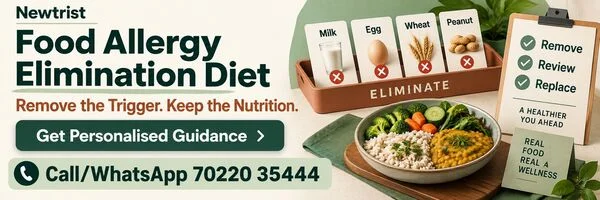
What Is a Food Allergy Elimination Diet?
A food allergy elimination diet removes one or more selected foods for a defined reason.
That is different from simply maintaining avoidance of a food that has already been identified as an allergen.
The distinction matters because elimination diets can become broader very quickly.
Removing several foods together can affect:
- staple meals
- protein choices
- breakfast options
- convenient snacks
- family cooking
- eating outside the home
The more foods that disappear, the more important it becomes to understand why each food is being excluded.
Avoid turning uncertainty into a growing food-restriction list
Removing extra foods “just in case” can make the diet harder to interpret and harder to maintain.
Each additional restriction should have a clear purpose.
Otherwise, someone may eventually be following a very limited diet without knowing which exclusions are genuinely relevant and which were added along the way.
Hypoallergenic Diet: What to Eat?
There is no single hypoallergenic diet or universal hypoallergenic food list that suits everyone with food allergies.
The term can sound as though certain foods are automatically safe for everybody. In practice, suitability depends on the specific allergy.
A nut-based replacement may work for someone avoiding milk but not for someone with a nut allergy. A soy-based alternative is only useful when soy itself is suitable. The same principle applies to wheat-based and other substitutes.
So instead of asking:
“Which foods are hypoallergenic?”
Ask:
“Which foods are suitable replacements for the allergen I need to avoid?”
That question is more likely to produce a practical diet without removing unrelated foods.

Sample 1-Day Food Allergy Diet
A useful food allergy meal example needs to specify which allergen is being excluded.
A single menu cannot simultaneously represent milk allergy, wheat allergy, egg allergy, nut allergy and other food allergies.
The following example illustrates familiar Indian food choices for an adult avoiding milk and milk-containing foods only, assuming every other ingredient shown is suitable.
Example: 1-Day Milk-Free Indian Food Pattern
| Meal | Illustrative food choice |
| Breakfast | Vegetable poha prepared without milk ingredients, with fresh fruit |
| Mid-morning | Suitable fresh fruit |
| Lunch | Rice, dal, vegetable sabzi and cucumber salad |
| Evening | Roasted chana |
| Dinner | Chapati, chana masala and mixed vegetables prepared without milk ingredients |
This is an illustrative example rather than a universal food allergy diet plan.
Someone who also needs to avoid wheat, pulses or another ingredient shown would need different choices.
The useful lesson from the example is not the individual dishes. It is that excluding one allergen does not automatically require replacing the person’s entire way of eating.
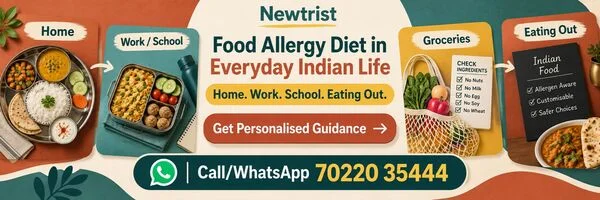
How Do You Make a Food Allergy Diet Work in Everyday Indian Life?
A theoretically suitable diet is not enough if it becomes difficult at home, at work or while eating with other people.
Food allergy planning needs to work in situations where meals are actually eaten.
At home: change the part that needs changing
Consider a household meal containing rice or roti, dal, vegetables and another side dish.
If only one component contains the relevant allergen, the rest of the meal may still be suitable.
Adapting one ingredient or preparation can often be more practical than cooking a completely separate menu.
At work or school: make routine choices predictable
Regular meals are easier to manage when suitable foods are already familiar.
The challenge often comes from shared snacks, celebrations, canteens or food offered unexpectedly.
Knowing precisely what needs avoiding makes those decisions clearer than working from a vague list of foods that “might cause allergy”.
When eating outside: ask about the specific preparation
A dish name alone does not always reveal its ingredients.
Restaurant gravies, bakery foods, desserts, sauces and mixed preparations may vary substantially between kitchens.
Asking what has gone into the particular dish gives more useful information than assuming that every version of a familiar food is prepared the same way.
When Is a Generic Food Allergy Diet No Longer Enough?
Generic guidance can explain which questions to ask.
It cannot determine whether your own diet is still nutritionally adequate after foods have been removed.
Personalised nutrition becomes more useful when:
- several foods are being excluded
- a staple food has disappeared from everyday meals
- suitable meals are becoming repetitive
- replacements are difficult within a vegetarian or other preferred eating pattern
- family cooking has become complicated
- school, work or travel regularly disrupts the diet
- you are relying on only a small number of convenient foods
- you are unsure what should replace foods that were previously eaten frequently
At this stage, another list of “foods to eat” is rarely the main need.
The more useful questions are:
What can remain unchanged?
Which exclusions are creating genuine nutritional gaps?
Which replacements fit my normal Indian food pattern?
How can I make this work consistently rather than only for a few days?
Chief Nutritionist Vasanthi Senthilvel can assess the foods currently being excluded alongside usual meals, dietary preferences and everyday routine to develop an individual food pattern rather than applying the same allergy menu to everyone.
For readers who need that individual planning, Newtrist’s Personalised Diet Plan for Clinical Nutrition provides the appropriate next step.
Frequently Asked Questions About Food Allergy Diets
Can cooking make an allergenic food safe to eat?
Not necessarily.
Heating changes foods in different ways, and an allergenic food should not be assumed to become suitable simply because it has been cooked, baked or processed.
Follow the advice given for the specific allergy rather than testing a different preparation based on assumption.
Do I need expensive allergy-free products?
Not always.
Many ordinary foods may already be suitable for the allergy being managed.
A specialised replacement can be useful when it genuinely replaces a frequently eaten food, but buying products labelled for restricted diets is not automatically necessary for every meal.
Are “free-from” foods automatically healthier?
No.
A food being free from one ingredient tells you that the particular ingredient is absent. It does not automatically make the product nutritionally better.
The food still needs to be considered as part of the complete eating pattern.
Can a food allergy diet affect body weight?
It can if dietary restrictions substantially change how much or what someone eats.
For example, limited food choices may unintentionally reduce overall intake, while depending heavily on a narrow range of convenient alternatives can change the balance of the diet in another direction.
The effect therefore depends on the resulting eating pattern rather than the allergy alone.
Can a vegetarian food allergy diet be nutritionally adequate?
Yes.
The important question is which foods remain available after the vegetarian preference and food allergy are considered together.
If the allergy removes foods that were frequently used for protein or other nutrients, suitable alternatives need greater attention.
What should I prepare before a personalised nutrition consultation?
A simple picture of your current eating pattern is useful.
Note your regular meals and snacks, the foods currently being excluded, commonly used packaged foods, dishes that are difficult to replace and the situations in which following the diet becomes most difficult.
This helps the consultation focus on the practical problems that need solving rather than starting from a generic food list.
The Goal Is Not to Eat Less Variety. It Is to Know What Fits.
Food allergies can make people focus almost entirely on foods they cannot eat.
Good nutrition planning changes the question.
Instead of continually asking “What else should I remove?”, the focus becomes:
“What can I confidently keep, and what genuinely needs replacing?”
For someone with one straightforward exclusion, the answer may be relatively simple.
When staple foods disappear, multiple restrictions accumulate or everyday Indian meals become difficult to organise, a generic food list has reached its limit.
That is when personalised planning has a clear purpose.
Chief Nutritionist Vasanthi Senthilvel can develop a personalised diet around the foods you need to avoid, the familiar foods you want to retain and the nutritional needs your remaining diet must meet.
Author
Chief Nutritionist Vasanthi Senthilvel leads Newtrist Nutritionist Dietitian Dietician, providing personalised diet plans for weight management and clinical nutrition for children, adolescents, adults and families.
She has 21 years of experience in nutrition and has received professional recognition for her work.
- Pride of Bharat Awards 2026: Outstanding Achievement in Holistic Health & Nutrition Innovation
- Doctor of The Year: Nutritionist 2026: Excellence in Clinical Nutrition and Weight Loss.
Her approach considers age, growth, health history, medical conditions, laboratory reports, medication, body composition, weight history, dietary preferences, regional food habits, family routines, activity, sleep and personal health goals. Recommendations are developed according to individual needs rather than using one standard diet for everyone.
Consultations are available in person at Bangalore HSR Layout, Koramangala, Bellandur, Haralur and Electronic City, as well as online across India.
Independent Medical Review Panel
Newtrist health and nutrition articles undergo medical review, where appropriate, by doctors with relevant specialist expertise. The medical professionals listed below contribute to Newtrist’s review process within their respective specialties.
| Speciality | Doctor |
|---|---|
| Endocrinology | Dr Vinay Prasad MBBS, MD, DM |
| Gastroenterology & Hepatology | Dr Sunil kumar N MBBS, MD, DM |
| Gynaecology | Dr Prathiba G MBBS, DNB, FIRM, FMAS |