
Written by: Chief Nutritionist Vasanthi Senthilvel
21 years of experience | Newtrist Nutritionist Dietitian Dietician
Best Nutritionist in Bangalore with multiple awards for excellence in clinical nutrition, weight loss, holistic health and nutrition innovation.
Medically reviewed by: Dr Prathiba G MBBS, DNB, FIRM, FMAS | Dr Sunil kumar N MBBS, MD, DM | Dr Vinay Prasad MBBS, MD, DM
Medical Disclaimer: Nutritional needs vary based on an individual’s profile. The information on this page is for general educational purposes only and is not intended to replace personalised medical or nutrition care.
Your child refuses dinner and says, “I’m not hungry”, then asks for curd rice shortly afterwards. The next evening, even a normally reliable favourite is left untouched.
Both situations may be described as picky eating, but they do not necessarily point to the same problem.
The more useful question is not simply, “How do I make my child eat more?”
“What is getting in the way of eating?”
Some children are hungry but accept only a narrow range of foods. Some show little interest in eating even when familiar foods are available. Others have both limited food acceptance and poor appetite.
Knowing which pattern is happening most often gives you a much better starting point than another generic list of foods for picky eaters.
Key takeaway: Picky eating and selective eating are overlapping descriptions of children who restrict or strongly prefer particular foods. The practical question is whether your child is hungry but accepts a limited range, has little interest in eating overall, or experiences both patterns. Persistent restriction, a shrinking food range, poor appetite or eating difficulties affecting nutrition or daily life deserve closer assessment rather than simply another diet chart.
Table of Contents

Picky Eating, Selective Eating and Poor Appetite: How Can You Tell Them Apart?
There is no need to force every child into a label.
Instead, look at what happens when food is actually available.
| What you notice | What it may suggest | Useful question |
| Child refuses the meal but readily eats a preferred food | Food selectivity is probably important | What makes certain foods acceptable? |
| Child accepts only particular textures, preparations or presentations | Sensory or familiarity-related selectivity may be important | What do the accepted foods have in common? |
| Child accepts a reasonable variety but eats very little of most foods | Appetite may be more important than variety | When does genuine hunger appear? |
| Child shows little appetite and also accepts very few foods | Both factors may be contributing | Which issue is limiting eating most? |
A fussy eater who eagerly eats favourite foods is different from a child who rarely appears interested in eating anything.
That distinction changes what deserves attention next.

Four Questions That Reveal More Than an Unfinished Plate
An unfinished meal tells you how much was left. It does not tell you why.
Instead of focusing only on quantity, observe these four patterns over several days.
Does Interest Return When a Preferred Food Appears?
Imagine your child refuses lunch and says there is no appetite. Ten minutes later, the child asks for dosa and eats comfortably.
That does not prove why lunch was refused, but it tells you something useful: the ability and motivation to eat were present when the food felt acceptable.
Now compare that with a child who turns away from both lunch and the usually preferred dosa.
The second pattern makes appetite more important to investigate.
How Broad Is the Accepted Food Range Really?
Counting dishes can sometimes overestimate variety.
A child may eat idli, dosa, bread, plain rice and noodles. That sounds like five accepted foods, but the choices may still share similar characteristics: mild flavour, predictable appearance and familiar texture.
Look beyond the number of food names.
Ask whether your child comfortably accepts foods with genuinely different textures, flavours and nutritional roles.
Does the Same Food Become Acceptable When Prepared Differently?
A child may accept potato when crisp but reject it when soft. Rice may be acceptable when plain but refused when ingredients are mixed through it.
This means “likes potato” or “doesn’t like rice” may not fully describe what is happening.
Preparation, texture, temperature, appearance and predictability can all influence food acceptance.
Recognising the pattern gives you a more useful starting point than repeatedly introducing completely unrelated foods.
When Does Eating Happen Most Easily?
Some children arrive at breakfast genuinely hungry but show little interest in dinner.
Others hardly eat before school but become hungry in the afternoon.
Look for the times when your child approaches food most naturally.
The aim is not to make every meal equally large. It is to understand the child’s appetite pattern before deciding that every low-intake meal is a problem.

If Your Child Is Hungry but Accepts Only a Few Foods
When hunger is present but the accepted range is narrow, simply serving a larger quantity does not address the main difficulty.
The question becomes:
How can the child’s range expand from foods that already feel acceptable?
Look for the Pattern Behind Accepted Foods
Start with the foods your child already eats comfortably.
What do they have in common?
Perhaps the child prefers foods that are crisp rather than soft, plain rather than mixed, dry rather than saucy, separated rather than touching, or very predictable in appearance.
That information can help you choose a smaller next step.
For example, a child comfortable with several crisp foods may find another crisp food easier to explore than an unfamiliar soft mixed dish.
The purpose is not to keep the child’s diet permanently within one texture. It is to identify a realistic bridge rather than repeatedly presenting changes that feel completely unfamiliar.
Think in Terms of the Next Food, Not the Perfect Diet
Parents often know what an ideal varied diet looks like.
The challenge is getting from what the child eats now to that wider range.
For a very selective eater, the useful question is therefore not:
“What should a healthy child eat?”
It is:
“What is the next realistic food change from the range my child already accepts?”
That shift can make food expansion much more practical.

If Your Child Eats Different Foods but Has Little Appetite
A child can accept dal, rice, fruit, curd, eggs and vegetables and still eat only small amounts.
In this situation, adding another ten recipes may not address the concern.
The central question is appetite.
Find the Child’s Natural Appetite Window
Notice when eating happens without much encouragement.
Is breakfast consistently easier? Does hunger appear after school? Does the child eat comfortably after active play but show little interest later in the evening?
Patterns like these can help distinguish a child who can eat but is rarely hungry at the expected meal time from a child whose interest in food remains low across the day.
Look at the Whole Eating Pattern
A child who eats something frequently throughout the day may approach a main meal differently from a child with clearer gaps between eating occasions.
This does not mean withholding food to create extreme hunger.
It means looking at the entire pattern before concluding that the child simply needs more tempting meals.
When poor appetite remains persistent even when preferred foods are available, the situation deserves more individual attention than a recipe change alone can provide.

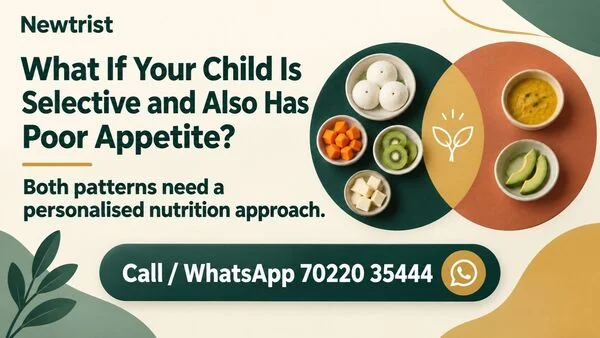
What If Your Child Is Selective and Also Has Poor Appetite?
This is where generic advice becomes particularly difficult to use.
There may be only a small number of foods the child accepts, and the child may not be very motivated to eat even those foods.
Trying to increase quantities, introduce several unfamiliar foods and change the entire routine at once can leave parents unsure which change is helping.
Start by answering three questions:
Which foods are reliably eaten?
When is appetite usually strongest?
What characteristics seem to determine whether a food is accepted?
These answers establish the child’s practical starting point.
A useful nutrition approach can then work outwards from that starting point rather than beginning with an ideal menu that bears little resemblance to what the child currently eats.
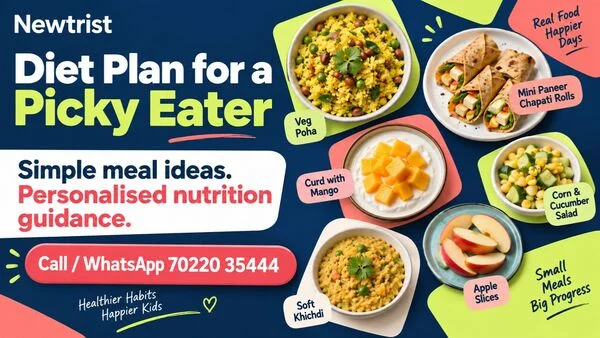
Sample 1-Day Diet Plan for a Picky Eater
A sample diet plan can show how familiar foods and dietary variety might appear within the same day. It cannot determine what an individual child should eat or how much the child requires.
The following example is therefore an illustration rather than a prescription.
| Meal | Menu |
| Breakfast | Idli or dosa with curd, with fruit available alongside |
| School / mid-morning | A familiar fruit with a paneer or cheese-based food |
| Lunch | Rice with dal and curd, with a family vegetable alongside |
| After-school snack | Paneer sandwich or egg sandwich with fruit |
| Dinner | Chapati with paneer, egg or chicken according to family preference, with a family vegetable |
| If already part of the child’s usual pattern | Milk or another familiar family food |
The value of this example is not the exact menu.
It illustrates three principles.
Familiar foods remain part of the day. Improving variety does not mean removing everything the child already accepts.
Variety can be considered across the day. Every meal does not need to contain every food group.
The family diet remains relevant. A vegetarian family, egg-eating family and non-vegetarian family can apply the same principle using different familiar foods.
If your child’s accepted range is much narrower than this example, copying the menu may simply lead to more refusal.
In that situation, the better starting point is your child’s existing food range and the next achievable change from there.
For broader guidance on nutritional needs through childhood and adolescence, see Newtrist’s Pediatric Nutrition guide.
The Solution Should Match the Eating Pattern
A common reason parents feel stuck is that they are trying sensible solutions for the wrong problem.
More Food Does Not Solve Limited Food Acceptance
If a child is hungry but highly selective, increasing the portion of an unfamiliar meal does not make that food easier to accept.
The difficulty is variety, not simply quantity.
More Recipes Do Not Automatically Solve Poor Appetite
When a child accepts a broad range but has little interest in eating, repeatedly creating new dishes can turn every meal into a search for something tempting enough to produce a few bites.
The underlying appetite pattern may remain unchanged.
An Ideal Diet Chart Does Not Solve Both Problems
A chart can contain nutritionally excellent foods and still be unusable if a child accepts almost none of them.
When food range and appetite are both limited, the plan has to begin with the child rather than with the chart.
This is where personalised assessment can add value.
When Does Picky Eating Need Closer Attention?
Closer assessment is appropriate when the eating pattern is persistent, becoming more restrictive, affecting nutrition or making everyday eating increasingly difficult.
Examples include:
- the accepted food range continues to shrink
- appetite remains persistently low
- meals regularly cause considerable distress
- eating outside the home becomes very difficult
- the child’s usual diet has very limited variety
- chewing or swallowing appears difficult
- feeding takes an increasing amount of family time or negotiation
- there are concerns about growth
Severe picky eating is not defined simply by refusing vegetables or having strong preferences.
The more important questions are how restrictive the pattern has become, how long it persists and what effect it is having on nutrition and normal daily life.
Difficulty chewing or swallowing, significant growth concerns or other persistent symptoms may also require appropriate medical assessment rather than nutrition guidance alone.
If your main concern is the child’s growth rather than food selectivity itself, Newtrist’s separate guide to poor weight gain in children and teenagers covers that search intent in greater detail.
Why Personalised Nutrition Can Be More Useful Than Another Picky-Eater Menu
Consider two children.
One becomes genuinely hungry and eats good quantities, but accepts only a very narrow set of foods and textures.
The other accepts foods from several groups but rarely seems interested enough to eat much.
Both families could search for picky eating in children.
Yet giving both children the same diet chart would overlook the most important difference between them.
A personalised nutrition assessment can establish what is actually limiting the individual child’s eating.
It can consider the child’s accepted foods, patterns among rejected foods, appetite through the day, preferred textures and presentations, school eating pattern, family food habits, dietary preferences and growth information where relevant.
The purpose is not simply to identify more foods the child could eat.
It is to determine:
What is the most useful next nutritional change for this child?
Chief Nutritionist Vasanthi Senthilvel can assess the child’s current eating pattern and develop personalised diet and nutrition guidance around the child’s food acceptance, appetite, family diet and everyday routine.
For one child, the priority may be broadening an unusually restricted range.
For another, it may be organising nutrition around a consistently low appetite.
For a child experiencing both concerns, the approach may need to address each limitation gradually rather than expecting one standard diet to solve everything.
You can also read how Newtrist approaches an individual personalised diet plan before deciding whether personalised guidance is appropriate for your child.
Frequently Asked Questions
Is It a Problem If My Child Eats the Same Breakfast Every Day?
Not automatically.
A predictable breakfast may be only one repeated meal within an otherwise varied diet.
Look at the child’s food range across the rest of the day and week. Repeating one breakfast is different from relying on the same few foods at nearly every eating occasion.
Why Does My Child Eat Better at School Than at Home?
A different setting can change eating behaviour.
Meal timing, the presence of other children, distractions, expectations and how much attention is placed on eating may all differ.
Instead of treating the difference as misbehaviour, notice what the easier setting may reveal about when and how your child eats more comfortably.
Why Will My Child Eat Individual Ingredients but Refuse Them When Mixed?
A mixed dish changes more than flavour.
Texture, appearance, predictability and the way foods touch one another all change.
If the ingredients are eaten comfortably on their own, the child may already accept those foods. The difficulty may be the combined presentation rather than the ingredients themselves.
Why Does My Child Accept Only One Brand, Shape or Version of a Food?
For some selective eaters, familiarity depends on very specific characteristics.
A change in shape, texture, smell, colour or consistency can make a food that appears almost identical to an adult feel unfamiliar to the child.
This pattern can help identify how small the next change may need to be.
Should I Keep a Food Record Before Seeking Nutrition Guidance?
A short record of foods the child actually accepts can be useful, particularly if you also note obvious patterns in appetite or presentation.
You do not need to calculate calories or create a perfect food diary.
The purpose is simply to make the child’s normal eating pattern easier to understand.
My Child Used to Eat a Food but Suddenly Refuses It. Has It Been Permanently Lost?
Not necessarily.
Children’s preferences can change, and one refusal does not prove that a previously accepted food will never be eaten again.
A repeated change over time is more informative than one unexpected meal.
Stop Asking Only “How Do I Make My Child Eat More?”
When a child eats poorly, quantity easily becomes the centre of attention.
But eating more may not be the first problem that needs solving.
A child who is hungry but highly selective needs a different approach from a child who accepts many foods but has little appetite.
And a child experiencing both needs a starting point that accounts for both.
The questions that move the situation forward are:
What foods already work?
What seems to limit acceptance?
When does genuine hunger appear?
What is the next realistic change for this child?
Those answers are individual. A generic picky-eater diet chart cannot provide them. If your child’s accepted food range remains very narrow, appetite is consistently poor or you are unsure what should change next, Chief Nutritionist Vasanthi Senthilvel can assess the child’s current eating pattern and develop personalised diet and nutrition guidance around the child’s needs, familiar foods, family diet and everyday routine.
Author
Chief Nutritionist Vasanthi Senthilvel leads Newtrist Nutritionist Dietitian Dietician, providing personalised diet plans for weight management and clinical nutrition for children, adolescents, adults and families.
She has 21 years of experience in nutrition and has received professional recognition for her work.
- Pride of Bharat Awards 2026: Outstanding Achievement in Holistic Health & Nutrition Innovation
- Doctor of The Year: Nutritionist 2026: Excellence in Clinical Nutrition and Weight Loss.
Her approach considers age, growth, health history, medical conditions, laboratory reports, medication, body composition, weight history, dietary preferences, regional food habits, family routines, activity, sleep and personal health goals. Recommendations are developed according to individual needs rather than using one standard diet for everyone.
Consultations are available in person at Bangalore HSR Layout, Koramangala, Bellandur, Haralur and Electronic City, as well as online across India.
Independent Medical Review Panel
Newtrist health and nutrition articles undergo medical review, where appropriate, by doctors with relevant specialist expertise. The medical professionals listed below contribute to Newtrist’s review process within their respective specialties.
| Speciality | Doctor |
|---|---|
| Endocrinology | Dr Vinay Prasad MBBS, MD, DM |
| Gastroenterology & Hepatology | Dr Sunil kumar N MBBS, MD, DM |
| Gynaecology | Dr Prathiba G MBBS, DNB, FIRM, FMAS |
| Nephrology | Dr Priyashree R MBBS, MD, DNB, DM |