
Written by: Chief Nutritionist Vasanthi Senthilvel
21 years of experience | Newtrist Nutritionist Dietitian Dietician
Best Nutritionist in Bangalore with multiple awards for excellence in clinical nutrition, weight loss, holistic health and nutrition innovation.
Medically reviewed by: Dr Prathiba G MBBS, DNB, FIRM, FMAS | Dr Sunil kumar N MBBS, MD, DM | Dr Vinay Prasad MBBS, MD, DM
Medical Disclaimer: Nutritional needs vary based on an individual’s profile. The information on this page is for general educational purposes only and is not intended to replace personalised medical or nutrition care.
You look up the calories in your breakfast and find two entries for “one bowl of upma.” One turns out to be a small katori, the other a much larger serving. Before you pick a number, check how many grams it represents.
Key Takeaway
A 106 g reference serving of rava upma contains about 157 calories, 3.5 g of protein and 3.4 g of fibre. For a more balanced breakfast, add a side that contributes protein.
Table of Contents
How many calories are in one bowl of upma?
Both columns use the same standard rava upma recipe from the Indian Nutrient Databank. The serving column shows the reference portion. The per-100 g column lets you compare it with another preparation at the same weight.
| Nutrient | Per 100 g of rava upma | Per reference serving (106 g) |
| Calories | 148 kcal | 157 kcal |
| Protein | 3.3 g | 3.5 g |
| Carbohydrates | 16.3 g | 17.3 g |
| Fat | 7.5 g | 8.0 g |
| Fibre | 3.2 g | 3.4 g |
What changes the nutrition in your bowl of upma?
Oil or ghee can change the calories at the same serving weight
Two bowls can weigh the same and have different calorie counts. If one batch is made with more oil or ghee, the cooking fat can account for some of that difference. When estimating your own bowl, include the fat used for tempering as well as any ghee stirred in at the end.
Vegetables, peas and peanuts contribute different nutrients
Rava, also called suji, supplies much of the carbohydrate. Carrots and beans add fibre, peas add fibre and some protein, and peanuts contribute protein and fat. How much they contribute depends on how much goes into the pan. A sprinkling of peanuts will add less protein than a separate serving of dal or egg.

What to eat with upma for a balanced meal
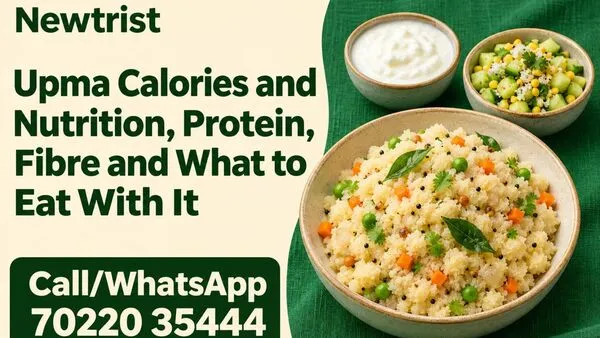
Vegetable upma with plain curd and moong dal kosambari
Pair warm vegetable upma with plain curd and a small serving of moong dal kosambari. The moong dal and curd add protein, while cucumber in the kosambari adds crunch. It’s a vegetarian combination you can put together when you already have the sides in the fridge.
Rava upma with a boiled egg and guava
If you usually make plain upma, serve it with a boiled egg and sliced guava. The egg adds protein and the guava adds fibre. You can keep your usual upma and change what goes on the plate beside it.
Frequently asked questions
How can I calculate the calories in my homemade upma?
Add up the calories from all the ingredients in the batch. If you divide it into equal portions, divide the total by the number of portions. If you serve by weight, divide your serving weight by the cooked batch weight and multiply by the batch calories. For example, 150 g from a 600 g batch containing 720 calories comes to 180 calories.
Does adding more water change the calories in upma?
Water adds weight without adding calories. If more water remains in the finished upma, the same batch will have fewer calories per 100 g. The total batch calories stay the same when the other ingredients stay the same.
Find the upma serving and sides that fit your morning
If you’re hungry again well before lunch or unsure whether to serve more upma or add a side, bring Chief Nutritionist Vasanthi Senthilvel a photo of your usual breakfast. Tell her roughly how you make it and when you next get a chance to eat. She can use that information to help you choose a portion and pairing that fit your appetite, schedule and personalised nutrition plan.
Author
Chief Nutritionist Vasanthi Senthilvel leads Newtrist Nutritionist Dietitian Dietician, providing personalised diet plans for weight management and clinical nutrition for children, adolescents, adults and families.
She has 21 years of experience in nutrition and has received professional recognition for her work.
- Pride of Bharat Awards 2026: Outstanding Achievement in Holistic Health & Nutrition Innovation
- Doctor of The Year: Nutritionist 2026: Excellence in Clinical Nutrition and Weight Loss.
Her approach considers age, growth, health history, medical conditions, laboratory reports, medication, body composition, weight history, dietary preferences, regional food habits, family routines, activity, sleep and personal health goals. Recommendations are developed according to individual needs rather than using one standard diet for everyone.
Consultations are available in person at Bangalore HSR Layout, Koramangala, Bellandur, Haralur and Electronic City, as well as online across India.
Independent Medical Review Panel
Newtrist health and nutrition articles undergo medical review, where appropriate, by doctors with relevant specialist expertise. The medical professionals listed below contribute to Newtrist’s review process within their respective specialties.
| Speciality | Doctor |
|---|---|
| Endocrinology | Dr Vinay Prasad MBBS, MD, DM |
| Gastroenterology & Hepatology | Dr Sunil kumar N MBBS, MD, DM |
| Gynaecology | Dr Prathiba G MBBS, DNB, FIRM, FMAS |
| Nephrology | Dr Priyashree R MBBS, MD, DNB, DM |