
Written by: Chief Nutritionist Vasanthi Senthilvel
21 years of experience | Newtrist Nutritionist Dietitian Dietician
Best Nutritionist in Bangalore with multiple awards for excellence in clinical nutrition, weight loss, holistic health and nutrition innovation.
Medically reviewed by: Dr Prathiba G MBBS, DNB, FIRM, FMAS | Dr Sunil kumar N MBBS, MD, DM | Dr Vinay Prasad MBBS, MD, DM
Medical Disclaimer: Nutritional needs vary based on an individual’s profile. The information on this page is for general educational purposes only and is not intended to replace personalised medical or nutrition care.
You’ve had one paratha for breakfast. A calorie app gives you three different entries for it, all labelled “one piece”. Which one is closest to what you ate? Start by matching the filling and checking the serving weight behind the number.
Key Takeaway
One paratha has about 135 to 224 calories across the seven standard recipes below, with methi at the lower end and paneer at the upper end.
Table of Contents
How many calories are in one paratha?
Each row shows the estimated nutrition in one paratha from a standard recipe in the Indian Nutrient Databank. Reference weights are based on the recipe ingredients. A finished paratha may weigh less after moisture evaporates during cooking.
| Paratha type | Reference weight for one piece | Calories | Protein | Carbohydrates | Fat | Fibre |
| Plain | 56 g | 166 kcal | 2.8 g | 17.1 g | 9.4 g | 3.0 g |
| Aloo | 93 g | 191 kcal | 3.5 g | 22.3 g | 9.5 g | 3.9 g |
| Paneer | 85 g | 224 kcal | 6.8 g | 20.7 g | 12.4 g | 3.4 g |
| Gobi | 102 g | 181 kcal | 3.8 g | 19.2 g | 9.7 g | 4.8 g |
| Methi | 91 g | 135 kcal | 3.9 g | 20.2 g | 3.9 g | 4.7 g |
| Mooli | 100 g | 184 kcal | 3.3 g | 20.5 g | 9.5 g | 4.3 g |
| Dal | 77 g | 206 kcal | 5.2 g | 23.0 g | 10.0 g | 5.0 g |
Why plain and aloo paratha compare differently per piece and per 100 g
The plain paratha has fewer calories per piece in the table. Compare equal recipe weights and the order reverses. The plain recipe has about 298 calories per 100 g, and the aloo recipe has about 205 calories per 100 g. The potato filling adds weight, so the larger aloo portion still has more calories when you eat the whole piece.
How paneer and dal parathas compare on protein and fibre
Paneer provides the most protein per piece among the seven recipes. Dal provides the most fibre and comes second for protein. If you’re deciding between those two fillings, the protein and fibre columns help you see what each one contributes.
What explains the difference between gobi, methi and mooli parathas?
The gobi and mooli recipes are close in weight and calories. The methi portion is only slightly lighter, but it contains less than half as much fat as either one. That helps explain why its calorie count is lower even though the portions are similar in size.
How to calculate calories in a homemade paratha
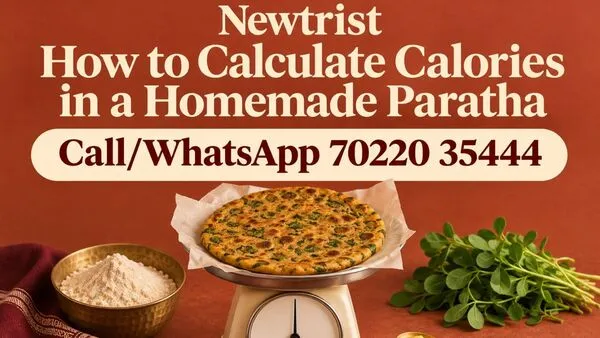
Add up the batch and divide by the number of pieces
Count the calories in the atta, filling and oil or ghee used to make the batch. Divide the total by the number of equal-sized parathas you make. If the ingredients add up to 1,200 calories and you make six equal parathas, each one contains about 200 calories.
Count any butter or ghee added when serving
If you add a pat of butter or brush ghee onto a cooked paratha, add those calories to that piece. That way, the same batch estimate works whether someone takes a paratha straight from the tawa or adds butter at the table.
Frequently asked question
How do I calculate calories in one frozen paratha from the packet?
Use the calories per piece if the label gives them. If the label gives calories per 100 g, multiply that number by the weight of one frozen paratha in grams and divide by 100. For example, an 80 g paratha listed at 280 calories per 100 g contains 224 calories.
Get a personalised diet plan that includes your usual parathas
If you make parathas by eye and want to know how your usual portion fits into breakfast, bring a photo of your plate and describe how you make them. Chief Nutritionist Vasanthi Senthilvel can help you estimate the portion and build a personalised diet plan around the meals you already eat.
Author
Chief Nutritionist Vasanthi Senthilvel leads Newtrist Nutritionist Dietitian Dietician, providing personalised diet plans for weight management and clinical nutrition for children, adolescents, adults and families.
She has 21 years of experience in nutrition and has received professional recognition for her work.
- Pride of Bharat Awards 2026: Outstanding Achievement in Holistic Health & Nutrition Innovation
- Doctor of The Year: Nutritionist 2026: Excellence in Clinical Nutrition and Weight Loss.
Her approach considers age, growth, health history, medical conditions, laboratory reports, medication, body composition, weight history, dietary preferences, regional food habits, family routines, activity, sleep and personal health goals. Recommendations are developed according to individual needs rather than using one standard diet for everyone.
Consultations are available in person at Bangalore HSR Layout, Koramangala, Bellandur, Haralur and Electronic City, as well as online across India.
Independent Medical Review Panel
Newtrist health and nutrition articles undergo medical review, where appropriate, by doctors with relevant specialist expertise. The medical professionals listed below contribute to Newtrist’s review process within their respective specialties.
| Speciality | Doctor |
|---|---|
| Endocrinology | Dr Vinay Prasad MBBS, MD, DM |
| Gastroenterology & Hepatology | Dr Sunil kumar N MBBS, MD, DM |
| Gynaecology | Dr Prathiba G MBBS, DNB, FIRM, FMAS |
| Nephrology | Dr Priyashree R MBBS, MD, DNB, DM |