
Written by: Chief Nutritionist Vasanthi Senthilvel
21 years of experience | Newtrist Nutritionist Dietitian Dietician
Best Nutritionist in Bangalore with multiple awards for excellence in clinical nutrition, weight loss, holistic health and nutrition innovation.
Medically reviewed by: Dr Prathiba G MBBS, DNB, FIRM, FMAS | Dr Sunil kumar N MBBS, MD, DM | Dr Vinay Prasad MBBS, MD, DM
Medical Disclaimer: Nutritional needs vary based on an individual’s profile. The information on this page is for general educational purposes only and is not intended to replace personalised medical or nutrition care.
Your dosa is perfectly crispy. The coconut chutney tastes delicious. But the sambar is just enough for a few dips.
It looks like a complete breakfast. Is it really?
When we eat dosa, we often focus on how many we have. We rarely consider whether the accompaniments are contributing enough to make the meal satisfying.
And that’s where a small change can make a difference.
You don’t need to replace your traditional dosa or prepare an elaborate breakfast spread. What matters is how you put the complete plate together.
Key Takeaway
To make a healthy dosa meal more balanced and filling, serve your regular dosa with a substantial portion of dal-rich vegetable sambar, add a protein source such as curd, eggs, paneer or tofu when needed, and enjoy chutney as an accompaniment. This provides a more varied combination of nutrients. Choose quantities that suit your appetite and individual nutritional needs.
Table of Contents

Why Might Dosa With Chutney Alone Not Be Filling Enough?
Traditional dosa, prepared using rice and urad dal batter, provides carbohydrates for energy along with some protein.
However, when most of your breakfast consists of dosa and a little coconut chutney, the meal may contain relatively limited protein and fibre.
Both nutrients contribute to satiety, the feeling of satisfaction after eating.
That doesn’t mean dosa is an unsuitable breakfast choice. How satisfied you feel also depends on the total quantity eaten, your activity and the time until your next meal.
The practical opportunity is to choose accompaniments that complement what your dosa already provides.

Four Ways to Make Your Dosa Meal More Balanced
You can improve your usual dosa breakfast with familiar ingredients already available in your kitchen.
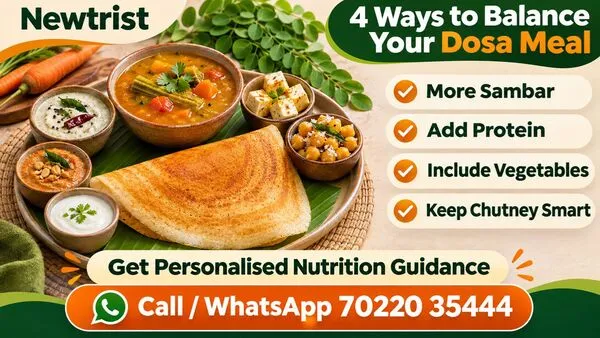
1. Make Sambar a Substantial Part of the Meal
Sambar is often treated as a dipping accompaniment, although it can contribute meaningfully to breakfast.
When prepared with sufficient toor dal, it provides plant protein and fibre. Vegetables add vitamins, minerals and other nutrients.
But here’s something worth noticing.
A bowl containing mostly liquid and a few vegetables may not provide as much protein as you expect.
The quantity of cooked dal matters more than how thick or flavourful the sambar appears.
Instead of taking only a few spoonfuls for dipping, serve a proper bowl containing meaningful amounts of dal and vegetables.
You can include familiar ingredients such as drumstick (moringa pods), pumpkin, carrots and brinjal.
Pumpkin and carrots contribute beta-carotene, while drumstick and brinjal add fibre and other nutrients.
A useful kitchen tip: When preparing sambar for the family, consider how much dal goes into the total number of servings. This gives you a better understanding of what your portion contributes.
2. Choose a Protein-Rich Accompaniment That Suits Your Meal
What can you eat with dosa to increase protein?
You have several familiar choices that fit naturally into an Indian breakfast.
| Protein-rich food | How to include it |
| Plain curd | Serve a small bowl alongside dosa |
| Eggs | Include boiled eggs or an omelette |
| Paneer | Use a substantial savoury filling |
| Tofu | Prepare a lightly cooked filling with onions |
| Chickpea sundal | Serve cooked, seasoned chickpeas as a side |
You don’t need all these foods together.
Choose according to your food preferences, what you’re already preparing and the nutrients your other accompaniments provide.
For example, curd may be convenient when you already have sambar ready. Paneer or tofu may work better when you prefer a filled dosa.
The serving size matters too.
A few pieces of paneer contribute less protein than a substantial filling. Similarly, a spoonful of chickpeas provides less than a proper serving of sundal.
The useful question is whether your chosen accompaniment contributes enough protein to make a meaningful difference to the meal.
3. Include Vegetables Without Preparing Another Dish
Vegetables can fit naturally into your dosa breakfast without adding another cooking task.
If your sambar already contains a generous variety of vegetables, you may not need a separate vegetable side.
Otherwise, consider a simple dosa filling.
Finely chopped murungai keerai (moringa leaves) can be cooked with onions and spices.
Spinach, capsicum, grated carrots and cooked cabbage are other convenient choices that contribute fibre, vitamins, minerals and different flavours.
They can also make your familiar dosa more interesting without changing the basic preparation.
Make it easier: When chopping vegetables for lunch or dinner, reserve a small portion for the following morning’s dosa filling.
This simple habit can make vegetable inclusion easier on busy weekdays.
4. Let Chutney Complement Your Breakfast
Coconut chutney is part of what makes dosa enjoyable, and there’s no need to give it up.
However, different chutneys provide different nutrients.
| Chutney | Main nutritional contribution |
| Coconut chutney | Dietary fat and some fibre |
| Peanut chutney | Unsaturated fats, some protein and magnesium |
| Sesame (ellu) chutney | Dietary fats and minerals, including calcium |
| Tomato-onion chutney | Flavour and nutrients from vegetables |
Peanuts and sesame seeds are nutrient-dense ingredients, but their contribution depends on the quantity you eat.
For example, a tablespoon of peanut chutney provides some protein, but considerably less than a substantial serving of paneer or eggs.
Enjoy whichever chutney you prefer and let it complement the rest of the meal.
What Does a Balanced Dosa Meal Look Like?
You don’t need an elaborate breakfast spread to put these ideas into practice.
Here are two practical combinations using familiar Indian foods.
| What you have available | Example dosa meal |
| Sambar is ready | Your usual dosa portion, a bowl of dal-rich vegetable sambar, plain curd and a little coconut chutney |
| Sambar isn’t available | Dosa with a substantial paneer-and-spinach filling, served with tomato chutney |
If you eat eggs, an omelette can be another protein-rich accompaniment. Tofu can replace paneer when you prefer plant-based foods.
These are examples of how to assemble a meal, not fixed serving recommendations.
The appropriate quantities depend on your appetite, food preferences and individual nutritional requirements.
You also don’t need to prepare everything fresh each morning. Using sambar that’s already available or choosing a convenient filling can make breakfast easier.
A balanced dosa meal should be practical enough to prepare regularly, not something that requires an elaborate spread every morning.
What If Your Dosa Breakfast Still Doesn’t Keep You Satisfied?
Perhaps you’ve already improved your accompaniments, but your breakfast still doesn’t feel satisfying on some mornings.
Before adding another ingredient, notice what happens after you eat.
Are you comfortably satisfied when breakfast ends?
If you’re still genuinely hungry, the overall meal quantity may need attention.
When does hunger return?
Consider whether it happens unusually soon or close to your next planned mealtime.
Does your morning routine change?
A physically demanding morning may influence appetite differently from several hours spent sitting.
These observations can help you understand whether your meal quantity, timing or overall eating pattern deserves closer attention.
If you’re repeatedly changing your breakfast without finding an approach that works, looking at your individual nutritional requirements may provide more clarity than trying another food combination.
Frequently Asked Questions
Can vegetable kootu be served with dosa instead of sambar?
Yes. Vegetable kootu can be a useful accompaniment, particularly when prepared with lentils. It combines vegetables with plant protein and fibre. The nutritional contribution depends on the ingredients and the quantity served.
Is dosa with podi and gingelly oil a balanced meal?
Podi and gingelly oil provide flavour and dietary fat. Depending on its ingredients, podi may also contribute some protein and minerals. However, typical servings may contain limited protein and vegetables. Other accompaniments can help make the meal more complete.
Can avial be a healthy accompaniment to dosa?
Yes. Avial can add a variety of vegetables and nutrients to a dosa meal. Its protein contribution depends on the ingredients and preparation, so consider whether the complete meal includes a meaningful protein source.
Your Dosa Meal May Look Balanced. But Does It Meet Your Needs?
You may already be making thoughtful choices.
Perhaps your breakfast includes homemade sambar, vegetables and a protein-rich accompaniment.
Yet there’s something a sample meal cannot tell you.
Are the foods and quantities you’re eating actually appropriate for your individual nutritional requirements?
Maybe you feel satisfied after breakfast on some days but hungry much sooner on others.
Perhaps you’re unsure whether your usual accompaniments contribute enough protein.
Or you’ve tried adjusting your portions without knowing which change would genuinely help.
These questions aren’t always answered by adding another nutritious ingredient.
Your appetite, daily routine, activity and overall eating pattern influence which portions and combinations work for you.
Get Personalised Nutrition Guidance From Chief Nutritionist Vasanthi Senthilvel
At Newtrist, Chief Nutritionist Vasanthi Senthilvel provides personalised nutrition assessments that consider your existing eating habits, appetite, food preferences, daily routine and health goals.
If dosa is part of your regular breakfast, you can start with the meal you actually enjoy.
Bring a photograph of your usual dosa plate or describe what you typically eat, including your portions, sambar, chutney and other accompaniments.
An individual assessment can help clarify whether your meal composition, quantities or timing deserve attention within your overall eating pattern.
For example, your current food choices may already be suitable, but the portions might need adjusting. Or an accompaniment you rely on for protein may contribute less than you expect in the amount you normally eat.
Rather than repeatedly guessing what to change, personalised guidance can help identify practical dietary priorities that are relevant to you.
You don’t need to give up your favourite dosa. You need to understand how the foods you already enjoy can fit your nutritional needs.
Book a personalised nutrition consultation with Chief Nutritionist Vasanthi Senthilvel at Newtrist.
Author
Chief Nutritionist Vasanthi Senthilvel leads Newtrist Nutritionist Dietitian Dietician, providing personalised diet plans for weight management and clinical nutrition for children, adolescents, adults and families.
She has 21 years of experience in nutrition and has received professional recognition for her work.
- Pride of Bharat Awards 2026: Outstanding Achievement in Holistic Health & Nutrition Innovation
- Doctor of The Year: Nutritionist 2026: Excellence in Clinical Nutrition and Weight Loss.
Her approach considers age, growth, health history, medical conditions, laboratory reports, medication, body composition, weight history, dietary preferences, regional food habits, family routines, activity, sleep and personal health goals. Recommendations are developed according to individual needs rather than using one standard diet for everyone.
Consultations are available in person at Bangalore HSR Layout, Koramangala, Bellandur, Haralur and Electronic City, as well as online across India.
Independent Medical Review Panel
Newtrist health and nutrition articles undergo medical review, where appropriate, by doctors with relevant specialist expertise. The medical professionals listed below contribute to Newtrist’s review process within their respective specialties.
| Speciality | Doctor |
|---|---|
| Endocrinology | Dr Vinay Prasad MBBS, MD, DM |
| Gastroenterology & Hepatology | Dr Sunil kumar N MBBS, MD, DM |
| Gynaecology | Dr Prathiba G MBBS, DNB, FIRM, FMAS |
| Nephrology | Dr Priyashree R MBBS, MD, DNB, DM |