
Written by: Chief Nutritionist Vasanthi Senthilvel
21 years of experience | Newtrist Nutritionist Dietitian Dietician
Best Nutritionist in Bangalore with multiple awards for excellence in clinical nutrition, weight loss, holistic health and nutrition innovation.
Medically reviewed by: Dr Prathiba G MBBS, DNB, FIRM, FMAS | Dr Sunil kumar N MBBS, MD, DM | Dr Vinay Prasad MBBS, MD, DM
Medical Disclaimer: Nutritional needs vary based on an individual’s profile. The information on this page is for general educational purposes only and is not intended to replace personalised medical or nutrition care.
Two packets of paneer. One is regular. The other promises more protein with less fat.
You might assume the second packet is the better choice. But look beyond the calories and you could discover differences you weren’t expecting.
Does the lower-fat paneer actually provide more protein? What happens to calcium and sodium? And does low-fat mean the same thing as non-fat?
If you’re considering switching from regular paneer, these details can help you make a choice that genuinely suits your nutritional needs.
Key Takeaway
Low-fat paneer contains less milk fat than regular full-fat paneer, but it does not automatically contain more protein or qualify as fat-free.
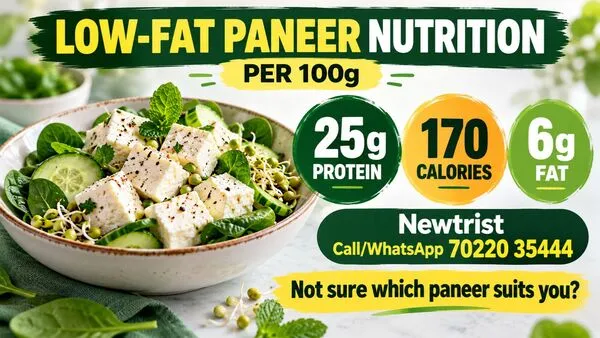
For example, Amul High Protein Tin Paneer provides 25g protein, 170 calories and 6g fat per 100g, compared with 20g protein, 312 calories and 24g fat in Amul Fresh Paneer.
These are product-specific values, not universal figures for every paneer variety. The best choice depends on the complete nutrition label and your individual requirements.
Table of Contents

What Is Low-Fat Paneer?
Low-fat paneer is a variety of paneer with a lower proportion of milk fat than regular full-fat paneer.
It is commonly prepared using skimmed or reduced-fat milk. However, the amount of moisture retained during manufacturing also affects its final nutritional composition.
In India, the Food Safety and Standards Authority of India (FSSAI) defines separate compositional categories for regular, medium-fat and low-fat paneer.
| Paneer classification | Milk fat on a dry-matter basis |
| Regular paneer | At least 50% |
| Medium-fat paneer | More than 20% but less than 50% |
| Low-fat paneer | Not more than 20% |
These percentages refer to the milk fat present in paneer’s dry matter, not the grams of fat in 100g of paneer as sold.
What Does Milk Fat on a Dry-Matter Basis Mean?
Paneer contains water. Dry matter is what remains when that water is excluded.
For example, imagine 100g of paneer containing 40g dry matter and 6g fat. Its fat content on a dry-matter basis would be 15%, while its nutrition label would show 6g fat per 100g.
This distinction explains why a paneer product can fall under the low-fat paneer category without containing zero fat.
For everyday nutritional comparisons, the declared grams of fat per 100g are generally easier to use.
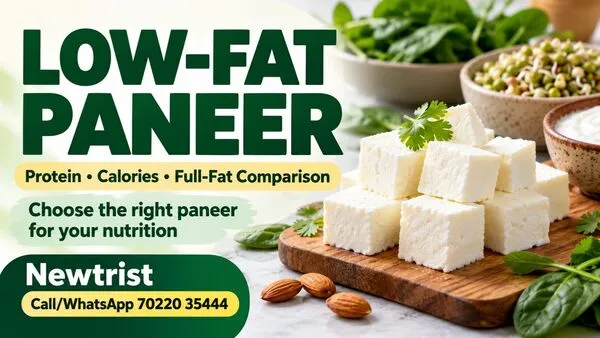
Low-Fat Paneer Nutrition per 100g
How much protein is in 100g of low-fat paneer?
There is no single figure that applies to every product. The protein, calories and fat depend on the milk composition, manufacturing process and moisture content.
To see how much the nutritional values can differ, consider these two Amul products.
| Nutrient per 100g | Amul High Protein Tin Paneer | Amul Fresh Paneer |
| Calories | 170 kcal | 312 kcal |
| Protein | 25g | 20g |
| Total fat | 6g | 24g |
| Saturated fat | 4g | 14.4g |
| Carbohydrates | 4g | 4g |
| Calcium | 350mg | 480mg |
| Sodium | 190mg | 24mg |
| Cholesterol | 15mg | 70mg |
Values are approximate manufacturer-declared figures for the named products. Amul High Protein Tin Paneer is packed in brine. Other paneer products may have different nutritional values.
Full-Fat vs Low-Fat Paneer: What Changes?
In this comparison, the lower-fat product provides 5g more protein, 18g less fat and 142 fewer calories per 100g.
That may make it attractive if you are looking for a higher protein concentration with less energy coming from fat.
But the comparison also reveals something important: the high-protein product contains less calcium and more sodium than the regular paneer.
That does not automatically make either product unsuitable.
It means the choice depends on which nutritional differences matter for you.
A paneer product should not be judged by its protein content alone.
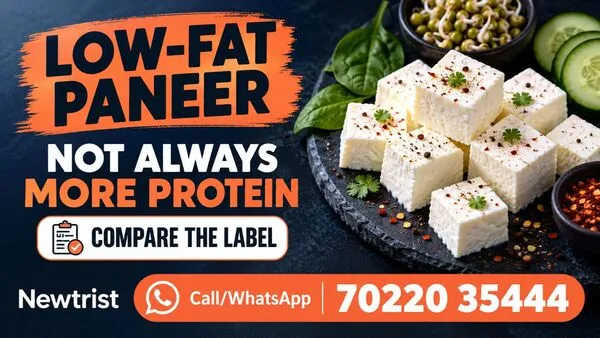
Does Low-Fat Paneer Always Contain More Protein?
No. Reducing the fat in paneer does not automatically increase its protein content.
Several factors affect the amount of protein in the finished product.
Milk Composition
The milk used to prepare paneer determines the milk solids available during processing. Different starting compositions can produce different nutritional profiles.
Moisture Retention
Water contributes to paneer’s weight but does not supply protein.
A paneer variety retaining more moisture may therefore contain less protein per 100g than a firmer variety with a higher concentration of milk solids.
Manufacturing Process
Some products are specifically manufactured to provide higher protein concentrations.
Others are designed to reduce fat while retaining particular texture characteristics.
This is why low-fat and high-protein are different descriptions.
One refers to fat composition. The other refers to protein content.
If protein is your main reason for comparing paneer products, look at the actual grams declared per 100g rather than assuming the lower-fat product must provide more.
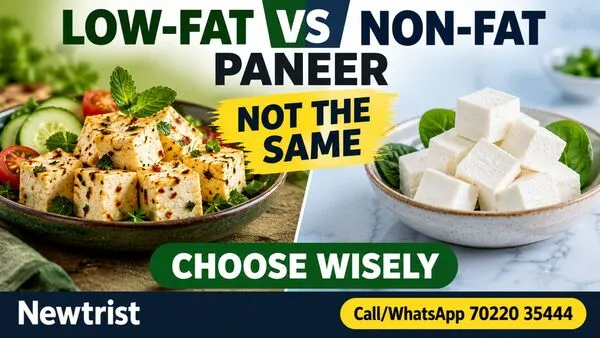
Low-Fat vs Non-Fat Paneer: Are They the Same?
No. Low-fat paneer and non-fat paneer should not automatically be considered nutritionally equivalent.
People sometimes use non-fat, fat-free and zero-fat as alternative names for low-fat paneer. However, these descriptions can imply much lower fat quantities.
The difference becomes clearer when you look at India’s general nutrition-claim conditions.
| General fat-content claim | Fat-content condition for solid foods |
| Low fat | Not more than 3g fat per 100g |
| Fat free | Not more than 0.5g fat per 100g |
These general nutrient-content claim conditions are separate from the product standard used to classify low-fat paneer by its fat percentage on a dry-matter basis.
For example, Amul High Protein Tin Paneer contains 6g fat per 100g and is described by its manufacturer as a low-fat paneer product. However, 6g exceeds the general 3g-per-100g threshold for a low-fat nutrient-content claim.
The two measurements should not be confused.
Does Non-Fat Paneer Contain Absolutely Zero Fat?
Not necessarily.
Under the general fat-free claim condition, a solid food may contain up to 0.5g fat per 100g.
Therefore, fat-free does not necessarily mean that laboratory testing would detect absolutely no fat.
If you are specifically looking for non-fat paneer, examine the declared total fat value rather than relying on the product name alone.
Is Paneer Made From Skimmed Milk Always Fat-Free?
No.
Skimmed milk contains very little fat, but small amounts may remain in the finished paneer.
The actual quantity depends on the starting milk and processing conditions.
Using skimmed milk is therefore not enough, by itself, to establish that a paneer product contains zero fat.
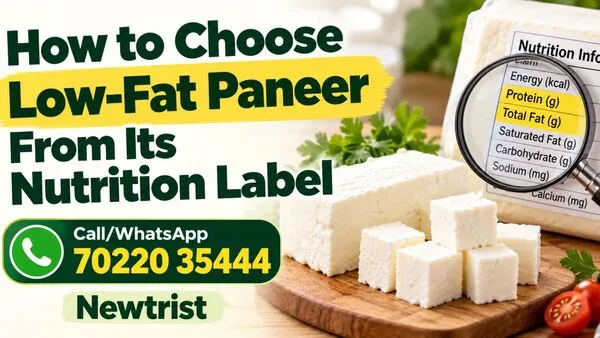
How to Choose Low-Fat Paneer From Its Nutrition Label
Imagine finding two lower-fat paneer products at the supermarket.
One highlights protein. The other draws attention to reduced calories.
Which one should you buy?
Start with the nutritional declaration rather than the promotional wording.
1. Compare Values per 100g
Check that you are comparing equivalent quantities.
A packet displaying nutrients per 50g cannot be directly compared with another displaying values per 100g without adjusting for the serving weight.
Using a common reference quantity makes the differences clearer.
2. Look at Total Fat and Saturated Fat
Total fat and saturated fat are not identical.
If moderating saturated fat intake is relevant to your nutritional requirements, check that value separately.
A reduction in total fat does not tell you everything about the product’s fat composition.
3. Check Calcium and Sodium
Some paneer varieties are packed in brine, which can contribute to a higher sodium content.
Calcium concentrations may also differ between products.
A higher protein value should not be taken as evidence that every other nutrient is present in a higher amount.
4. Read the Product Description and Ingredients
Look for information identifying the paneer variety, ingredients and milk composition.
If the product is packed in liquid, check whether the label also declares its drained weight.
The drained weight represents the paneer remaining after the packing liquid is removed.
These checks help you understand exactly what you are purchasing.
Why Does Low-Fat Paneer Have a Different Texture?
If you regularly eat full-fat paneer, you may notice that some lower-fat varieties feel firmer or less creamy.
Milk fat contributes to paneer’s richness and mouthfeel. Reducing it can alter the texture of the curds.
Moisture and processing also make a difference, so not every lower-fat paneer has the same firmness.
Does Low-Fat Paneer Become Rubbery When Cooked?
Some varieties can become firm or rubbery when heated excessively.
This may be noticeable when replacing regular paneer with a lower-fat product in familiar dishes.
For instance, palak paneer, methi paneer and paneer bhurji may feel different depending on the paneer used.
A product with suitable texture and flavour may be easier to enjoy regularly than one chosen solely because it has the lowest fat value.
Nutrition matters, but so does whether the food works in the meals you actually enjoy.
Should You Switch From Regular Paneer to Low-Fat Paneer?
You may be considering switching because you want fewer calories, less saturated fat or more protein from your paneer.
But what if your regular paneer already fits your nutritional requirements?
Or what if the lower-fat product you are considering changes nutrients that you also need to pay attention to?
The answer depends on why you want to make the change.
When Might Low-Fat Paneer Be a Better Choice?
A suitable lower-fat variety may be useful when reducing fat, saturated fat or energy from paneer is relevant to your dietary requirements.
Some lower-fat products may also provide a higher protein concentration.
However, the significance of that difference depends on the rest of your usual food intake.
When Might Regular Paneer Still Be Suitable?
Regular paneer may remain appropriate when its composition fits your needs and you prefer its taste or texture.
There is no requirement for everyone to replace full-fat paneer simply because a lower-fat alternative is available.
Consider two people who eat paneer regularly.
One may benefit from a product with less saturated fat. Another may already have a dietary pattern in which regular paneer is appropriate.
The same recommendation does not necessarily apply to both.
The goal is not to choose the paneer with the most impressive label. It is to choose a variety whose nutritional differences are useful for you.
Frequently Asked Questions About Low-Fat Paneer
Does Low-Fat Paneer Still Contain Lactose?
Yes. Low-fat paneer may contain residual lactose. Reducing milk fat does not remove lactose, although some lactose is separated with the whey during paneer preparation.
Does Low-Fat Paneer Contain Cholesterol?
Yes. Low-fat paneer can still contain cholesterol because it is made from milk. Its cholesterol content depends on the product’s composition, and reduced fat does not automatically mean zero cholesterol.
Can Someone With a Milk Protein Allergy Eat Low-Fat Paneer?
No. Low-fat paneer still contains milk proteins. Reducing the fat does not make paneer suitable for someone with a diagnosed milk protein allergy.
Is Switching to Low-Fat Paneer the Right Choice for You?
You may have started with a straightforward question: Would low-fat paneer be better than my regular paneer?
You now know that two products can differ in protein, fat, calories and other nutrients.
But knowing those figures does not necessarily tell you whether changing your paneer would meaningfully improve your own nutrition.
Perhaps you want more protein but are unsure whether your existing meals already provide enough.
You may be comparing saturated fat values without knowing how they fit into your usual food intake.
Or you might be considering an unfamiliar product simply because its nutritional claims sound more attractive.
A nutrition label can help you compare products. Personalised guidance can help you decide whether making the change is worthwhile.
Get Personalised Nutrition Guidance With Chief Nutritionist Vasanthi Senthilvel
At Newtrist Nutritionist Dietitian Dietician, Chief Nutritionist Vasanthi Senthilvel provides personalised nutrition guidance based on individual nutritional requirements, food habits, health considerations and everyday routines.
If you are uncertain whether to switch from regular paneer to a lower-fat or higher-protein variety, a personalised assessment can help you make that decision in the context of your actual meals.
Bring the nutrition labels of the paneer products you are considering and details of what you usually eat.
Vasanthi can help you understand whether their differences in protein, calories, fat and other nutrients are relevant to your requirements.
You may discover that your current paneer already suits your needs, or that a different variety would be a practical improvement.
The objective is not to replace familiar foods unnecessarily. It is to make dietary choices that suit your nutritional requirements and remain enjoyable in your daily routine.
Before switching paneer varieties based on a product claim, find out whether the change would genuinely benefit your nutrition.
Enquire About a Personalised Nutrition Consultation With Chief Nutritionist Vasanthi Senthilvel
Choose the paneer that fits your nutritional needs, not simply the claim on the packet.
Author
Chief Nutritionist Vasanthi Senthilvel leads Newtrist Nutritionist Dietitian Dietician, providing personalised diet plans for weight management and clinical nutrition for children, adolescents, adults and families.
She has 21 years of experience in nutrition and has received professional recognition for her work.
- Pride of Bharat Awards 2026: Outstanding Achievement in Holistic Health & Nutrition Innovation
- Doctor of The Year: Nutritionist 2026: Excellence in Clinical Nutrition and Weight Loss.
Her approach considers age, growth, health history, medical conditions, laboratory reports, medication, body composition, weight history, dietary preferences, regional food habits, family routines, activity, sleep and personal health goals. Recommendations are developed according to individual needs rather than using one standard diet for everyone.
Consultations are available in person at Bangalore HSR Layout, Koramangala, Bellandur, Haralur and Electronic City, as well as online across India.
Independent Medical Review Panel
Newtrist health and nutrition articles undergo medical review, where appropriate, by doctors with relevant specialist expertise. The medical professionals listed below contribute to Newtrist’s review process within their respective specialties.
| Speciality | Doctor |
|---|---|
| Endocrinology | Dr Vinay Prasad MBBS, MD, DM |
| Gastroenterology & Hepatology | Dr Sunil kumar N MBBS, MD, DM |
| Gynaecology | Dr Prathiba G MBBS, DNB, FIRM, FMAS |
| Nephrology | Dr Priyashree R MBBS, MD, DNB, DM |