
Written by: Chief Nutritionist Vasanthi Senthilvel
21 years of experience | Newtrist Nutritionist Dietitian Dietician
Best Nutritionist in Bangalore with multiple awards for excellence in clinical nutrition, weight loss, holistic health and nutrition innovation.
Medically reviewed by: Dr Prathiba G MBBS, DNB, FIRM, FMAS | Dr Sunil kumar N MBBS, MD, DM | Dr Vinay Prasad MBBS, MD, DM
Medical Disclaimer: Nutritional needs vary based on an individual’s profile. The information on this page is for general educational purposes only and is not intended to replace personalised medical or nutrition care.
Your usual Indian lunch might include roti, dal, vegetable curry and curd. But on a low FODMAP Indian diet, which of these can stay? Should onion and garlic disappear from every dish? And how do you know what is actually causing discomfort?
A food list cannot answer all those questions. The variety, portion size and ingredients used in cooking can change a meal’s FODMAP content, while individual tolerance differs. The useful starting point is to understand what to change temporarily and how to test what can return.
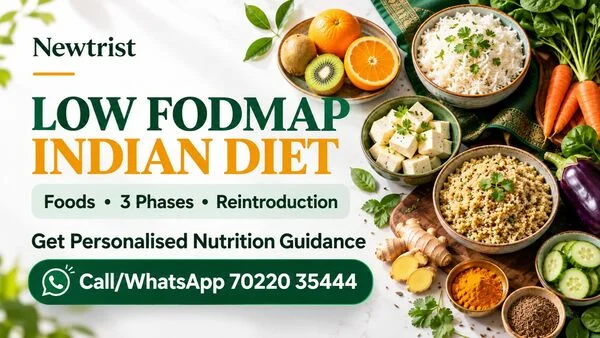
Key takeaway: A low FODMAP Indian diet has three steps: temporarily substitute higher-FODMAP ingredients, reintroduce FODMAP groups systematically, and personalise the long-term diet. Rice, many vegetables and suitable protein foods can remain; wheat, onion, garlic, pulses and some dairy products may require portion-specific changes. The objective is not permanent avoidance but a varied diet guided by individual tolerance.
Table of Contents

What Is a Low FODMAP Indian Diet?
A low FODMAP Indian diet temporarily reduces particular fermentable carbohydrates in familiar Indian foods. It is mainly used for selected people with irritable bowel syndrome (IBS) after appropriate clinical assessment.
FODMAP stands for Fermentable Oligosaccharides, Disaccharides, Monosaccharides and Polyols. Some of these carbohydrates are poorly absorbed in the small intestine; they can draw water into the bowel or be fermented by gut bacteria, contributing to symptoms in susceptible people.
| FODMAP group | Examples in Indian eating |
|---|---|
| Fructans | Wheat, onion, garlic |
| Galacto-oligosaccharides (GOS) | Rajma, chole, many dals |
| Lactose | Regular milk, some dairy products |
| Excess fructose | Mango, honey |
| Polyols | Apple, certain mushrooms |
FODMAP-containing foods are not inherently unhealthy. The purpose of the approach is to identify a person’s meaningful triggers without losing the nutrients and variety those foods may provide.
For a broader discussion of IBS nutrition beyond this specific approach, see Newtrist’s IBS diet guide.
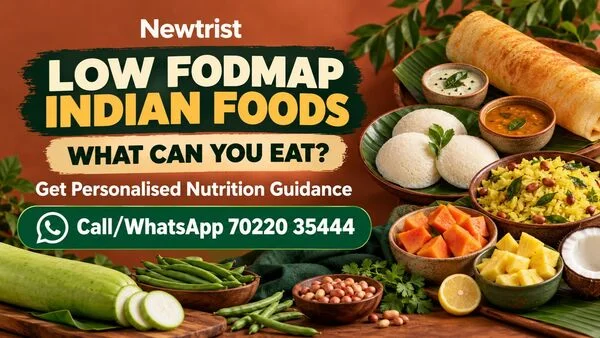
Low FODMAP Indian Foods: What Can You Eat?
The following examples are useful starting points, not permission to eat unlimited quantities. Food variety, processing, recipes and laboratory-tested serving sizes can change what is suitable.
Grains and Cereals
White and brown rice are generally straightforward low-FODMAP staples. Rice flour, quinoa and suitable portions of oats or corn-based products can provide alternatives. Some millet preparations may fit, but millet varieties should not be assumed interchangeable without portion-specific information.
Traditional wheat roti, chapati and naan contain fructans. During the initial step their amount may need reduction; reintroduction later helps establish whether wheat can return and in what quantity.
Vegetables and Fruits
Carrot, cucumber, potato, brinjal, green beans and green capsicum are examples of vegetables with suitable low-FODMAP servings. They can retain familiar regional flavours while providing nutrients, including beta-carotene from carrots.
Oranges, kiwi and pineapple are fruit options in suitable servings. Mango, apple and watermelon often need greater caution in usual portions. Freshness or a reputation for being healthy does not determine FODMAP suitability; the tested amount matters.
Protein Foods, Dal and Pulses
Eggs, plain fish and chicken contain negligible FODMAP carbohydrates. Firm tofu, peanuts and pumpkin seeds can support vegetarian choices, depending on individual needs. Seasonings and sauces added to these foods must be assessed separately.
Many dals, rajma and chole contain GOS. Some small tested servings of particular lentils or canned, drained legumes may be suitable, whereas larger portions may not be. Cooking and draining can reduce some water-soluble carbohydrates but do not reliably make every pulse low FODMAP.
For vegetarians who depend on legumes, indiscriminately removing pulses can narrow protein and fibre intake. Suitable replacements should be considered in the context of the complete diet.
Milk, Curd and Paneer
Regular milk contains lactose; lactose-free milk can be an option. Fermentation may lower lactose in curd, but the remaining amount varies. Paneer can differ by product and serving, so homemade and packaged versions should not be treated as identical.
Spices and Cooking Ingredients
Ginger, turmeric, cumin, curry leaves, mustard seeds, coriander leaves and cardamom can preserve familiar flavours. Garlic-infused oil can add garlic flavour if the garlic solids are completely removed, because fructans are not oil-soluble.
Read the ingredients of packaged masalas, curry pastes and compounded asafoetida: onion powder, garlic powder and wheat-based fillers can change the final dish.
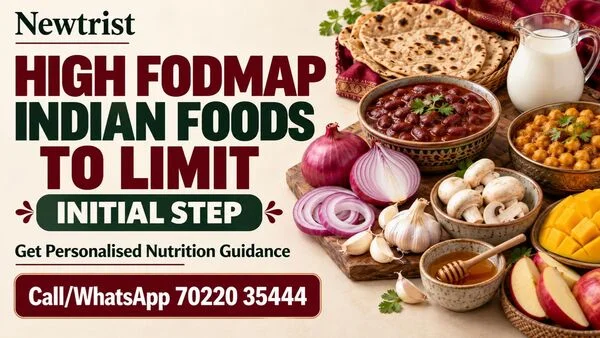
High FODMAP Indian Foods to Limit During the Initial Step
| Food or ingredient | Main FODMAP | Why to check it |
|---|---|---|
| Onion and garlic | Fructans | Frequent additions to gravies, chutneys and masalas |
| Wheat roti, naan and bread | Fructans | Total wheat quantity |
| Rajma and chole | GOS | Type, cooking method and portion |
| Regular milk | Lactose | Product and serving size |
| Mango and honey | Excess fructose | Common serving or amount added |
| Apple | Excess fructose, sorbitol | Typical serving may be high FODMAP |
| Certain mushrooms | Mannitol | Variety-dependent |
This is an initial substitution guide, not a lifelong avoidance list. Finished dishes must be assessed by ingredient and quantity rather than by their names alone.
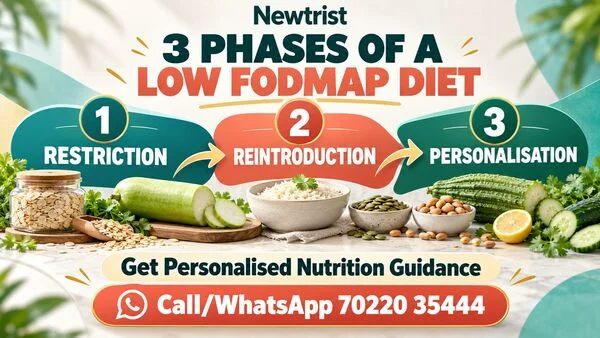
The 3 Phases of a Low FODMAP Diet
| Phase | Usual timeframe | Purpose |
|---|---|---|
| 1. Low-FODMAP substitution | 2–6 weeks | Check whether symptoms improve |
| 2. Reintroduction | Often 8–12 weeks | Identify tolerated FODMAP groups and quantities |
| 3. Personalisation | Long term | Bring back tolerated foods and maintain variety |
Phase 1: Temporary Substitution
Higher-FODMAP foods are replaced with appropriate lower-FODMAP choices while symptoms are assessed. For an Indian eater, changes might involve roti portions, the pulse used or onion and garlic in a curry base. If a properly followed trial brings no meaningful improvement, further restriction should be reconsidered rather than extended automatically.
Phase 2: Reintroduction
After symptoms improve sufficiently, specific FODMAP groups are challenged one at a time against a largely low-FODMAP background diet. This reveals more than the first phase alone can: whether a particular group and quantity is associated with symptoms.
Phase 3: Personalisation
Findings are used to broaden the diet, including suitable traditional foods again. Not everyone will need the same restrictions, and tolerance may change over time.
How Does Low FODMAP Reintroduction Work?
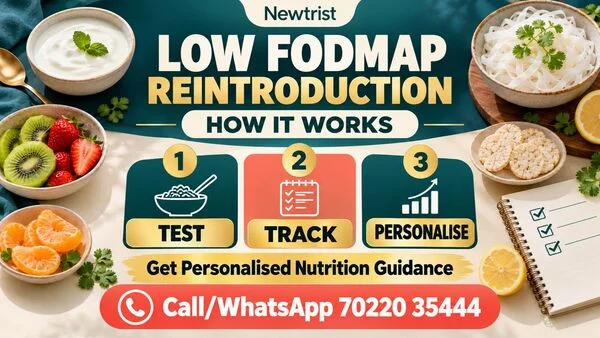
Imagine that discomfort improves after changing wheat, dal, garlic and milk at the same time. Which change mattered? A structured reintroduction can help distinguish those possibilities instead of keeping every food excluded.
Choose a Single FODMAP Challenge
A suitable test food is selected for lactose, excess fructose, fructans, GOS, sorbitol or mannitol. A mixed curry is usually a poor first challenge because it may contain several groups.
Increase the Challenge Quantity
A standard challenge commonly progresses over three days while the background diet remains low FODMAP. The challenge food and amounts should follow an appropriate protocol. Begin when symptoms are settled, and stop or review the challenge if significant symptoms develop.
Record Symptoms and Separate Challenges
Record the food, portion, time, bloating or abdominal discomfort, and any change in bowel habits. Leave a break between groups, especially after a symptomatic challenge. The interpretation should consider patterns rather than a single uncomfortable episode.
Apply the Findings to Indian Meals
The resulting information helps determine whether a food can return unchanged, in smaller quantities or less frequently. One person may tolerate wheat fructans but not larger servings of legumes; another may have a different pattern.
Why the Same Indian Dish May Have Different FODMAP Effects
Portions and Combined Ingredients
Many classifications depend on a measured serving. Several foods that contribute to the same FODMAP group can increase the total load in one meal, often called FODMAP stacking. This does not make all combinations unsuitable; actual quantities matter.
Regional and Restaurant Preparation
A vegetable curry made with ginger and cumin differs from one using onion, garlic and a packaged masala. The vegetable may be identical, but the complete dishes are not equivalent. This is especially relevant for shared family cooking and restaurant meals.
When Individual Nutrition Assessment Becomes Useful
Consider a vegetarian whose usual meals revolve around chapati, dal, curd and vegetable curry. Removing all these foods at once can affect protein, fibre, calcium and total food variety, yet does not prove that every one is a trigger.
Assessment becomes useful when several staple foods are excluded, the first phase is not helping, or challenge results are confusing. The priority is to identify meaningful food changes while meeting nutritional needs and preserving familiar Indian meals.
A low-FODMAP diet is not appropriate for everyone with bloating. Persistent, new or unexplained symptoms require clinical evaluation before a restrictive dietary trial is undertaken.
Personalised Clinical Nutrition With Vasanthi Senthilvel at Newtrist
If your list of foods to avoid keeps growing without clear answers, another generic chart is unlikely to settle which ingredients or quantities are relevant to you.
Chief Nutritionist Vasanthi Senthilvel at Newtrist provides personalised clinical nutrition guidance based on usual Indian meals, food preferences, nutritional requirements and digestive concerns. Where appropriate, individual assessment can help plan suitable substitutions, protect dietary adequacy and interpret a structured reintroduction process.
The goal is not a stricter list. It is a practical personalised nutrition approach that supports familiar foods wherever they are tolerated.
Frequently Asked Questions About the Low FODMAP Indian Diet
Are idli and dosa low FODMAP?
They may fit, but the rice-to-lentil ratio, fermentation, portion and accompaniments matter. Fermentation alone does not prove that a preparation is low FODMAP.
Can I eat wheat chapati during a low FODMAP diet?
Ordinary wheat chapati contains fructans, so its quantity may need adjustment initially. Whether it can return, and in what amount, depends on later tolerance testing.
Does soaking and cooking make every dal low FODMAP?
No. Some water-soluble FODMAPs may decrease, but pulse variety, drainage and serving size still determine suitability.
Is low FODMAP the same as gluten-free?
No. FODMAPs are fermentable carbohydrates, while gluten is a protein. A gluten-free food can still contain high-FODMAP ingredients.
Can I follow a low FODMAP Indian diet as a vegetarian?
Yes, but restricting legumes, dairy and wheat together can make it harder to meet protein, fibre and micronutrient needs. Appropriate alternatives need individual consideration.
Can I restart a food that previously caused discomfort?
Often it can be reassessed later using a suitable structured challenge. Tolerance may change; a previous response does not automatically justify lifelong avoidance.
Conclusion
A low FODMAP Indian diet is most useful when it helps answer specific food-tolerance questions. Appropriate substitutions, careful reintroduction and eventual personalisation can retain far more of the usual Indian diet than a permanent restriction chart suggests.
When familiar meals have become difficult to interpret or the diet is getting unnecessarily narrow, personalised clinical nutrition guidance can help translate the process into suitable everyday choices.
Author
Chief Nutritionist Vasanthi Senthilvel leads Newtrist Nutritionist Dietitian Dietician, providing personalised diet plans for weight management and clinical nutrition for children, adolescents, adults and families.
She has 21 years of experience in nutrition and has received professional recognition for her work.
- Pride of Bharat Awards 2026: Outstanding Achievement in Holistic Health & Nutrition Innovation
- Doctor of The Year: Nutritionist 2026: Excellence in Clinical Nutrition and Weight Loss.
Her approach considers age, growth, health history, medical conditions, laboratory reports, medication, body composition, weight history, dietary preferences, regional food habits, family routines, activity, sleep and personal health goals. Recommendations are developed according to individual needs rather than using one standard diet for everyone.
Consultations are available in person at Bangalore HSR Layout, Koramangala, Bellandur, Haralur and Electronic City, as well as online across India.
Independent Medical Review Panel
Newtrist health and nutrition articles undergo medical review, where appropriate, by doctors with relevant specialist expertise. The medical professionals listed below contribute to Newtrist’s review process within their respective specialties.
| Speciality | Doctor |
|---|---|
| Endocrinology | Dr Vinay Prasad MBBS, MD, DM |
| Gastroenterology & Hepatology | Dr Sunil kumar N MBBS, MD, DM |
| Gynaecology | Dr Prathiba G MBBS, DNB, FIRM, FMAS |
| Nephrology | Dr Priyashree R MBBS, MD, DNB, DM |