
Written by: Chief Nutritionist Vasanthi Senthilvel
21 years of experience | Newtrist Nutritionist Dietitian Dietician
Best Nutritionist in Bangalore with multiple awards for excellence in clinical nutrition, weight loss, holistic health and nutrition innovation.
Medically reviewed by: Dr Prathiba G MBBS, DNB, FIRM, FMAS | Dr Sunil kumar N MBBS, MD, DM | Dr Vinay Prasad MBBS, MD, DM
Medical Disclaimer: Nutritional needs vary based on an individual’s profile. The information on this page is for general educational purposes only and is not intended to replace personalised medical or nutrition care.
After gallbladder removal, the confusing part often begins when you try to eat normally again. A simple breakfast may feel completely comfortable, while a richer meal leaves you with heaviness, urgency, bloating or loose stools. Even the same food may feel fine in one quantity and uncomfortable in another.
A diet after cholecystectomy should help you understand these differences rather than leave you dependent on a permanent avoid-list. The practical goal is to find comfortable meal sizes, choose preparations your digestion handles well and gradually return to a varied diet without becoming unnecessarily afraid of food.
Key takeaway: Most people can gradually return to a varied diet after cholecystectomy. During the adjustment period, manageable portions and avoiding a large amount of fat in one sitting may improve food tolerance. There is no single diet or portion size that suits everyone, so your progression should reflect your appetite and digestive response.
Table of Contents
Why Can Digestion Feel Different After Gallbladder Removal?
Your liver still produces bile after the gallbladder is removed. The main difference is that bile is no longer stored between meals in the gallbladder and released in a larger amount when food reaches the intestine.
Instead, bile enters the small intestine more continuously.
This does not mean you can no longer digest normal food. Many people return to a broad diet. During the adjustment period, however, particularly rich meals may feel more difficult to handle.
That is why the useful question is not simply “Which foods are allowed?” but “What type of meal can I comfortably manage now?”
Diet After Cholecystectomy: How Should Meals Be Structured?
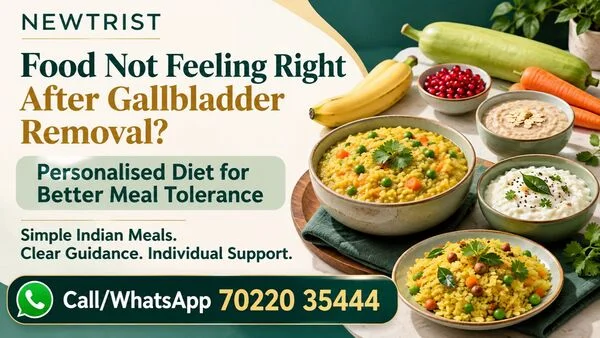
A practical post-cholecystectomy meal is neither excessively restrictive nor unnecessarily rich. Start with an amount you can comfortably finish, keep concentrated sources of fat moderate at one sitting and increase dietary variety according to tolerance.
Start with a comfortable portion
Your normal pre-surgery portion does not have to be your starting point.
If a full plate repeatedly leaves you overly full or uncomfortable, reduce the quantity at that meal. When the amount feels comfortable and you are still hungry, gradually increase it.
The aim is not to keep eating tiny meals indefinitely. It is to reach portions that satisfy hunger without repeatedly overwhelming your present tolerance.
Keep concentrated fat moderate at one sitting
You usually do not need a completely fat-free diet after gallbladder removal.
The amount and concentration of fat in one meal are more useful to consider. A home-cooked meal prepared with a modest quantity of oil is very different from combining fried starters, a butter-heavy curry and a rich dessert in one sitting.
Steaming, boiling, pressure cooking, grilling and light sautéing can make meals easier to adjust without making them bland.
Increase fibre progressively
Fibre-containing foods can remain part of your diet, but there is little advantage in suddenly making every meal extremely high in fibre.
Oats, dalia, dals, vegetables, fruit and whole grains can be increased progressively as your bowel pattern becomes more predictable.
Which Indian Foods Can Fit After Gallbladder Removal?
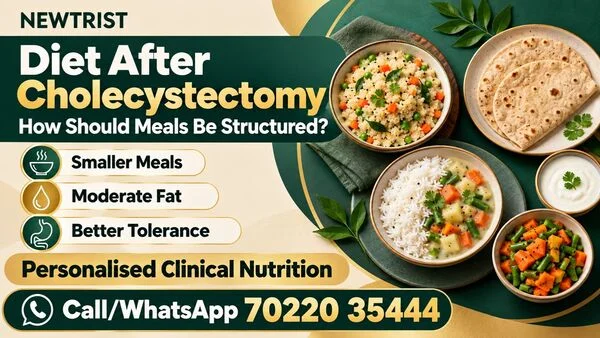
Familiar Indian foods can usually remain part of eating after gallbladder removal. The usefulness of a food depends less on whether it has a special label and more on how it is prepared, how much you eat and what accompanies it.
| Food | Why it can fit |
| Moong dal | Provides plant protein and can be prepared with little added fat |
| Dalia | Provides carbohydrate and fibre without needing a rich preparation |
| Oats | Provides soluble fibre and works well in simple preparations |
| Lauki | Can be cooked softly without cream or heavy gravies |
| Pumpkin | Provides vegetables and can be prepared with modest added fat |
| Papaya | Adds fruit and fibre without making a meal rich |
| Low-fat curd | Provides protein and calcium when dairy is comfortably tolerated |
| Makhana | Can be dry-roasted as an alternative to fried snacks |
| Eggs | Provide protein and can be prepared without substantial added fat |
| Lean fish or skinless chicken | Provide protein with less concentrated fat than fatty or fried meat preparations |
These are examples, not compulsory foods.
Your regional staples, vegetarian preferences, egg-based meals or non-vegetarian choices can usually be adapted using the same principles.
Which Foods Are Worth Testing More Carefully?
Some foods and preparations are worth reintroducing more cautiously because even a relatively small serving can make the overall meal much richer.
| Food or preparation | What makes it different |
| Poori, bhatura, pakoda, samosa and chips | Deep-frying substantially increases fat |
| Creamy or butter-heavy gravies | A modest serving may contain considerable added fat |
| Fatty cuts of meat or chicken with skin | More concentrated in fat than leaner alternatives |
| Rich bakery products and creamy desserts | A small portion may still contain substantial fat |
| Coconut-rich gravies | Large quantities of coconut can make the dish considerably richer |
| Large servings of nuts and seeds | Nutritious, but naturally concentrated in fat |
| Several rich dishes eaten together | Their combined effect may be more difficult than any one food |
Think of these as foods to test according to tolerance, not foods that automatically need permanent exclusion.
How Can You Find Your Personal Food Tolerance?
Food tolerance becomes clearer when you investigate the meal rather than immediately blaming one ingredient.
Separate the ingredient from its preparation
Suppose paneer butter masala causes discomfort.
That does not establish that paneer itself is unsuitable. Butter, cream, the quantity eaten and other foods in the meal may all change how you respond.
Trying paneer another time in a simpler preparation provides more useful information than removing paneer permanently after one experience.
Change one factor at a time
If you simultaneously reduce the portion, change the cooking method and remove several ingredients, you may feel better without knowing what helped.
When practical, adjust one obvious variable at a time. For example, you might compare a smaller serving of the same food or test it using a simpler preparation.
Look for repeated patterns
One uncomfortable meal does not always reveal a genuine food intolerance.
If your reactions remain difficult to predict, keep a brief record for a few days of:
- what you ate
- approximately how much
- how the meal was prepared
- what was eaten with it
- what happened afterwards
You are looking for a pattern, not creating a permanent diary.
Sample 1-Day Indian Diet After Gallbladder Removal
This example demonstrates how food can be distributed through the day without concentrating several rich foods into one meal. Use it only after suitable solid foods have been permitted.
It is an illustration rather than an individual prescription.
| Meal | Menu | What the meal demonstrates |
| Breakfast | 2 small idlis with ¾ cup lightly prepared sambar | Familiar food with little need for added fat |
| Mid-morning | 1 small bowl papaya | A simple eating occasion between larger meals |
| Lunch | 1 cup cooked rice, ¾ cup moong dal, 1 cup lauki sabzi and ½ cup low-fat curd if tolerated | Protein, carbohydrate and vegetables without a rich gravy |
| Evening | 1 small banana with a small handful of dry-roasted makhana | A non-fried snack combination |
| Dinner | 2 small phulkas, ¾ cup masoor dal and 1 cup pumpkin sabzi | A moderate evening meal without several concentrated fat sources |
Use modest amounts of oil during preparation.
Do not treat these quantities as targets. If this amount leaves you uncomfortably full, your current portion may need to be smaller. If you are consistently hungry and comfortably tolerating the meals, your requirements may be higher.
The purpose of the example is to demonstrate distribution and preparation, not to give everyone the same permanent menu.
Frequently Asked Questions
Can I drink tea or coffee after gallbladder removal?
Many people tolerate tea and coffee normally after gallbladder removal. If either repeatedly seems to cause urgency or discomfort, try a smaller or less concentrated serving and assess it separately from fried snacks or other rich foods that may normally accompany it.
Can I eat spicy food after gallbladder removal?
Spices do not automatically need to be avoided. Very spicy preparations may be uncomfortable for some people, so return to your usual spice level gradually if you are unsure of your tolerance.
Should I skip meals after gallbladder removal?
There is generally no need to skip meals simply because your gallbladder has been removed. Long gaps may leave you very hungry and make a much larger subsequent meal more likely. Choose an eating pattern that suits your appetite and daily routine.
What if I can eat normally without any digestive symptoms?
You do not need to create restrictions simply because the gallbladder has been removed. If your usual foods and portions feel comfortable, continue building a varied diet rather than following avoid-lists intended for people experiencing digestive difficulty.
Does food tolerance improve with time after gallbladder removal?
It can. Foods or quantities that are uncomfortable during the early adjustment period may be tolerated differently later. This is one reason permanent exclusions should not automatically be based on a single early reaction.
When should digestive symptoms be medically reviewed?
Persistent, severe or worsening diarrhoea, abdominal symptoms or other significant digestive problems should be medically assessed. Continually removing more foods without understanding the cause can make the diet unnecessarily restrictive.
When General Advice Stops Being Enough
A general gallbladder removal diet guide should make eating progressively easier. If instead your list of “safe foods” keeps getting shorter, general advice may have reached its limit.
Perhaps breakfast is comfortable but dinner remains unpredictable. You may have stopped eating eggs, paneer, curd, nuts or several vegetables because each appeared responsible at a different time. Or perhaps you are eating less than you want because you no longer know what quantity will feel comfortable.
At that point, another food list is unlikely to solve the problem.
The important questions become more personal:
- Which meals are actually causing difficulty?
- Is the problem the food, the amount or the preparation?
- Which restrictions are justified?
- Are your present portions and food choices still meeting your nutritional requirements?
Chief Nutritionist Vasanthi Senthilvel at Newtrist Nutritionist Dietitian Dietician can assess your usual Indian meals, appetite, food tolerance, portions, cooking methods, lifestyle and nutritional requirements and develop a personalised approach around what you can realistically eat.
The purpose is not to make your diet more restrictive. It is to remove unnecessary guesswork, preserve as much food variety as possible and decide what genuinely needs adjustment.
Author
Chief Nutritionist Vasanthi Senthilvel leads Newtrist Nutritionist Dietitian Dietician, providing personalised diet plans for weight management and clinical nutrition for children, adolescents, adults and families.
She has 21 years of experience in nutrition and has received professional recognition for her work.
- Pride of Bharat Awards 2026: Outstanding Achievement in Holistic Health & Nutrition Innovation
- Doctor of The Year: Nutritionist 2026: Excellence in Clinical Nutrition and Weight Loss.
Her approach considers age, growth, health history, medical conditions, laboratory reports, medication, body composition, weight history, dietary preferences, regional food habits, family routines, activity, sleep and personal health goals. Recommendations are developed according to individual needs rather than using one standard diet for everyone.
Consultations are available in person at Bangalore HSR Layout, Koramangala, Bellandur, Haralur and Electronic City, as well as online across India.
Independent Medical Review Panel
Newtrist health and nutrition articles undergo medical review, where appropriate, by doctors with relevant specialist expertise. The medical professionals listed below contribute to Newtrist’s review process within their respective specialties.
| Speciality | Doctor |
|---|---|
| Endocrinology | Dr Vinay Prasad MBBS, MD, DM |
| Gastroenterology & Hepatology | Dr Sunil kumar N MBBS, MD, DM |
| Gynaecology | Dr Prathiba G MBBS, DNB, FIRM, FMAS |
| Nephrology | Dr Priyashree R MBBS, MD, DNB, DM |