
Written by: Chief Nutritionist Vasanthi Senthilvel
21 years of experience | Newtrist Nutritionist Dietitian Dietician
Best Nutritionist in Bangalore with multiple awards for excellence in clinical nutrition, weight loss, holistic health and nutrition innovation.
Medically reviewed by: Dr Prathiba G MBBS, DNB, FIRM, FMAS | Dr Sunil kumar N MBBS, MD, DM | Dr Vinay Prasad MBBS, MD, DM
Medical Disclaimer: Nutritional needs vary based on an individual’s profile. The information on this page is for general educational purposes only and is not intended to replace personalised medical or nutrition care.
A fatty liver diet can become confusing surprisingly quickly. One person tells you to stop rice, another says fruit contains too much sugar, and someone else suggests removing carbohydrates altogether.
The result can be a long list of restrictions without a clear understanding of what your own diet actually needs.
A better approach is to look at the foods you eat regularly, improve the balance of your meals and change the habits that matter most. Familiar Indian foods can still have a place. The important questions are what you eat, how your meals are put together and whether the quantities suit your nutritional needs.
Key takeaway: A fatty liver diet generally includes more vegetables, whole fruits, fibre-rich carbohydrate foods and suitable protein sources while limiting added sugars, highly refined foods and portions that regularly exceed your requirements. Rice and other familiar Indian foods do not need to be banned automatically. The right meal structure and quantities depend on factors such as body composition, metabolic health, activity and usual food habits.
Table of Contents
What Should Change in a Fatty Liver Diet?
Start by looking at what happens during an ordinary week rather than concentrating on occasional foods.
For one person, sweets, bakery products or packaged snacks may appear almost every day. Another person’s meals may contain plenty of grain-based food but very little vegetable or protein. Someone else may make nutritious food choices but regularly eat more than their body requires.
Each situation calls for a different priority.
- Are vegetables regularly part of your main meals?
- Does each main meal contain a suitable protein source?
- What foods usually become your snacks?
- How often do sweets, bakery foods and packaged foods appear?
- Are you eating because you are hungry, or mainly because a habitual portion has been served?
These questions help identify where meaningful changes can begin without unnecessarily removing foods that may still fit your diet.
Foods to Eat More Often With Fatty Liver
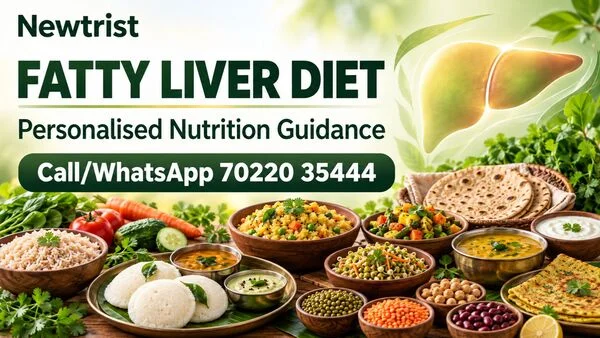
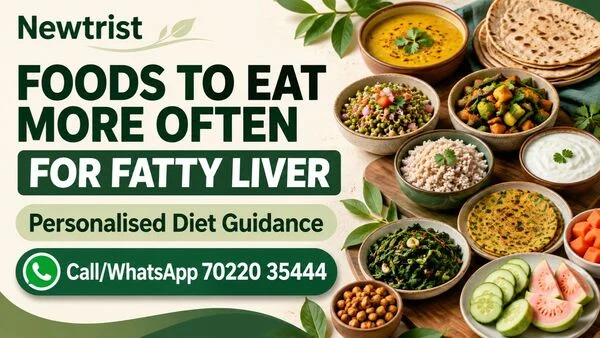
There is no single “best food” for fatty liver. The more useful approach is to regularly choose foods that improve the nutritional quality of the diet as a whole.
Vegetables and whole fruits
Vegetables provide fibre, nutrients and variety and can occupy a regular place in main meals.
Familiar Indian choices include gourds, beans, brinjal, ladies’ finger, carrots, cauliflower, cabbage, pumpkin and leafy vegetables. Seasonal and locally available vegetables are suitable; there is no need to search for unusual produce.
Whole fruits can also be included. Guava, papaya, oranges, apples, bananas, pomegranate, melons and other seasonal fruits can fit according to individual requirements.
Whole fruit is nutritionally different from sweets and highly sweetened foods and does not need to be excluded simply because it contains naturally occurring carbohydrate.
Fibre-rich carbohydrate foods
Having fatty liver does not mean you need to eliminate carbohydrates.
Whole wheat, oats, millets and other less-refined grain choices can form part of balanced meals. Familiar staples such as rice can also fit when their quantity and the rest of the meal are appropriate.
The objective is not to make carbohydrate disappear. It is to avoid letting one carbohydrate-rich food dominate the meal while vegetables and protein receive too little space.
Suitable protein foods
Protein helps make meals nutritionally complete and can improve satisfaction after eating.
Depending on dietary preferences, suitable sources can include dals, chickpeas, rajma and other pulses, as well as curd, paneer, eggs, fish or chicken.
How much protein is appropriate depends on the individual. Simply adding more protein because it is considered healthy does not automatically create a balanced diet.
Nuts, seeds and appropriate fats
A fatty liver diet does not need to be fat-free.
Nuts and seeds can contribute useful fats along with other nutrients, while cooking fats can remain part of normal food preparation.
The important point is moderation within the total diet. A nutritious food can still contribute more energy than needed when consumed in excessive amounts.
Foods to Avoid or Limit With Fatty Liver
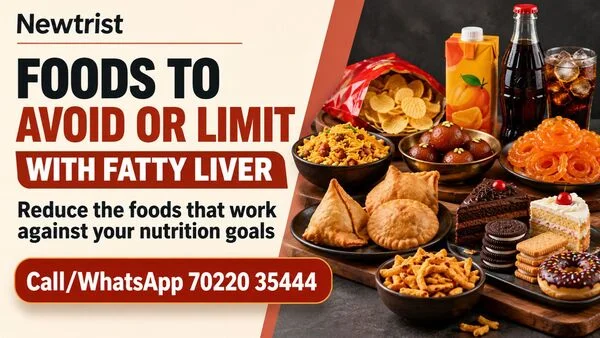
People searching for foods to avoid with fatty liver often expect a strict prohibited-food list. In practice, it is more useful to reduce food categories that have become too frequent rather than create unnecessary restrictions.
Foods high in added sugar
Sweets, confectionery, desserts, heavily sweetened packaged products and sugar-rich beverages can contribute substantial energy without providing the same nutritional value as minimally processed foods.
How often they appear matters.
An occasional sweet is different from having sweet foods or drinks repeatedly throughout the day.
Highly refined and heavily processed foods
Frequent bakery products, packaged snacks, refined flour foods and fried snacks can gradually replace more nutritious foods in everyday eating.
The goal does not have to be perfect avoidance. It is to prevent these foods from becoming routine choices that repeatedly crowd out vegetables, fruits, pulses and other nutritionally useful foods.
Portions that repeatedly exceed your needs
Food quality matters, but quantity still counts.
When total food intake regularly exceeds what the body requires, body-weight and metabolic goals can become harder to achieve.
This does not mean every person needs smaller portions. It means portion size should reflect the person’s actual needs rather than being copied from another person’s diet plan.
Is a Mediterranean Diet Good for Fatty Liver?
A Mediterranean-style diet can be a useful dietary pattern for fatty liver, but you do not need to replace Indian meals with Mediterranean dishes.
The useful principles include eating plenty of plant foods, choosing minimally processed grains, including pulses, nuts, seeds and appropriate protein foods, and relying less on highly refined and heavily processed foods.
These principles can be applied using familiar Indian ingredients.
Local vegetables, dals, traditional grains and familiar protein foods can provide the foundation. What matters is the nutritional pattern rather than whether the dishes belong to a particular cuisine.
A Mediterranean approach can therefore influence how you choose and balance foods without requiring you to abandon the foods your household normally eats.
Does Weight Loss Matter for Fatty Liver?
Weight reduction can be useful when excess body weight is relevant, but not everyone with fatty liver needs to lose weight.
For someone carrying excess body fat, gradual and sustainable weight management may be an important part of the nutrition strategy. Dietary quality should still be maintained rather than trying to achieve weight loss by simply eating as little as possible.
Someone whose body weight is already appropriate may need different priorities. Changing meal composition and food quality may be more relevant than trying to make the weighing scale move down.
The important distinction is simple: a fatty liver diet is not automatically a weight-loss diet.
Sample 1-Day Fatty Liver Diet Plan for an Indian Adult
The following day is designed to show how balanced food groups can come together using familiar foods. It is an example of meal structure rather than a personalised prescription.
| Meal | Menu |
| Breakfast | Vegetable moong dal chilla with plain curd |
| Mid-morning | Whole seasonal fruit with nuts |
| Lunch | Rice, sambar, cooked vegetable and plain curd |
| Evening | Roasted chana with unsweetened buttermilk |
| Dinner | Vegetable millet khichdi with cucumber curd |
What should you take from this sample?
The important lesson is not that these exact dishes have to be eaten.
Look instead at the structure. Vegetables appear through the day, protein-containing foods are included across meals and carbohydrate foods form part of meals rather than being the only substantial component.
The example also shows that rice does not have to disappear simply because fatty liver has been identified.
Your own meals could look completely different. A household may prefer chapati, idli, dosa or other familiar staples. Vegetarian and non-vegetarian diets can both be structured appropriately.
What a sample day cannot tell you is how much food you need.
That depends on factors such as body composition, activity, appetite, metabolic health and whether weight management is relevant. This is where copying a meal plan becomes less useful than understanding your own requirements.
When Does a Fatty Liver Diet Need to Be Personalised?
General nutrition advice can tell you which direction to move in. It cannot always tell you which change matters most for you.
Personalisation becomes more useful when several questions remain unresolved, such as:
- Should your portions actually be reduced?
- Is weight reduction appropriate for you?
- How should meals change when blood glucose or triglycerides are also a concern?
- How much carbohydrate and protein fit your requirements?
- Which familiar foods can remain part of your regular diet?
- How can your meals work around office timings, travel and family food?
- Why did previous diet plans become difficult to continue?
These decisions require more than knowing which foods are generally considered healthy.
Your everyday food habits matter
A diet has to work in the life you actually lead.
Someone eating a traditional South Indian diet may need different adjustments from someone eating mainly North Indian meals. A vegetarian household has different practical choices from a family that regularly includes eggs, fish or chicken.
Work schedules, eating outside, family cooking, affordability and food availability can also affect which changes are realistic.
The aim of personalised clinical nutrition is therefore not to replace familiar food unnecessarily. It is to decide how familiar food should be used for your nutritional goals.
When Should You Consider Consulting a Nutritionist for Fatty Liver?
Consider personalised nutrition when you understand the basic principles but are still unsure how to turn them into your own daily meals.
This can be particularly useful if you have tried making several changes at once, received conflicting advice about common foods, have metabolic concerns that need to be considered alongside your diet, or find standard diet charts difficult to follow.
At Newtrist, Chief Nutritionist Vasanthi Senthilvel can assess your current food intake, nutritional requirements, relevant clinical information, food preferences, daily routine and weight goals where appropriate before developing a personalised diet plan.
The purpose is not to give you a longer list of restrictions.
It is to answer practical questions that general information cannot settle:
What should you change first? What can you continue eating? How much food is appropriate for you? And how can those changes fit into meals you can realistically continue?
If you have reached the point where you know the general rules but still do not know how to apply them to yourself, a personalised diet plan can provide that missing clarity.
Consult Chief Nutritionist Vasanthi Senthilvel for a personalised diet plan based on your nutritional requirements, food habits and practical long-term goals.
Frequently Asked Questions
Can a vegetarian diet be suitable for fatty liver?
Yes. A vegetarian diet can be suitable when it includes a varied combination of vegetables, whole fruits, pulses, grains, nuts, seeds and suitable protein-rich foods. The nutritional balance of the complete diet matters more than whether it contains non-vegetarian food.
Do you need to eat every two or three hours if you have fatty liver?
No. There is no fixed eating interval that everyone with fatty liver needs to follow. Meal frequency should suit appetite, daily routine and nutritional requirements.
Is fasting necessary for fatty liver?
No. Fasting is not required to follow an appropriate fatty liver diet. A balanced eating pattern can be created without making fasting part of the approach.
Can you eat restaurant food if you have fatty liver?
Yes. Eating at a restaurant occasionally does not make an otherwise balanced diet unsuitable. Consider how often you eat outside, the size of the meal and whether the choice provides a reasonable balance of vegetables, protein-rich food and carbohydrate.
Do you need separate “diet food” from the rest of your family?
Usually not. Family meals can often be adjusted by changing their balance or the amount served to the individual. This can be easier to maintain than preparing completely separate meals every day.
How long should you follow a fatty liver diet?
The aim is to develop an eating pattern that can become part of normal life rather than follow a short-term programme for a fixed number of days. The details can be adjusted as nutritional needs, activity, body composition or metabolic goals change.
Author
Chief Nutritionist Vasanthi Senthilvel leads Newtrist Nutritionist Dietitian Dietician, providing personalised diet plans for weight management and clinical nutrition for children, adolescents, adults and families.
She has 21 years of experience in nutrition and has received professional recognition for her work.
- Pride of Bharat Awards 2026: Outstanding Achievement in Holistic Health & Nutrition Innovation
- Doctor of The Year: Nutritionist 2026: Excellence in Clinical Nutrition and Weight Loss.
Her approach considers age, growth, health history, medical conditions, laboratory reports, medication, body composition, weight history, dietary preferences, regional food habits, family routines, activity, sleep and personal health goals. Recommendations are developed according to individual needs rather than using one standard diet for everyone.
Consultations are available in person at Bangalore HSR Layout, Koramangala, Bellandur, Haralur and Electronic City, as well as online across India.
Independent Medical Review Panel
Newtrist health and nutrition articles undergo medical review, where appropriate, by doctors with relevant specialist expertise. The medical professionals listed below contribute to Newtrist’s review process within their respective specialties.
| Speciality | Doctor |
|---|---|
| Endocrinology | Dr Vinay Prasad MBBS, MD, DM |
| Gastroenterology & Hepatology | Dr Sunil kumar N MBBS, MD, DM |
| Gynaecology | Dr Prathiba G MBBS, DNB, FIRM, FMAS |
| Nephrology | Dr Priyashree R MBBS, MD, DNB, DM |