
Written by: Chief Nutritionist Vasanthi Senthilvel
21 years of experience | Newtrist Nutritionist Dietitian Dietician
Best Nutritionist in Bangalore with multiple awards for excellence in clinical nutrition, weight loss, holistic health and nutrition innovation.
Medically reviewed by: Dr Prathiba G MBBS, DNB, FIRM, FMAS | Dr Sunil kumar N MBBS, MD, DM | Dr Vinay Prasad MBBS, MD, DM
Medical Disclaimer: Nutritional needs vary based on an individual’s profile. The information on this page is for general educational purposes only and is not intended to replace personalised medical or nutrition care.
Searching for a PMOS diet chart for Indian women usually means you want something practical: familiar Indian meals, enough variety, and a chart you can actually imagine eating. This 7-day PMOS diet chart uses everyday grains, pulses, vegetables, fruits and protein-rich foods to show what that can look like without turning the page into a rigid prescription.
PMOS is the current name for the condition previously known as PCOS. The menu is designed to help you compare food choices and meal combinations; the foods and quantities that suit you still depend on your needs, preferences and routine.
Key Takeaway: A practical PMOS diet chart should make food choices easier, not stricter. It can be built from familiar Indian staples, varied protein sources, vegetables and fruit, with enough flexibility for regional and household preferences. The seven days below show useful combinations; an individual plan decides which foods, combinations and quantities fit you.
Table of Contents
What Should a Practical PMOS Diet Chart Include?
A practical PMOS diet chart should provide variety while remaining close enough to everyday Indian food to be realistic for the household.
- Different staples rather than dependence on one supposedly ideal grain.
- Varied protein choices from pulses, dairy, eggs, fish, chicken or suitable vegetarian alternatives.
- Vegetables and whole fruits across the eating pattern.
- Enough flexibility to accommodate vegetarian, egg-based and non-vegetarian preferences.
The menu below demonstrates these principles without prescribing individual quantities.
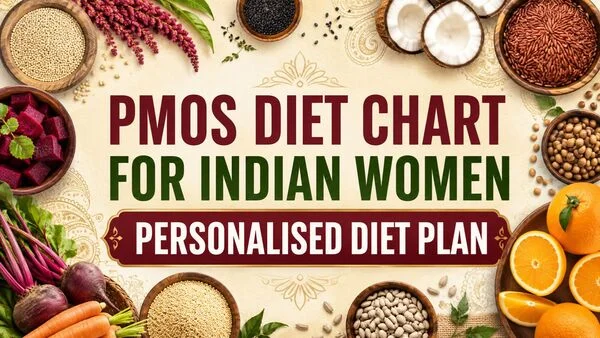
7-Day PMOS Diet Chart for Indian Women
This seven-day PMOS menu uses mostly familiar healthy Indian foods, with a few newer options for variety and convenience.
The between-meal option is optional. Whether one is useful depends on appetite, the interval between meals and individual nutritional needs.
Day 1: Overnight Oats, Rajma Rice and Methi Paneer
| Meal | Indian Menu |
|---|---|
| Breakfast | Overnight oats with plain curd or milk, seasonal fruit, chia seeds and nuts |
| Lunch | Rajma with rice, cucumber-tomato salad and plain curd |
| Between-meal option, if needed | Guava or apple with roasted chana |
| Dinner | Phulka with methi paneer and mixed vegetables |
Day 2: Ragi Dosa, Chole-Roti and Moong Dal Khichdi
| Meal | Indian Menu |
|---|---|
| Breakfast | Ragi dosa with vegetable-rich sambar |
| Lunch | Chole with phulka, bhindi sabzi and plain curd |
| Between-meal option, if needed | Orange or another seasonal fruit with unsalted nuts |
| Dinner | Vegetable moong dal khichdi with cucumber raita |
Day 3: Vegetable Poha, Chana-Millet Lunch and Palak Paneer
| Meal | Indian Menu |
|---|---|
| Breakfast | Vegetable poha with peas, peanuts and plain curd |
| Lunch | Millet lemon rice with chana sundal and cucumber-vegetable salad |
| Between-meal option, if needed | Roasted makhana with a seasonal whole fruit |
| Dinner | Phulka with palak paneer or palak tofu and seasonal vegetables |
Day 4: Idli-Sambar, Dal-Rice and Egg or Paneer Bhurji
| Meal | Indian Menu |
|---|---|
| Breakfast | Idli with vegetable-rich sambar |
| Lunch | Rice, mixed dal, beans poriyal and cucumber salad |
| Between-meal option, if needed | Sprouts chaat with cucumber, tomato and lemon |
| Dinner | Egg bhurji with roti and vegetables, or paneer bhurji as a vegetarian alternative |
Day 5: Moong Chilla, Rajma-Millet Bowl and Paneer or Tofu Wrap
| Meal | Indian Menu |
|---|---|
| Breakfast | Vegetable moong dal chilla with plain curd |
| Lunch | Rajma with millet or rice, mixed vegetables and cucumber raita |
| Between-meal option, if needed | Seasonal fruit with pumpkin seeds or unsalted nuts |
| Dinner | Whole-wheat paneer or tofu tikka wrap with vegetables and mint-curd dip |
Day 6: Vegetable Uthappam, Fish or Chicken Curry and Adai
| Meal | Indian Menu |
|---|---|
| Breakfast | Vegetable uthappam with sambar |
| Lunch | Rice with fish or chicken curry and vegetable poriyal; a bean-based curry can replace the non-vegetarian option |
| Between-meal option, if needed | Roasted chana with cucumber |
| Dinner | Vegetable adai with sambar and plain curd |
Day 7: Yoghurt-Fruit Bowl, Sambar Rice and Mixed Dal-Roti
| Meal | Indian Menu |
|---|---|
| Breakfast | Plain curd or Greek-style yoghurt with seasonal fruit, oats and mixed nuts |
| Lunch | Sambar rice with vegetable poriyal and plain curd |
| Between-meal option, if needed | Steamed dhokla with mint curd |
| Dinner | Chapati with mixed dal and seasonal vegetable sabzi |
What Does This Seven-Day PMOS Diet Chart Demonstrate?
The seven days demonstrate that familiar Indian foods can provide plenty of variety without making one grain, fruit or protein source compulsory.
Rice, roti and millets all appear. Protein comes from different combinations of pulses, dairy, tofu, eggs, fish or chicken. Vegetarian, egg-based and non-vegetarian preferences can therefore use the same broad framework.
The few contemporary choices are there for variety, not because newer foods are automatically better.
Which Healthy Indian Foods Can You Rotate in a PMOS Diet?
A useful PMOS food list gives you interchangeable choices rather than another list of foods everyone is expected to eat.
| Food Group | Familiar Healthy Choices |
|---|---|
| Pulses and legumes | Moong, masoor, toor dal, chana, rajma, lobia, whole green gram, sprouts and regional pulses |
| Dairy and vegetarian proteins | Plain curd, milk, paneer, tofu, soy foods and suitable non-dairy alternatives |
| Egg, fish and poultry choices | Eggs, fish and chicken for people who include them |
| Staples and grains | Rice, phulka, chapati, jowar, bajra, ragi, oats, dalia and regional millet preparations |
| Vegetables | Leafy vegetables, gourds, beans, bhindi, brinjal, carrot, beetroot, cauliflower, capsicum and seasonal vegetables |
| Whole fruits | Guava, orange, papaya, apple, pear, banana, pomegranate and other seasonal fruits |
| Nuts and seeds | Peanuts, almonds, walnuts, sesame, flaxseed, pumpkin seeds and chia seeds |
| Optional between-meal choices | Whole fruit, plain curd, roasted chana, sprouts, makhana, nuts or seeds |
The aim is rotation according to preference, region and availability, not buying everything on the list.
Can the PMOS Diet Chart Be Vegetarian, Egg-Based or Non-Vegetarian?
Yes. The overall structure can remain similar while the protein choices change according to food preference and nutritional requirements.
| Preference | How the Menu Can Vary |
|---|---|
| Vegetarian | Rotate dals, chana, rajma, curd, paneer, tofu, soy foods, nuts and seeds. |
| Egg-based | Eggs can replace selected paneer or tofu choices while pulses and other vegetarian foods remain part of the wider pattern. |
| Non-vegetarian | Fish or chicken can be included in selected meals while dals, vegetables, curd and familiar staples continue to provide variety. |
No one preference is automatically the right choice for everyone. What matters is whether the complete eating pattern meets the person’s nutritional requirements.
How Can You Adapt This PMOS Diet Chart to Regional and Family Foods?
Keep the role of the food, but change the ingredient when another regional or family choice fits better.
Change the Staple
Rice, roti, jowar, bajra, ragi, millet or another familiar staple can be used according to the meal and individual requirements. The chart does not make one grain compulsory.
Change the Protein
Paneer may be exchanged for tofu, a suitable pulse, egg, fish or chicken depending on food preference. Rajma or chana can similarly be replaced with another familiar pulse.
Use Seasonal Local Produce
The fruits and vegetables in the seven-day chart are examples. Seasonal local alternatives can be used according to availability and preference.
Keep Suitable Family Dishes
A household dal, sambar, vegetable curry, paneer preparation, egg dish or fish curry may already fit comfortably into the broader pattern. Sometimes the personalised decision is how much or what to combine with it, rather than whether the family dish needs replacing.
Does This PMOS Diet Chart Need to Change if You Have Insulin Resistance?
It may. Confirmed insulin resistance or abnormal glucose can change decisions about carbohydrate choices, meal combinations and individual quantities.
PMOS alone does not mean every woman needs the same insulin-resistance eating pattern.
When metabolic findings are present, the detailed decisions belong in the PCOS insulin resistance nutrition guidance rather than turning this page into a second insulin-resistance article.
Many familiar foods may still remain suitable while their quantity or combination needs individual review.
What if Weight Loss Is Also Your Goal?
This PMOS diet chart does not assume that every woman with PMOS needs intentional weight loss.
Its purpose is to provide a practical Indian diet-chart and meal-menu framework.
If weight management is an appropriate individual goal, appetite, present intake, weight history, previous dieting, activity and sustainability create additional decisions. Those belong in the dedicated PCOS weight-loss diet guidance.
The seven-day menu should not automatically become more restrictive simply because weight loss has been added as another goal.
When Should This 7-Day PMOS Diet Chart Be Personalised?
Personalisation becomes useful when the chart gives you suitable food possibilities but cannot determine which choices and quantities fit you.
- How much rice, roti, millet or another staple suits your nutritional requirements?
- Do you need a between-meal option at all?
- Which protein choices best fit your usual eating pattern?
- Which foods can stay exactly as your family already prepares them?
- Does a medical or metabolic finding change a meal?
- Does an allergy, intolerance or food preference require a substitution?
- Which apparently healthy additions are actually unnecessary for you?
These are decisions a general seven-day chart cannot make for one person.
Chief Nutritionist Vasanthi Senthilvel can review your usual food intake, relevant health information, food preferences, appetite and household meals and translate the broad chart into individual food, quantity and substitution decisions.
For one person, most familiar meals may stay exactly where they are and only quantities need adjusting. For another, vegetarian protein variety may need more attention. Someone with relevant metabolic findings may need a different combination of familiar foods. Another person may be buying several “healthy” foods they do not actually need when simpler household choices would work just as well.
That is the difference between receiving more food ideas and resolving the decisions that actually determine your own diet.
A 7-day PMOS diet chart shows you what your week could look like. A personalised diet plan determines which foods, quantities and substitutions your week actually needs.
Consult Chief Nutritionist Vasanthi Senthilvel for a personalised PMOS diet plan built around your nutritional requirements, familiar foods, health priorities and everyday eating pattern.
Author
Chief Nutritionist Vasanthi Senthilvel leads Newtrist Nutritionist Dietitian Dietician, providing personalised diet plans for weight management and clinical nutrition for children, adolescents, adults and families.
She has 21 years of experience in nutrition and has received professional recognition for her work.
- Pride of Bharat Awards 2026: Outstanding Achievement in Holistic Health & Nutrition Innovation
- Doctor of The Year: Nutritionist 2026: Excellence in Clinical Nutrition and Weight Loss.
Her approach considers age, growth, health history, medical conditions, laboratory reports, medication, body composition, weight history, dietary preferences, regional food habits, family routines, activity, sleep and personal health goals. Recommendations are developed according to individual needs rather than using one standard diet for everyone.
Consultations are available in person at Bangalore HSR Layout, Koramangala, Bellandur, Haralur and Electronic City, as well as online across India.
Independent Medical Review Panel
Newtrist health and nutrition articles undergo medical review, where appropriate, by doctors with relevant specialist expertise. The medical professionals listed below contribute to Newtrist’s review process within their respective specialties.
| Speciality | Doctor |
|---|---|
| Endocrinology | Dr Vinay Prasad MBBS, MD, DM |
| Gastroenterology & Hepatology | Dr Sunil kumar N MBBS, MD, DM |
| Gynaecology | Dr Prathiba G MBBS, DNB, FIRM, FMAS |