
Written by: Chief Nutritionist Vasanthi Senthilvel
21 years of experience | Newtrist Nutritionist Dietitian Dietician
Best Nutritionist in Bangalore with multiple awards for excellence in clinical nutrition, weight loss, holistic health and nutrition innovation.
Medically reviewed by: Dr Prathiba G MBBS, DNB, FIRM, FMAS | Dr Sunil kumar N MBBS, MD, DM | Dr Vinay Prasad MBBS, MD, DM
Medical Disclaimer: Nutritional needs vary based on an individual’s profile. The information on this page is for general educational purposes only and is not intended to replace personalised medical or nutrition care.
A weight-management approach can be sensible on paper and still fail because it was designed for the wrong life. A desk job, college timetable, childcare, a changing life stage or later-life priorities can alter what is practical and what needs protecting nutritionally.
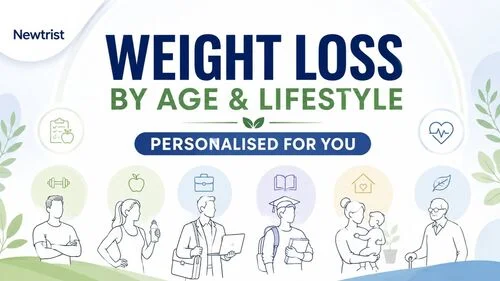
Weight loss by age and lifestyle is therefore not about creating a separate diet chart for every group. It is about recognising which parts of the approach need to change when the person’s stage of life, schedule and responsibilities change.
Key takeaway: Weight loss by age and lifestyle means adapting weight-management priorities to the circumstances that shape eating, activity and nutritional needs. Men, women, professionals, students, mothers and seniors may share many of the same familiar foods, but they do not automatically share the same constraints or priorities. Exact dietary changes depend on the individual, with additional care needed during growth, pregnancy or breastfeeding, and later life.
Table of Contents

How Weight Loss by Age and Lifestyle Changes the Planning Problem
The main difference is usually not a new set of “weight-loss foods”. It is the problem the plan has to solve. For one person, the priority may be making food choices work around unpredictable work hours. For another, it may be protecting growth, recovery, muscle, appetite or day-to-day function while body weight is being considered.
The broad principles of safe weight management are covered in Newtrist’s weight loss tips. This page focuses only on how age, life stage and routine change the application of those principles.
Weight Loss for Men: What May Need a Different Approach
Weight loss for men should reflect the man’s actual goal and routine, not a standard “men’s diet”. A desk-based professional, a physically active man and someone with a demanding manual job can have very different eating patterns, activity demands and practical barriers even when all three want to manage body weight.
For someone who trains regularly or values strength, an unnecessarily restrictive approach can make training and recovery harder to sustain. For someone whose day is largely sedentary, the recurring problem may instead be long work hours, late eating or limited movement during the day.
Sex can influence nutritional requirements, but it is not enough to prescribe an approach. Age, body composition, appetite, activity, health context and the structure of the working day can matter just as much. A demographic label should start the assessment, not complete it.
Weight Loss for Women: How Life Stage and Routine Can Matter
Weight loss for women can mean very different things at different life stages. A woman in early adulthood, a woman recovering after childbirth and a woman approaching or living through menopause may all search for the same advice while having different nutritional priorities.
Pregnancy, the postpartum period and breastfeeding should not be treated as ordinary short-term weight-loss situations. The nutritional context changes, and the appropriate focus depends on recovery, feeding status, health and individual circumstances.
Menopause also deserves more than a generic “weight loss for women” explanation. Readers looking specifically at that life stage can use Newtrist’s diet plan for menopause for the issues unique to menopause. The wider point is that one women’s weight-loss formula cannot represent every stage of life.
Weight Loss for Busy Professionals: Making Healthy Changes Fit a Workday
Weight loss for busy professionals often breaks down at the level of logistics. A plan may look reasonable on a quiet weekend and become unworkable during the week because meetings, commuting, travel, shifts, client commitments or late finishes change when and where food is available.
The test of a useful approach is whether it can survive the person’s ordinary workday without depending on perfect timing or special foods. One professional may repeatedly miss eating opportunities during long meetings. Another may face restaurant meals, rotating shifts or travel that changes the food environment from one day to the next.
Those are different practical problems, so they should not receive the same “office diet”. Weight-management planning becomes more useful when it is built around the constraints that recur most often rather than an ideal routine that rarely happens.
Weight Loss Diet for Students: What to Consider Around Classes and Campus Life
A weight loss diet for students should first distinguish adult students from adolescents who are still growing. Adult college or university students may need to work around lectures, exams, hostel or canteen food, limited budgets, social eating and schedules that change from one day to another.
For an adult student, the central issue may be consistency in an environment with limited control over food access and timing. A useful approach should fit the food environment the student actually has, rather than assume a private kitchen, expensive speciality foods or a perfectly predictable timetable.
For children and adolescents, adult-style restrictive weight-loss dieting should not simply be copied. Growth, development, activity, appetite and the individual growth pattern need to be considered together. Parents concerned about a younger student’s weight or growth should use age-appropriate pediatric nutrition guidance rather than a smaller version of an adult diet.
Weight Loss for Busy Moms: What Makes an Approach Practical
Weight loss for busy moms often succeeds or fails on whether it fits around caregiving and shared family routines. A separate “diet menu” can become one more task in a day already organised around children, work, shopping, school schedules and household responsibilities.
The practical question is how much extra effort the approach adds. If weight management depends on separate preparation, rigid timing or a routine the household cannot support, the design of the approach may be the obstacle.
Busy mothers also differ widely in work hours, childcare demands, support at home and personal time. A useful approach should fit those realities instead of assuming that every mother has the same schedule or capacity for change.
Weight Loss Diet for Seniors: Prioritising Nutrition, Strength and Health
A weight loss diet for seniors should not be judged only by how quickly the number on the scale falls. In later life, maintaining muscle, strength, mobility, appetite and nutritional adequacy can be as important as changing body weight.
Older adults may also face practical issues that are less common earlier in adulthood, including reduced appetite, difficulty chewing or swallowing, lower mobility or social barriers to eating regularly. These factors can change whether intentional weight loss is appropriate and how cautiously it should be approached.
Unintentional or unexplained weight loss in an older adult should not be treated as successful dieting. It deserves medical assessment because the first priority is to understand why weight is falling and whether nutritional status or function is being affected. For some older adults, maintaining weight and strength may be more appropriate than actively pursuing weight loss.
A Few Questions That Do Not Fit a Simple Age Group
Does shift work need a different weight-management approach?
Yes, because shift work can change sleep periods, activity, food access and eating opportunities. The answer is not a universal “night-shift diet”. A workable approach needs to reflect the actual shift pattern, how often it changes and what food is realistically available during work and recovery periods.
Can two adults in the same household use the same weight-loss plan?
They can often share many of the same household foods, but the complete approach may still need to differ. Body size, activity, appetite, life stage, work pattern, health and personal goals can change appropriate quantities and priorities. Shared food can be practical without assuming that two people need identical dietary instructions.
Do men automatically need a higher-protein weight-loss diet than women?
No. Sex alone does not determine an appropriate protein intake or weight-loss approach. Body size, lean mass, activity, training demands, total food intake and individual health considerations can all influence protein needs. A general article cannot determine the correct amount for one person.
Does a major routine change mean a previously workable plan may need adjustment?
Yes. Moving into a hostel, starting shift work, becoming a parent, changing jobs or retiring can alter food access, activity and the structure of the day. A plan that fitted the previous routine may become impractical even if its general principles were reasonable. Reassessment should focus on what changed rather than simply adding more restriction.
When Age and Lifestyle Overlap
Most people fit more than one label. A woman may also be a shift-working professional and a mother; a senior may still train regularly; an adult student may work part-time and live in a hostel. Once several realities overlap, advice written for a single audience can start to pull in different directions.
That is the real value of looking at weight loss by age and lifestyle. The labels identify the questions that need answering, but they should not become six different generic diets. The final approach still has to make sense for one person’s life.
When Personalised Nutrition Guidance May Help
General advice becomes less useful when several priorities collide or when a sensible plan repeatedly fails to fit the person’s actual day. At that point, the missing piece is often not another list of foods but a decision about which priorities matter most and how they can work together.
Chief Nutritionist Vasanthi Senthilvel at Newtrist Nutritionist Dietitian Dietician provides personalised weight-management guidance. An individual assessment can consider life stage, body composition, weight history, appetite, activity, work or study schedule, family responsibilities, food preferences, regional food habits and relevant health factors, then use those findings to develop a personalised diet plan.
Consult Chief Nutritionist Vasanthi Senthilvel for a personalised diet plan developed around your life stage, routine, food preferences and weight-management goals.
Author
Chief Nutritionist Vasanthi Senthilvel leads Newtrist Nutritionist Dietitian Dietician, providing personalised diet plans for weight management and clinical nutrition for children, adolescents, adults and families.
She has 21 years of experience in nutrition and has received professional recognition for her work.
- Pride of Bharat Awards 2026: Outstanding Achievement in Holistic Health & Nutrition Innovation
- Doctor of The Year: Nutritionist 2026: Excellence in Clinical Nutrition and Weight Loss.
Her approach considers age, growth, health history, medical conditions, laboratory reports, medication, body composition, weight history, dietary preferences, regional food habits, family routines, activity, sleep and personal health goals. Recommendations are developed according to individual needs rather than using one standard diet for everyone.
Consultations are available in person at Bangalore HSR Layout, Koramangala, Bellandur, Haralur and Electronic City, as well as online across India.
Independent Medical Review Panel
Newtrist health and nutrition articles undergo medical review, where appropriate, by doctors with relevant specialist expertise. The medical professionals listed below contribute to Newtrist’s review process within their respective specialties.
| Speciality | Doctor |
|---|---|
| Endocrinology | Dr Vinay Prasad MBBS, MD, DM |
| Gastroenterology & Hepatology | Dr Sunil kumar N MBBS, MD, DM |
| Gynaecology | Dr Prathiba G MBBS, DNB, FIRM, FMAS |
| Nephrology | Dr Priyashree R MBBS, MD, DNB, DM |