
Written by: Chief Nutritionist Vasanthi Senthilvel
21 years of experience | Newtrist Nutritionist Dietitian Dietician
Best Nutritionist in Bangalore with multiple awards for excellence in clinical nutrition, weight loss, holistic health and nutrition innovation.
Medically reviewed by: Dr Prathiba G MBBS, DNB, FIRM, FMAS | Dr Sunil kumar N MBBS, MD, DM | Dr Vinay Prasad MBBS, MD, DM
Medical Disclaimer: Nutritional needs vary based on an individual’s profile. The information on this page is for general educational purposes only and is not intended to replace personalised medical or nutrition care.
Strength progress can stall even when protein intake rises, because muscle gain is an adaptation problem, not a protein problem alone. Sports nutrition for muscle gain has to support progressive resistance training, enough total energy, repeatable training quality and recovery while keeping body-composition change useful rather than indiscriminate.
Chief Nutritionist Vasanthi Senthilvel at Newtrist Nutritionist Dietitian Dietician considers the training programme, current eating pattern, appetite, body composition and progression because the limiting factor differs between athletes.
Key takeaway: Sports nutrition for muscle gain should support the training stimulus that drives adaptation, not simply increase food or protein without context. Adequate energy, well-distributed high-quality protein, carbohydrate that supports demanding resistance sessions and recovery all matter, but the appropriate amounts vary with training status, programme, appetite, body composition and rate of progress. A copied bulking routine cannot determine one athlete’s needs.
Table of Contents

Why sports nutrition for muscle gain starts with adaptation, not food volume
Resistance training provides the stimulus for strength and muscle adaptation. Food provides the energy and building blocks that allow the athlete to respond to that stimulus. If training is not progressing, simply adding more food does not guarantee that the additional body weight will be useful lean mass.
The practical aim is to make the training programme easier to progress and recover from while monitoring what kind of change is occurring. Strength, repetitions completed, training quality, recovery and body-composition trends can be more informative together than scale weight alone.
Energy availability should support progression, not uncontrolled gain
Strength and power athletes need enough energy to support daily life, resistance training and tissue-building processes. When intake repeatedly falls short of the workload, training quality and adaptation can become harder to sustain. At the other extreme, a very large increase in food intake can raise body weight faster than the athlete can convert that extra energy into lean tissue.
That makes the useful question more specific than “Am I eating enough?” It is whether the current intake supports progressive training without creating an unnecessary mismatch between body-weight gain, body composition and performance. Training status, programme volume, appetite and the athlete’s starting body composition all change that answer.
Protein should support resistance-training adaptation, not dominate the diet
Protein supplies amino acids used in repair and adaptation after resistance training, but muscle gain does not depend on one oversized protein serving or one special food. Total intake, protein quality and how protein-containing foods are distributed through the day are more useful considerations than chasing a single “perfect” post-workout dose.
The broader protein principles belong in Newtrist’s sports and performance nutrition guidance. For strength athletes, the key consequence is that protein needs to sit inside an eating pattern that also supplies enough total energy, carbohydrate, dietary fats and micronutrients. More protein cannot fully compensate for inadequate food intake or a training programme that is not producing progressive overload.
Carbohydrate protects the training work that produces the signal
Carbohydrate is not a direct substitute for resistance training or protein, but it can support the quality of demanding strength sessions. High-volume resistance training, repeated sets, accessory work and concurrent sport can all increase the importance of arriving at sessions with enough available fuel.
An athlete who removes too much carbohydrate to make room for extra protein may reduce the amount or quality of work that can be completed. The appropriate emphasis depends on the programme: a short low-volume session creates a different fuel problem from a long hypertrophy-focused session or a strength programme combined with team or endurance training.
Appetite and food volume can become the real bottleneck
Some athletes know they need to eat more but struggle to do so consistently. Low appetite, long work or college days, early training, very bulky food choices and digestive comfort can all limit total intake even when the athlete is highly motivated.
The solution is not automatically to rely on highly processed “bulking” foods or specialised products. A useful review looks at whether food volume, energy density, eating opportunities and dietary variety are workable for the athlete’s routine. The same food pattern can feel adequate at one training volume and become too difficult when the programme progresses.
Recovery from resistance training should be judged by the next session
Recovery matters because progressive resistance training depends on repeating high-quality work. Nutrition is part of that process, but persistent soreness or stalled performance is not solved by one recovery food. The timing of the next demanding session, the training split, total food intake, sleep and the athlete’s ability to eat after hard sessions all influence readiness.
A strength-focused plan therefore asks whether the athlete can return to the next relevant session able to perform the planned work. If recovery repeatedly limits progression, the useful response is to examine the whole training-and-eating pattern rather than simply adding another protein product.
Body-composition progression should be useful, not simply faster
A muscle-gain phase can increase scale weight without every kilogram representing new muscle. Changes in fluid, stored carbohydrate, fat mass and lean tissue can all influence body weight, while strength progress also reflects technique and training experience.
The goal is therefore not the fastest possible increase on the scale. The athlete should be able to see whether body-composition change is supporting the sport and the training objective. Athletes who are simultaneously trying to reduce body fat may need a different strategy, which is covered in Newtrist’s performance-sensitive body composition guide.
Creatine can be relevant, but it is not the starting point
Creatine monohydrate is one of the better-studied supplements for adult strength and power athletes, and it can improve strength and lean-mass outcomes for some people when combined with resistance training. It is not required to build muscle, and it does not replace adequate food intake or a progressive training programme.
Whether creatine is appropriate depends on factors such as age, health context, sport rules, current intake, product quality and the athlete’s actual objective. The strength page therefore treats creatine as a specific tool that may have a purpose, not as the foundation of a muscle-gain plan or a reason to build a long supplement list.
Indian superfoods relevant to strength and muscle gain
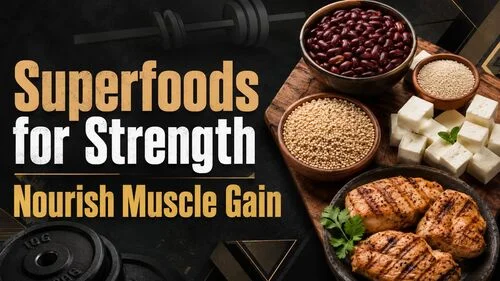
Here, “superfood” is only a reader-friendly label. No individual food can create muscle gain by itself. These examples show characteristics that may be useful within a varied strength-focused eating pattern without forming a menu or prescribing quantities.
- Besan (gram flour): provides plant protein and carbohydrate in a familiar Indian staple ingredient and can broaden protein-source variety.
- Rajma: contributes plant protein, carbohydrate, iron and fibre, making it a substantial pulse choice rather than a specialised sports food.
- Tofu: provides concentrated plant protein; mineral content varies by how the product is made, so the label can matter.
- Chicken: provides high-quality protein and vitamin B12 for athletes who include poultry.
- Rohu and other locally eaten fish: provide high-quality protein and vitamin B12, while fat and omega-3 content vary by species.
- Milk: provides protein, carbohydrate and calcium in a relatively compact form for athletes who include and tolerate dairy.
- Cashews: contribute energy, unsaturated fats, some protein and minerals in a small food volume, which can matter when appetite is limiting.
When personalised strength planning may help
General information can explain what supports resistance-training adaptation, but it cannot determine how much one athlete should eat, how quickly body composition should change or how food should fit a specific programme. The limiting factor may be insufficient total intake, poor training fuel, low appetite, inconsistent recovery, dietary monotony or an expectation that exceeds what the current programme can support.
Vasanthi may assess the training programme, current eating pattern, body composition, appetite, recovery, progression and food preferences. A personalised diet plan can then focus on the variables that are actually limiting lean-mass development while remaining practical for the athlete’s routine and food culture.
Strength and muscle gain FAQs
Do I need protein immediately after lifting?
No. Resistance-training adaptation does not depend on hitting one exact post-workout minute. A sensible whole-day protein pattern, adequate total food intake and repeated high-quality training matter more than treating one short window as decisive. The practical timing still depends on when the athlete last ate, session timing, appetite and the rest of the day’s food pattern.
Should a strength athlete eat much less on rest days?
Not automatically. A non-lifting day can still involve recovery, tissue adaptation and ordinary daily activity, so a large routine drop in food intake may not match the athlete’s needs. The appropriate change depends on the training week, activity outside the gym, appetite, body-composition objective and how soon the next demanding session occurs.
Do beginners and experienced lifters need the same muscle-gain strategy?
No. Training experience changes how quickly strength and lean mass may progress and how much training stress is needed to create further adaptation. A beginner may respond to a simpler programme, while an experienced lifter may need more precise coordination between training volume, recovery and food intake. One rate of weight gain or one food target therefore cannot suit every training age.
Can an athlete build muscle while also training for another sport?
Yes, but the plan has to reflect the combined workload. A footballer, runner or racquet athlete adding resistance training may need to support both sport-specific sessions and strength work, while recovery time can become a limiting factor. Nutrition for muscle gain should therefore fit the primary sport, weekly training structure and competition demands rather than copy a stand-alone gym routine.
Is creatine necessary for muscle gain?
No. Creatine can be a useful evidence-based option for some adult strength and power athletes, but muscle gain still depends on resistance training, adequate food intake and recovery. Suitability varies with age, health context, sport rules and product quality. An athlete can make meaningful progress without creatine, so it should solve a specific problem rather than be treated as compulsory.
Progress that supports the sport
Sports nutrition for muscle gain works best when food intake supports the training programme rather than becoming a separate “bulk” project. The useful outcome is progressive strength and lean-mass development that fits the athlete’s sport, appetite, recovery and body-composition goals, which is why one standard muscle-gain diet cannot suit every athlete.
Personalised strength and muscle-gain support
If your strength programme is progressing but your eating pattern is difficult to match to appetite, body-composition goals or recovery, you may consult Vasanthi for an individual assessment and a personalised diet plan designed around your training programme and food preferences.
Author
Chief Nutritionist Vasanthi Senthilvel leads Newtrist Nutritionist Dietitian Dietician, providing personalised diet plans for weight management and clinical nutrition for children, adolescents, adults and families.
She has 21 years of experience in nutrition and has received professional recognition for her work.
- Pride of Bharat Awards 2026: Outstanding Achievement in Holistic Health & Nutrition Innovation
- Doctor of The Year: Nutritionist 2026: Excellence in Clinical Nutrition and Weight Loss.
Her approach considers age, growth, health history, medical conditions, laboratory reports, medication, body composition, weight history, dietary preferences, regional food habits, family routines, activity, sleep and personal health goals. Recommendations are developed according to individual needs rather than using one standard diet for everyone.
Consultations are available in person at Bangalore HSR Layout, Koramangala, Bellandur, Haralur and Electronic City, as well as online across India.
Independent Medical Review Panel
Newtrist health and nutrition articles undergo medical review, where appropriate, by doctors with relevant specialist expertise. The medical professionals listed below contribute to Newtrist’s review process within their respective specialties.
| Speciality | Doctor |
|---|---|
| Endocrinology | Dr Vinay Prasad MBBS, MD, DM |
| Gastroenterology & Hepatology | Dr Sunil kumar N MBBS, MD, DM |
| Gynaecology | Dr Prathiba G MBBS, DNB, FIRM, FMAS |
| Nephrology | Dr Priyashree R MBBS, MD, DNB, DM |