
Written by: Chief Nutritionist Vasanthi Senthilvel
21 years of experience | Newtrist Nutritionist Dietitian Dietician
Best Nutritionist in Bangalore with multiple awards for excellence in clinical nutrition, weight loss, holistic health and nutrition innovation.
Medically reviewed by: Dr Prathiba G MBBS, DNB, FIRM, FMAS | Dr Sunil kumar N MBBS, MD, DM | Dr Vinay Prasad MBBS, MD, DM
Medical Disclaimer: Nutritional needs vary based on an individual’s profile. The information on this page is for general educational purposes only and is not intended to replace personalised medical or nutrition care.
Psoriasis affects the skin, but researchers are increasingly looking beyond the skin to understand how the gut microbiome, immune system and psoriasis may be connected.
This matters because microorganisms in the digestive tract interact with the foods we eat and with immune signalling. Differences in the gut microbiome have been observed in people with psoriasis, making gut health a relevant area of nutrition research.
For everyday life, the useful question is not how to “fix” the gut. It is how to build a diet that supports the digestive environment, provides enough variety and remains comfortable to eat.
Key takeaway: Psoriasis and gut health may be connected through interactions between the gut microbiome and immune system. Supporting the gut with varied fibre-rich foods and suitable fermented foods can improve the nutritional quality of the diet, while the best food pattern depends on individual digestive tolerance and needs.
Table of Contents

Why Gut Health Matters in Psoriasis
The digestive tract contains trillions of microorganisms collectively known as the gut microbiome.
These microorganisms interact with food components and the intestinal environment. Some of the compounds they produce also interact with immune pathways, which is one reason the microbiome has become an important area of psoriasis research.
Studies have reported differences in the composition of gut microorganisms in some people with psoriasis. Researchers are still working out what those differences mean, but they reinforce the importance of looking at digestive and nutritional health as part of overall wellbeing.
What Is the Gut-Skin Connection?
The gut-skin connection describes communication between the digestive environment, immune pathways and skin.
In psoriasis, researchers are investigating whether changes in the intestinal environment may influence immune activity associated with the skin.
The practical significance is not that the gut alone determines psoriasis. It is that nutrition can support one part of a much wider system involved in health.
How Does Food Support the Gut Microbiome?
Food is one of the factors that shapes the environment in which gut microorganisms live.
Different plant foods provide different types of fibre and plant compounds. These become dietary substrates for microorganisms in the digestive tract.
That makes food variety more useful than depending heavily on one supposedly gut-friendly ingredient.
Include Different Sources of Fibre
Indian diets can provide fibre through familiar foods such as:
- Moong, masoor, chana and rajma
- Oats and barley
- Ragi, jowar and other whole grains
- Bhindi, beans, gourds and leafy vegetables
- Guava, amla, banana, apple and pear
- Flaxseed and walnuts
These foods do not all need to appear every day.
Rotating different pulses, grains, vegetables, fruits, nuts and seeds across meals can create a broader dietary pattern without making eating complicated.
Where Do Fermented Foods Fit?
Plain curd containing live cultures can be part of a gut-supportive Indian diet when it is well tolerated.
Fermented foods are one option rather than a requirement. Their usefulness depends on how they fit into the person’s usual diet and digestive comfort.
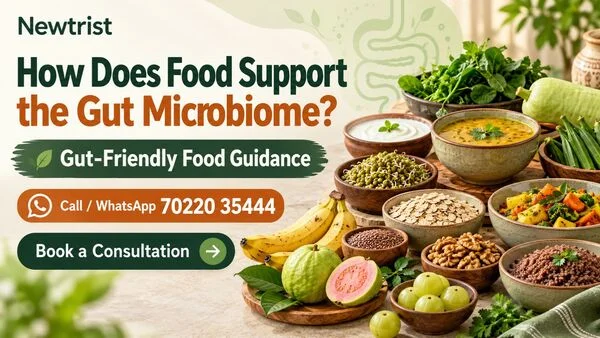
Indian Foods for a Gut-Supportive Eating Pattern
| Food group | Indian examples | Main contribution |
| Pulses and legumes | Moong, masoor, chana, rajma | Fibre and plant protein |
| Whole grains and millets | Oats, barley, ragi, jowar | Fibre and grain diversity |
| Vegetables | Bhindi, bottle gourd, beans, carrots, leafy vegetables | Fibre and plant variety |
| Fruits | Guava, amla, banana, apple, pear | Fibre and varied plant compounds |
| Fermented foods | Plain curd with live cultures | Live cultures when tolerated |
| Nuts and seeds | Walnuts, flaxseed | Fibre and healthy fats |
Foods such as amla, guava, lentils, millets, flaxseed and walnuts fit naturally into familiar Indian meals. Their value comes from contributing to the overall dietary pattern rather than acting as individual treatments for psoriasis.
For broader psoriasis nutrition guidance, including foods to eat, foods to limit, fruits and vegetables, see our Psoriasis Diet Plan.
One-Day Indian Gut-Supportive Meal Example
The example below shows how several sources of fibre and plant foods can fit across one day. It is an illustration rather than a fixed diet prescription because suitable foods and quantities vary between individuals.
| Meal | Menu |
| Breakfast | Vegetable oats with ground flaxseed and plain curd, if tolerated |
| Mid-morning | Guava |
| Lunch | Millet or brown rice with moong dal, bhindi or beans and mixed vegetables |
| Evening | Roasted chana with a seasonal fruit |
| Dinner | Whole-wheat roti with masoor dal and bottle gourd or mixed vegetables |
The strength of this pattern is the range of foods across the day, rather than any one ingredient.
For someone who tolerates these foods comfortably, this can be a simple way to increase dietary diversity using familiar meals.
What If Fibre-Rich Foods Cause Bloating?
This is where general gut-health advice often becomes less useful.
A person may start eating more pulses, vegetables, whole grains and seeds because they are considered healthy, only to develop bloating or fullness.
That does not automatically mean fibre is unsuitable.
Different Foods Can Be Tolerated Differently
One person may digest moong comfortably but struggle with rajma. Another may find cooked vegetables easier than large amounts of raw vegetables.
Tolerance can change with the type of food, the amount eaten, preparation, frequency and the combination of foods within a meal.
Rather than removing an entire food group, it can be more useful to identify which forms and combinations are comfortable.
Large Dietary Changes Can Be Difficult to Tolerate
Someone whose usual diet contains relatively little fibre may feel uncomfortable if several high-fibre foods are introduced at once.
A gut-supportive eating pattern should be practical enough to maintain, not something that creates new digestive difficulties.
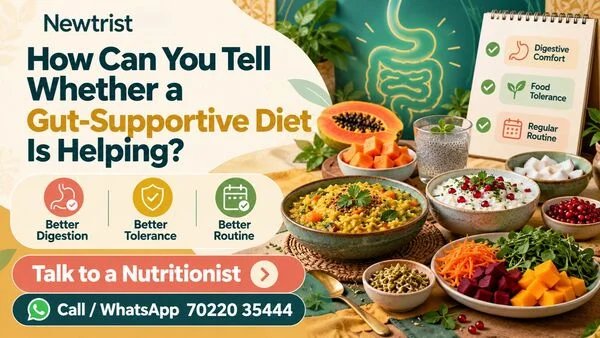
How Can You Tell Whether a Gut-Supportive Diet Is Helping?
The benefit of a gut-focused eating pattern should not be judged only by what happens to the skin.
- More comfortable digestion
- More regular bowel habits
- Greater variety in everyday meals
- A wider range of foods that can be eaten comfortably
- Better nutritional balance
- An eating pattern that feels sustainable
These outcomes matter because gut health is ultimately about more than one symptom or one food.
Do You Need a Special Microbiome Diet?
Usually, the better starting point is the diet you already eat.
Look at your usual meals and ask:
- How many different plant foods do I eat regularly?
- Do I rotate pulses and grains or repeatedly eat the same ones?
- Which fibre-rich foods feel comfortable?
- Are my meals becoming more varied or more restrictive?
- Can my usual Indian foods be adjusted rather than replaced?
For many people, supporting gut health means improving familiar meals, not adopting an entirely new diet.
When Personalised Nutrition Can Make a Difference
General information becomes less useful when you know what is considered healthy but still do not know what works for you.
For example, you may find that:
- Certain pulses repeatedly cause discomfort
- Increasing fibre makes bloating worse
- Several foods have already been removed
- Your meals have become repetitive
- You are uncertain whether a food actually needs to be avoided
- Your digestive comfort and nutritional needs seem to conflict
At this stage, another generic list of foods is unlikely to solve the problem.
Chief Nutritionist Vasanthi Senthilvel can assess your current eating pattern, digestive tolerance, existing food restrictions, Indian food preferences and nutritional requirements to identify which changes are relevant to you.
The goal is to create a personalised nutrition plan that supports gut health without making everyday eating unnecessarily restrictive or difficult to maintain.
Frequently Asked Questions About Psoriasis and Gut Health
Can gut health matter if I do not have digestive symptoms?
Yes. The gut microbiome continues to interact with food and immune processes even when digestion feels normal. However, people without digestive difficulties do not need to make major dietary changes simply because they have psoriasis.
Can a vegetarian Indian diet support the gut microbiome?
Yes. Pulses, whole grains, millets, vegetables, fruits, nuts and seeds can provide considerable fibre and dietary variety in a vegetarian Indian diet.
Are cooked vegetables useful for gut health?
Yes. Cooked vegetables continue to provide fibre and plant compounds. They may also be easier to tolerate than large quantities of raw vegetables for some people.
Can rice and roti remain part of a gut-supportive diet?
Yes. Gut health does not require removing familiar staple foods. Rice and roti can fit within a varied diet alongside pulses, vegetables, fruits, nuts, seeds and other appropriate foods.
Do gut-friendly foods have to be expensive or unusual?
No. Familiar foods such as dals, oats, millets, vegetables, guava, banana, curd, flaxseed and walnuts can all contribute to a gut-supportive eating pattern. Specialised or imported foods are not necessary.
How long should I follow a dietary change before deciding whether it suits me?
There is no single timeline that applies to everyone. Digestive tolerance depends on the foods introduced, the size of the dietary change and the person’s usual eating pattern. Changes are more useful when they can be evaluated consistently rather than changing several foods at the same time.
Author
Chief Nutritionist Vasanthi Senthilvel leads Newtrist Nutritionist Dietitian Dietician, providing personalised diet plans for weight management and clinical nutrition for children, adolescents, adults and families.
She has 21 years of experience in nutrition and has received professional recognition for her work.
- Pride of Bharat Awards 2026: Outstanding Achievement in Holistic Health & Nutrition Innovation
- Doctor of The Year: Nutritionist 2026: Excellence in Clinical Nutrition and Weight Loss.
Her approach considers age, growth, health history, medical conditions, laboratory reports, medication, body composition, weight history, dietary preferences, regional food habits, family routines, activity, sleep and personal health goals. Recommendations are developed according to individual needs rather than using one standard diet for everyone.
Consultations are available in person at Bangalore HSR Layout, Koramangala, Bellandur, Haralur and Electronic City, as well as online across India.
Independent Medical Review Panel
Newtrist health and nutrition articles undergo medical review, where appropriate, by doctors with relevant specialist expertise. The medical professionals listed below contribute to Newtrist’s review process within their respective specialties.
| Speciality | Doctor |
|---|---|
| Endocrinology | Dr Vinay Prasad MBBS, MD, DM |
| Gastroenterology & Hepatology | Dr Sunil kumar N MBBS, MD, DM |
| Gynaecology | Dr Prathiba G MBBS, DNB, FIRM, FMAS |
| Nephrology | Dr Priyashree R MBBS, MD, DNB, DM |