
Written by: Chief Nutritionist Vasanthi Senthilvel
21 years of experience | Newtrist Nutritionist Dietitian Dietician
Best Nutritionist in Bangalore with multiple awards for excellence in clinical nutrition, weight loss, holistic health and nutrition innovation.
Medically reviewed by: Dr Dr Prathiba G MBBS, DNB, FIRM, FMAS | Dr Sunil kumar N MBBS, MD, DM | Dr Vinay Prasad MBBS, MD, DM
Medical Disclaimer: Nutritional needs vary based on an individual’s profile. The information on this page is for general educational purposes only and is not intended to replace personalised medical or nutrition care.
Pregnancy does not require a completely new diet every time you enter another trimester. What changes is the eating challenge.
In the first trimester, the priority may be getting enough useful food despite nausea or food aversions. In the second, an improving appetite creates an opportunity to make meals more complete. By the third trimester, you may need to maintain good nutritional intake even when large meals feel uncomfortable.
That is what pregnancy nutrition by trimester is really about: adapting familiar food to the stage of pregnancy you are experiencing rather than repeatedly starting a new diet.
Key takeaway: The foundation of a pregnancy diet remains broadly similar across all three trimesters, with staple foods, protein-rich foods, vegetables, fruits and calcium-rich foods forming part of a varied diet. What changes is how you use them: the first trimester often requires flexibility around food tolerance, the second allows more attention to meal completeness, and the third may require nutrition to be spread across smaller eating occasions. Individual food quantities cannot be decided from trimester alone.
Table of Contents
First Trimester Diet and Nutrition
The first trimester can make eating unpredictable.
A meal you usually enjoy may suddenly smell unpleasant. Hunger may come at unusual times, and a normal portion can sometimes feel overwhelming.
A useful first trimester diet therefore needs to work with your food tolerance rather than expecting you to eat perfectly every day.
What Should You Prioritise During the First Trimester?
The priority is to maintain useful food intake even when appetite is inconsistent.
Instead of concentrating on eating larger quantities, try to include different food groups across the day whenever they are comfortable.
A staple food can form the base of a meal, while dal, pulses, dairy foods, nuts, seeds, eggs, fish or meat can contribute protein according to your usual diet. Vegetables and whole fruits can add further variety.
Look at your food intake across several meals rather than judging yourself by one difficult eating occasion.
Foods to Eat During the First Trimester
- rice, roti, idli, dosa, poha, upma and oats
- dal, moong, chana, rajma and other pulses
- curd and paneer where tolerated
- cooked vegetables and leafy vegetables
- varied whole fruits
- nuts and seeds
- thoroughly cooked eggs, fish or meat for women who eat them
Think in terms of combinations rather than individual pregnancy foods.
Idli with sambar provides a broader combination than plain idli. Rice accompanied by dal and vegetables gives a more complete meal than rice eaten mainly with gravy.
There is also no need to force one particular food because it has been labelled essential during pregnancy. If it becomes difficult to tolerate, an appropriate alternative can usually take its place.
Foods and Drinks to Avoid or Limit During the First Trimester
The main reasons to avoid particular foods during pregnancy are related to food safety.
Avoid raw or inadequately cooked eggs, meat, poultry and seafood. Use appropriately pasteurised dairy foods and pay attention to washing, preparation, refrigeration and safe storage.
Fish selection also matters because some varieties can contain higher levels of mercury.
Caffeine-containing drinks are better kept moderate.
For a more detailed pregnancy-wide food safety list, see Newtrist’s foods to avoid during pregnancy.
Avoid creating additional food restrictions simply because ordinary foods are described as “hot”, “cold” or unsuitable for early pregnancy. When nausea is already narrowing your choices, unsupported restrictions can make adequate eating more difficult.
How to Eat With Nausea and Food Aversions
If a normal meal feels too large, smaller eating occasions may be easier.
Some women prefer relatively simple foods. For others, temperature, smell or texture determines what feels acceptable.
If one food consistently triggers nausea, choosing another suitable option is more practical than forcing yourself to eat it because it is considered nutritious.
Meal timing can also be flexible. Long gaps make nausea worse for some women, while others prefer more space between eating occasions.
The aim is to find a pattern that lets you eat reasonably well.
Persistent vomiting or difficulty maintaining normal food and fluid intake is different from ordinary first trimester food aversion and cannot be adequately addressed by a generic diet chart.

1-Day Sample Vegetarian First Trimester Diet Chart
| Meal | Menu |
| Breakfast | Mini pesarattu with coconut-coriander chutney |
| Mid-morning | Sweet lime with pistachios |
| Lunch | Lemon rice with black-eyed pea curry and beetroot poriyal |
| Evening | Paneer and vegetable whole-wheat toast |
| Dinner | Idiyappam with mixed vegetable stew |
This example keeps meals relatively simple while providing useful foods at different points through the day.
1-Day Sample Non-Vegetarian First Trimester Diet Chart
| Meal | Menu |
| Breakfast | Ragi dosa with spinach and thoroughly cooked egg scramble |
| Mid-morning | Pear with walnuts |
| Lunch | Jeera rice with mild chicken stew and beans-carrot stir-fry |
| Evening | Sweet corn and pomegranate bowl |
| Dinner | Soft chapati with fish moilee and ash-gourd vegetable |
The non-vegetarian foods add options without replacing pulses, vegetables, fruits and other plant foods.
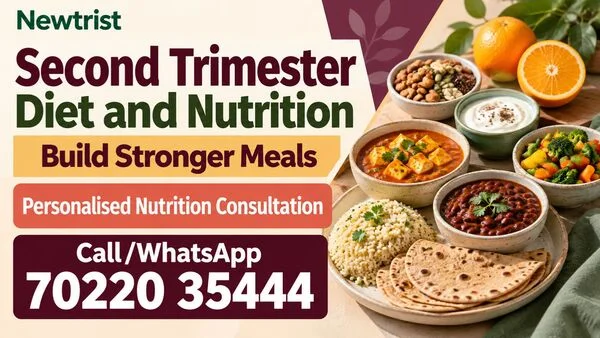
Second Trimester Diet and Nutrition
For many women, eating becomes easier in the second trimester.
When nausea settles and appetite improves, simply making every meal larger is not necessarily the most useful response. This stage offers an opportunity to make ordinary meals more complete.
What Should You Prioritise During the Second Trimester?
The priority is to get more nutritional value from the meals you already eat.
A practical main meal can usually be built around:
- a suitable staple food
- a meaningful protein source
- vegetables
Fruits and other useful foods can appear at different times through the day.
This shifts the focus from “What special second trimester food should I eat?” to “What is missing from my usual meal?”
For example, increasing the amount of rice adds more food. Adding dal and vegetables changes what the meal provides.
Foods to Eat During the Second Trimester
Use an improving appetite to broaden the foods eaten across the week.
Different dals, chana, rajma and other legumes can be rotated. Use a range of vegetables and whole fruits rather than relying repeatedly on the same few choices.
Curd and paneer can provide additional options for vegetarians. Eggs, fish and chicken can be included by women who normally eat non-vegetarian foods.
You do not need every nutritious food on one plate. A useful eating pattern develops through variation across meals and days.
Foods and Drinks to Avoid or Limit During the Second Trimester
The general food-safety precautions followed earlier in pregnancy continue.
The more relevant second trimester issue is often what fills the extra appetite.
If sweets, bakery foods, fried snacks or sugary beverages become the main response to hunger, they may gradually displace meals providing more protein, fibre and micronutrients.
These foods do not need to be labelled forbidden. What matters is how often they are being chosen and what they are replacing.
Pregnancy also does not mean automatically doubling normal meal portions.
How to Improve Meals When Appetite Gets Better
Look first at meals that are incomplete rather than immediately making portions larger.
If breakfast consists mainly of a cereal-based food, consider whether an appropriate protein-containing accompaniment can be added.
If lunch is mostly rice or roti, look at what accompanies it. Dal, another protein food and vegetables can make a meaningful difference to the meal.
Protein sources can also be rotated. Moong on one day, chana on another, paneer elsewhere and egg, fish or chicken where preferred creates a broader food pattern without making meals complicated.
1-Day Sample Vegetarian Second Trimester Diet Chart
| Meal | Menu |
| Breakfast | Besan vegetable chilla with tofu filling and mint chutney |
| Mid-morning | Guava with pumpkin seeds |
| Lunch | Foxtail millet vegetable pulao with rajma and cucumber raita |
| Evening | Roasted makhana with orange segments |
| Dinner | Jowar roti with palak paneer and roasted pumpkin |
The day uses different vegetarian protein foods rather than relying heavily on one source.
1-Day Sample Non-Vegetarian Second Trimester Diet Chart
| Meal | Menu |
| Breakfast | Vegetable uttapam with peanut-tomato chutney |
| Mid-morning | Chikoo with almonds |
| Lunch | Brown rice with methi chicken and cabbage-peas poriyal |
| Evening | Black chana and vegetable chaat |
| Dinner | Vegetable barley bowl with sesame and a side of cucumber raita |
Plant and animal protein foods can both fit naturally into a mixed diet.
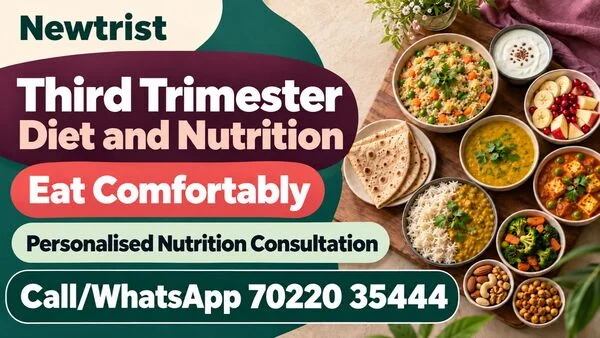
Third Trimester Diet and Nutrition
The third trimester often introduces a different problem.
You may have a reasonable appetite but become full sooner than before. Heartburn or constipation can also make normal meal patterns less comfortable.
A useful third trimester diet therefore needs to provide enough useful nutrition without depending on very large meals.
What Should You Prioritise During the Third Trimester?
The priority is to maintain nutritional quality even when comfortable meal size becomes smaller.
Continue using familiar staple foods, protein-containing foods, vegetables, fruits and other everyday foods.
What may change is where they appear during the day.
If lunch or dinner cannot comfortably hold everything you previously ate, parts of the day’s food can be distributed across other eating occasions instead.
Foods to Eat During the Third Trimester
- dal and other pulses
- curd and paneer
- cooked vegetables and leafy vegetables
- whole fruits
- rice, wheat, oats and millets
- nuts and seeds
- thoroughly cooked eggs, fish or meat where preferred
A nutritious meal does not need to be large or contain many separate dishes.
A comfortable amount of staple food accompanied by a protein source and vegetables may be more practical than trying to place every desirable food on one plate.
Foods and Drinks to Avoid or Limit During the Third Trimester
The pregnancy food-safety principles followed earlier still apply.
What becomes more individual now is digestive comfort.
Very large meals and heavily fried foods may worsen reflux or uncomfortable fullness in some women. Particular spicy or acidic foods may affect one woman and cause no problem for another.
For that reason, there is little value in giving every woman the same long list of foods to eliminate.
If a food repeatedly causes discomfort, reduce it or choose an alternative. If it is comfortable and otherwise appropriate, it does not need to be removed solely because someone else avoids it.
How to Eat With Heartburn, Constipation or Early Fullness
If large meals become uncomfortable, smaller eating occasions can make the day’s food easier to manage.
For constipation, consider the overall pattern rather than relying on one supposedly corrective food. Vegetables, whole fruits, pulses and whole grains contribute fibre, while adequate fluids support normal bowel function.
When you become full quickly, prioritise the nutritionally useful components of the meal rather than filling up first on foods that contribute relatively little.
The objective is not merely to reduce individual meal size. It is to make the entire day’s nutritional intake achievable despite smaller meals.
1-Day Sample Vegetarian Third Trimester Diet Chart
| Meal | Menu |
| Breakfast | Savoury oats with vegetables and sesame |
| Mid-morning | Kiwi with cashews |
| Lunch | Soft phulka with paneer-lauki curry and carrot-beans vegetable |
| Evening | Baked sweet potato chaat |
| Dinner | Vegetable barley and masoor khichdi with sauteed zucchini |
This structure spreads useful foods through the day instead of depending on one particularly large meal.
1-Day Sample Non-Vegetarian Third Trimester Diet Chart
| Meal | Menu |
| Breakfast | Appam with vegetable stew |
| Mid-morning | Apple with sunflower and pumpkin seeds |
| Lunch | Red rice with thoroughly cooked prawn curry and snake-gourd poriyal |
| Evening | Hung-curd fruit bowl with pomegranate |
| Dinner | Soft methi paratha with mixed vegetable korma |
The same principle applies: preserve the quality of the day’s food while making individual meals easier to manage.
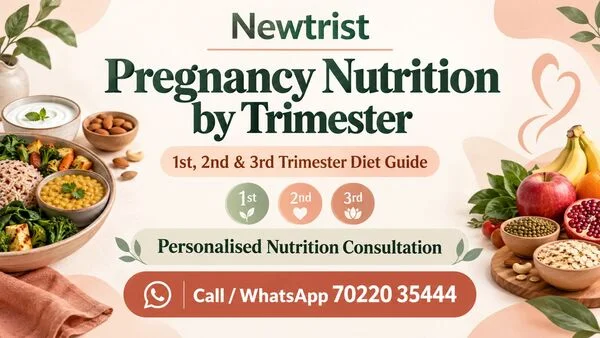
How Does Pregnancy Nutrition Change by Trimester?
The difference between trimesters is not that one set of foods suddenly becomes unsuitable and another becomes necessary. It is what your diet needs to help you manage at that stage.
| Trimester | Main eating challenge | Practical nutrition focus |
| First trimester | Nausea, food aversions and unpredictable appetite | Maintain useful intake with foods that are tolerable |
| Second trimester | Improving appetite | Make ordinary meals more complete |
| Third trimester | Fullness, heartburn or constipation | Maintain nutritional quality through manageable meals |
In simple terms: first trimester nutrition is about tolerance, second trimester nutrition is about strengthening meals, and third trimester nutrition is about maintaining good intake despite reduced meal comfort.
When Is a Sample Pregnancy Diet Not Enough?
A sample diet can show you what a possible day of eating looks like.
It cannot tell you whether that day is appropriate for you.
That difference becomes important when your questions change from:
- “What foods can I eat?”
- “How much should I eat?”
- “Does my usual diet provide enough?”
- “What should I change in the meals my family already cooks?”
Two women can be in the same trimester and still have very different appetites, routines, food preferences, symptoms and nutritional needs.
Personalised nutrition becomes particularly useful when standard examples do not resemble the way you normally eat, important foods are excluded from your diet, pregnancy symptoms are repeatedly affecting your meals, or you understand which foods are nutritious but remain uncertain about combinations and quantities.
This is where a generic pregnancy diet chart reaches its limit.
Chief Nutritionist Vasanthi Senthilvel can assess your trimester together with your current food pattern, appetite, preferences, symptoms, routine and nutritional requirements before developing a personalised diet.
The purpose is not to replace familiar Indian home food with a complicated special menu. It is to determine which familiar foods, meal combinations and quantities are appropriate for you.
A sample diet gives you possibilities. Personalised nutrition determines how those possibilities should be adapted to you.
Frequently Asked Questions About Pregnancy Nutrition by Trimester
Can I Mix the Vegetarian and Non-Vegetarian Sample Diets?
Yes.
The two versions are examples rather than separate systems. A woman who eats non-vegetarian food can still have vegetarian breakfasts, snacks or meals and include egg, fish or chicken only where they naturally fit her normal food pattern.
Can I Use Regional Indian Foods Instead of the Foods Shown?
Yes.
South Indian, North Indian and other regional Indian food patterns can all be used. You do not need to change cuisine simply because you are pregnant.
The useful question is whether the overall meals contain appropriate food combinations rather than whether they match a particular sample menu.
Do I Need to Cook Separate Pregnancy Meals From the Rest of My Family?
Not necessarily.
Normal home food can often be adapted by changing what appears on your plate and how the meal is combined.
A pregnancy diet should ideally fit into everyday family eating unless there is a specific reason for a separate preparation.
Can I Use a Meal Shown in One Trimester During Another Trimester?
Yes.
A dosa shown in the second trimester does not suddenly become unsuitable in the first or third trimester.
The sample diets differ because they demonstrate different practical priorities, not because each trimester has a completely separate set of permitted foods.
Should I Repeat the Same 1-Day Diet Every Day?
No.
A one-day diet is useful for demonstrating meal structure, not for daily repetition.
Changing vegetables, fruits, pulses, grains and protein foods across the week helps create a broader eating pattern and makes the diet more practical.
From General Pregnancy Advice to Your Own Diet
A trimester guide is useful because it tells you what problem your meals may need to solve at this stage of pregnancy.
But knowing that dal, curd, vegetables, fruit, eggs or fish can fit into a pregnancy diet still does not tell you how much of each food is appropriate for you.
That is where the difference between general information and personalised nutrition becomes important. If you want a pregnancy diet built around your trimester, usual Indian food habits, routine, preferences and nutritional requirements, Chief Nutritionist Vasanthi Senthilvel can develop a personalised diet rather than asking you to copy a standard chart.
Author
Chief Nutritionist Vasanthi Senthilvel leads Newtrist Nutritionist Dietitian Dietician, providing personalised diet plans for weight management and clinical nutrition for children, adolescents, adults and families.
She has 21 years of experience in nutrition and has received professional recognition for her work.
- Pride of Bharat Awards 2026: Outstanding Achievement in Holistic Health & Nutrition Innovation
- Doctor of The Year: Nutritionist 2026: Excellence in Clinical Nutrition and Weight Loss.
Her approach considers age, growth, health history, medical conditions, laboratory reports, medication, body composition, weight history, dietary preferences, regional food habits, family routines, activity, sleep and personal health goals. Recommendations are developed according to individual needs rather than using one standard diet for everyone.
Consultations are available in person at Bangalore HSR Layout, Koramangala, Bellandur, Haralur and Electronic City, as well as online across India.
Independent Medical Review Panel
Newtrist health and nutrition articles undergo medical review, where appropriate, by doctors with relevant specialist expertise. The medical professionals listed below contribute to Newtrist’s review process within their respective specialties.
| Speciality | Doctor |
|---|---|
| Endocrinology | Dr Vinay Prasad MBBS, MD, DM |
| Gastroenterology & Hepatology | Dr Sunil kumar N MBBS, MD, DM |
| Gynaecology | Dr Prathiba G MBBS, DNB, FIRM, FMAS |