
Written by: Chief Nutritionist Vasanthi Senthilvel
21 years of experience | Newtrist Nutritionist Dietitian Dietician
Best Nutritionist in Bangalore with multiple awards for excellence in clinical nutrition, weight loss, holistic health and nutrition innovation.
Medically reviewed by: Dr Dr Prathiba G MBBS, DNB, FIRM, FMAS | Dr Sunil kumar N MBBS, MD, DM | Dr Vinay Prasad MBBS, MD, DM
Medical Disclaimer: Nutritional needs vary based on an individual’s profile. The information on this page is for general educational purposes only and is not intended to replace personalised medical or nutrition care.
Planning pregnancy can turn everyday eating into a surprisingly long list of questions. Should you change your grains? Eat more seeds? Choose certain fruits? Follow a fertility diet chart?
A better starting point is much simpler: look at how you already eat.
Fertility nutrition is about making sure your everyday diet provides adequate nourishment before conception and identifying gaps that may deserve attention. Someone who regularly misses meals, someone following a restricted vegetarian diet and someone already eating a varied diet will not necessarily need the same changes.
This guide will help you understand the nutritional foundation and, importantly, recognise when general advice may no longer be enough.
Key takeaway: A good fertility nutrition approach is a varied, nutritionally adequate way of eating before conception. Vegetables, fruits, protein-rich foods, suitable carbohydrate sources and healthy fats form the foundation of a preconception diet, but the right food choices and meal pattern depend on your existing diet and individual nutritional needs.
Table of Contents
What Should You Eat When Trying to Conceive?
A diet for trying to conceive should include a variety of food groups rather than revolve around particular foods promoted for fertility.
For most people, familiar Indian foods can provide this foundation. You do not need an expensive or unfamiliar fertility menu.
Include vegetables and fruits for variety
Different vegetables and fruits provide different combinations of fibre, vitamins, minerals and naturally occurring plant compounds.
Instead of choosing one fruit or vegetable because it has acquired a fertility reputation, aim for variety across your usual meals.
Seasonal and locally available produce works well. There is no nutritional requirement to depend on imported berries, exotic fruits or expensive produce when planning conception.
Include protein-rich foods regularly
Protein sources can include:
- dal and pulses
- beans and legumes
- milk, curd and paneer
- eggs
- fish
- chicken
- tofu and other soy foods
Both vegetarian and non-vegetarian diets can provide adequate protein when planned appropriately.
The more useful question is not “Which protein is best for fertility?” but “Does my normal diet provide enough protein consistently?”
Keep appropriate carbohydrate foods in the diet
Trying to conceive is not, by itself, a reason to eliminate carbohydrates.
Rice, chapati, oats, millets and other grains can all form part of a balanced preconception diet.
Look at the complete meal rather than judging one food in isolation. A meal combining a suitable carbohydrate source with vegetables and protein provides a different nutritional balance from one based mainly on refined foods with little variety.
Include suitable sources of dietary fat
Nuts, seeds and other foods containing unsaturated fats can contribute useful nutrients and dietary variety.
They do not need to be eaten according to special fertility schedules.
Adding one particular nut or seed every day also cannot compensate for nutritional gaps elsewhere in the diet.
Include dairy or suitable alternatives according to your food pattern
Milk, curd and paneer can contribute protein and other nutrients where dairy forms part of the diet.
If you do not consume dairy, your preconception diet can still be nutritionally appropriate. The question is whether your overall food choices meet the nutrients that need to be covered.
Which Nutrients Deserve Attention Before Conception?
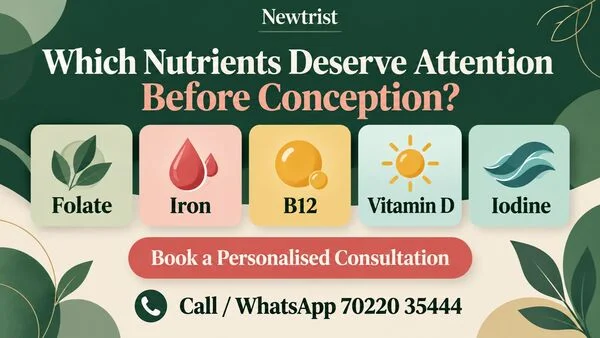
There is no single nutrient that determines fertility. Several nutrients, however, deserve attention because they contribute to normal body and reproductive functions.
The aim is nutritional adequacy, not consuming unusually large amounts of individual nutrients.
Folate and iron
Folate is involved in normal cell division and is particularly relevant around conception. Green leafy vegetables, pulses, beans and several other vegetables contribute folate.
Iron also deserves attention. Vegetarian sources include pulses, beans and green leafy vegetables, while people who eat animal foods have additional dietary sources.
A useful distinction is that eating foods containing a nutrient does not automatically tell you whether your nutritional status is adequate. If someone already has low iron status, for example, simply adding more spinach or dates may not address the full nutritional issue.
Vitamin B12 and vitamin D
Vitamin B12 deserves particular attention when a diet contains little or no animal-derived food.
Vitamin D is different because food contributes only part of the overall picture. Individual vitamin D status can therefore vary even between people with apparently similar diets.
These are good examples of why a diet can look healthy at first glance while still having nutritional areas worth reviewing.
Iodine
Iodine contributes to normal thyroid function and is relevant during the preconception period.
The objective is adequate intake rather than deliberately increasing iodine-rich foods without an individual reason.
Where thyroid health already changes nutritional requirements, it is better addressed as a separate clinical nutrition issue rather than turning a general fertility diet into a thyroid diet. Newtrist discusses that separately in its thyroid nutrition guide.
Zinc, selenium and omega-3 fats
Zinc and selenium are involved in several normal metabolic and reproductive processes. Depending on dietary preference, foods such as pulses, nuts, seeds, dairy, eggs, fish and other animal foods can contribute them.
Omega-3 fats form part of overall dietary fat quality. Fish provides certain forms, while some nuts and seeds provide plant forms.
None needs to become the centrepiece of a fertility diet. Their value comes from being part of an appropriately varied eating pattern.
Can Certain Foods Improve Fertility?
Foods such as pomegranate, beetroot, avocado, walnuts and different seeds are often described as fertility foods. Many are nutritious choices, but that is different from having a unique ability to make conception happen.
Consider someone who adds a special seed mixture every morning but regularly misses lunch, consumes very little protein and eats from a narrow range of foods.
The seed mixture is not the most important nutritional issue.
This is why the more useful question is:
“What is missing from the way I normally eat?”
Good nutrition can support reproductive and general health. It cannot guarantee pregnancy or resolve every cause of difficulty conceiving.
That is also why a fixed 7-day or 28-day programme should not be treated as a formula for conception. The number of days in a diet cannot identify what an individual actually needs.
Sample 1-Day Preconception Diet Plan
A one-day example can help show how several food groups may fit together. It cannot determine exactly what you should eat without knowing your nutritional requirements.
| Meal | Menu |
|---|---|
| Breakfast | Vegetable dosa with sambar and curd, with a seasonal fruit |
| Mid-morning | Seasonal fruit with nuts |
| Lunch | Rice or chapati with dal, cooked vegetables, curd and salad |
| Evening | Roasted chana or another pulse-based snack with fruit |
| Dinner | Rice or chapati with vegetables and paneer, egg, fish or chicken according to dietary preference |
| Later, if appropriate | Milk or another suitable food from the person’s usual diet |
The value of this example is the combination of different food groups across the day, not the specific dishes.
Your suitable meals may look completely different.
That difference is important. A sample diet can answer:
“What could a balanced day look like?”
It cannot answer:
“What should I change in my own diet?”
How Do You Know Whether Your Preconception Diet Needs More Attention?
Knowing the basics of healthy eating does not always tell you whether your own diet is nutritionally adequate.
This is where useful questions become more individual:
- Do you frequently miss meals because of your work schedule?
- Does your diet contain only a limited range of foods?
- Do you struggle to include protein regularly?
- Do you follow several food restrictions?
- Are you unsure whether your vegetarian or vegan diet covers your nutritional needs?
- Is weight management also an important consideration?
- Do existing health concerns affect how you eat?
- Have conflicting fertility-food rules made your diet unnecessarily complicated?
You do not necessarily need to change everything because you answered yes to one of these questions.
The point is that the priority changes from person to person.
Someone whose main difficulty is irregular eating does not automatically need more foods removed. Someone whose diet already contains good variety may need only small adjustments.
This is precisely where a generic fertility diet reaches its limit.
What Is Different About Personalised Fertility Nutrition?
A generic plan starts by asking:
“What should a person trying to conceive eat?”
Personalised nutrition asks:
“What does this person need?”
That change in question makes a substantial difference.
It starts with your existing diet
A personalised approach looks first at what you normally eat rather than replacing it immediately with an idealised menu.
This helps identify what is already working before deciding what needs to change.
It prioritises the relevant nutritional gaps
Imagine three people who are all planning pregnancy.
One has very little protein during the working day.
Another eats enough protein but has a highly restricted range of foods.
The third already has considerable dietary variety but has other nutritional or weight-related concerns to consider.
The same fertility diet chart would not solve the same problem for all three.
Personalisation helps distinguish the changes worth making from the ones that add unnecessary complexity.
It fits real Indian eating patterns
An eating plan has to survive normal life.
It should therefore consider whether you eat vegetarian, vegan, egg-based or non-vegetarian foods, as well as regional preferences, family cooking, work timings, eating outside the home, appetite and affordability.
Planning conception should not require abandoning familiar Indian foods for a completely different “fertility diet”.
It can simplify eating rather than make it stricter
Trying to conceive often exposes people to numerous rules about foods they should add, avoid, combine or eat at particular times.
That can create the impression that successful preconception nutrition requires constant dietary management.
It does not.
Good personalisation should clarify priorities and remove unnecessary rules, not simply produce a longer restriction list.
When Is Personalised Preconception Nutrition Worth Considering?
You do not need an individual diet simply because you have started planning pregnancy.
Personalised guidance becomes more useful when you understand the general principles but still cannot confidently answer:
“What does my own diet need?”
Perhaps your diet looks healthy but you are uncertain whether it covers your nutritional requirements.
Perhaps several food restrictions make planning difficult.
Perhaps weight management also needs consideration.
Or perhaps you have read so much conflicting fertility advice that you are unsure which changes are genuinely relevant.
A personalised nutrition consultation with Chief Nutritionist Vasanthi Senthilvel can begin with your current food pattern, nutritional priorities, dietary preferences, health context and practical routine rather than handing you a standard fertility diet chart.
The purpose is not to make eating stricter.
It is to determine what deserves your attention, what does not, and how the changes can realistically fit into your everyday life.
If you already know the general principles of healthy eating but remain uncertain about what your diet needs before conception, that is where individual nutrition planning can offer more value than another list of fertility foods.
Frequently Asked Questions About Fertility Nutrition
How early should I improve my diet before trying to conceive?
You do not need to wait for a specific countdown. If you are planning conception, improving dietary variety, regularity and nutritional adequacy can begin now. Consistent habits are more useful than relying on a highly restrictive short-term programme immediately before trying to conceive.
Can a vegetarian diet be suitable when trying to conceive?
Yes. A varied vegetarian diet can provide many nutrients relevant to preconception health. Greater attention may be useful when several food groups are restricted because nutritional adequacy depends on the complete eating pattern rather than simply whether it is labelled vegetarian.
Should I eat differently around ovulation?
Most people do not need to completely change their eating pattern for a few days around ovulation. Maintaining good nutritional quality consistently is a more practical foundation than repeatedly adding or removing foods according to particular points in the menstrual cycle.
Is soy okay when trying to conceive?
Normal food amounts of soy foods such as tofu can form part of a varied diet for most people. Soy does not need to be automatically excluded simply because conception is being planned. Individual food exclusions should have a relevant nutritional or health reason.
Do I need to eat meals at fixed times when trying to conceive?
There is no universal fertility meal timetable. Regular eating may be useful when long gaps lead to missed meals or inadequate overall intake, but meal timing should work with appetite, work schedules and individual needs rather than following arbitrary fertility timings.
Do both partners need the same preconception diet?
Not necessarily. Both partners benefit from good nutritional health, but their food intake, nutritional status, body size, dietary restrictions and health considerations may differ. The changes worth making therefore do not have to be identical.
Author
Chief Nutritionist Vasanthi Senthilvel leads Newtrist Nutritionist Dietitian Dietician, providing personalised diet plans for weight management and clinical nutrition for children, adolescents, adults and families.
She has 21 years of experience in nutrition and has received professional recognition for her work.
- Pride of Bharat Awards 2026: Outstanding Achievement in Holistic Health & Nutrition Innovation
- Doctor of The Year: Nutritionist 2026: Excellence in Clinical Nutrition and Weight Loss.
Her approach considers age, growth, health history, medical conditions, laboratory reports, medication, body composition, weight history, dietary preferences, regional food habits, family routines, activity, sleep and personal health goals. Recommendations are developed according to individual needs rather than using one standard diet for everyone.
Consultations are available in person at Bangalore HSR Layout, Koramangala, Bellandur, Haralur and Electronic City, as well as online across India.
Independent Medical Review Panel
Newtrist health and nutrition articles undergo medical review, where appropriate, by doctors with relevant specialist expertise. The medical professionals listed below contribute to Newtrist’s review process within their respective specialties.
| Speciality | Doctor |
|---|---|
| Endocrinology | Dr Vinay Prasad MBBS, MD, DM |
| Gastroenterology & Hepatology | Dr Sunil kumar N MBBS, MD, DM |
| Gynaecology | Dr Prathiba G MBBS, DNB, FIRM, FMAS |