
Written by: Chief Nutritionist Vasanthi Senthilvel
21 years of experience | Newtrist Nutritionist Dietitian Dietician
Best Nutritionist in Bangalore with multiple awards for excellence in clinical nutrition, weight loss, holistic health and nutrition innovation.
Medically reviewed by: Dr Dr Prathiba G MBBS, DNB, FIRM, FMAS | Dr Sunil kumar N MBBS, MD, DM | Dr Vinay Prasad MBBS, MD, DM
Medical Disclaimer: Nutritional needs vary based on an individual’s profile. The information on this page is for general educational purposes only and is not intended to replace personalised medical or nutrition care.
Gestational diabetes can make a familiar plate suddenly feel uncertain. Rice gets questioned. Fruit starts to look risky. Millets may be presented as the answer. And every glucose reading can leave you wondering whether you ate the wrong thing.
A gestational diabetes diet should reduce that confusion, not add to it. The goal is to help manage blood glucose while still meeting the nutritional demands of pregnancy, using foods that can realistically fit your routine and food preferences.
The most useful diet is therefore not necessarily the strictest one. It is the one that makes sense for your glucose pattern, pregnancy needs and medical treatment.
Key takeaway: A gestational diabetes diet does not usually mean eliminating carbohydrates or eating special “diabetic” foods. Familiar foods can often remain part of the diet, but their type, quantity, combination and timing may need adjustment. Because glucose responses differ between women and can change during pregnancy, a personalised nutrition approach can be more useful than following a standard pregnancy sugar diet chart.
Table of Contents

What Can You Eat With Gestational Diabetes?
Most women with gestational diabetes can continue eating a varied diet. The focus shifts from simply asking whether a food is “allowed” to understanding what it contributes and how it affects the overall eating pattern.
- Carbohydrate foods: rice, roti, millets, oats, other grains, pulses, milk, curd and whole fruit, selected according to the overall diet and glucose response.
- Protein foods: dal, pulses, beans, curd, paneer, eggs, fish, chicken, lean meat, soy foods, nuts and seeds according to food preference.
- Vegetables: a variety of vegetables to contribute fibre, vitamins, minerals and overall dietary quality.
- Fibre-rich foods: vegetables, pulses, legumes, whole grains, nuts, seeds and whole fruits.
- Pregnancy nutrient sources: foods that contribute protein, iron, folate, calcium, vitamin B12, vitamin D, iodine and other nutrients required during pregnancy.
The important point is that a food does not become suitable simply because it appears on a “gestational diabetes foods to eat” list. How foods come together across the day matters.

What Matters Most in a Gestational Diabetes Diet?
Carbohydrates deserve particular attention because they have an important influence on blood glucose after eating. But carbohydrate management is different from carbohydrate elimination.
Carbohydrate quality matters. Less refined foods that also provide fibre, protein or micronutrients can contribute more nutritional value than foods dominated by refined starch or added sugar.
Distribution matters. A large amount of carbohydrate eaten at one time can affect glucose differently from carbohydrate distributed differently across the day. The most appropriate pattern varies from person to person.
The rest of the meal matters. A carbohydrate food eaten by itself is not necessarily equivalent to the same food eaten as part of a mixed meal containing protein, vegetables and other foods.
Pregnancy nutrition matters. A diet should not be judged only by glucose readings. It also has to remain nutritionally adequate for pregnancy.
Gestational diabetes has pregnancy-specific requirements, so a general diabetes diet should not simply be copied into pregnancy without considering pregnancy nutrition and medical care.
This is why simply removing one food rarely gives the full answer.
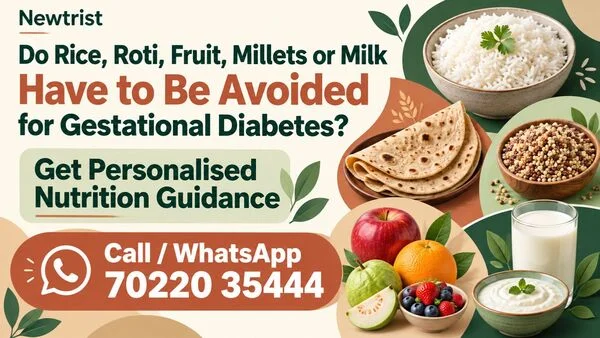
Do Rice, Roti, Fruit, Millets or Milk Have to Be Avoided?
These everyday foods create some of the greatest anxiety after a gestational diabetes diagnosis. None can be judged properly from its name alone.
Can you eat rice with gestational diabetes?
Rice contains carbohydrate and can influence post-meal glucose, but a diagnosis of gestational diabetes does not automatically mean rice must be stopped.
The amount, type of rice, accompanying foods and individual glucose response all matter. Replacing rice with another grain is not automatically an improvement if the rest of the meal remains unsuitable for that person’s needs.
Is roti better than rice?
Not necessarily.
Roti also provides carbohydrate. Some people may see different glucose responses to different staple foods, but there is no universal rule that makes roti suitable and rice unsuitable for every woman with gestational diabetes.
Are millets good for gestational diabetes?
Millets can be nutritious and can provide variety, but they are not carbohydrate-free or a treatment for gestational diabetes.
The type of millet, processing, preparation and the rest of the meal influence its nutritional effect. A food does not become unlimited simply because it contains millet.
Can you eat fruit?
Whole fruit can provide fibre, vitamins, minerals and other useful nutrients during pregnancy.
Gestational diabetes does not automatically require avoiding all fruit. The type, quantity, timing and individual glucose response may influence how fruit fits into the diet.
Fruit juice is different from whole fruit because carbohydrate can be consumed more quickly and much of the intact food structure is lost.
What about milk and curd?
Milk and curd can contribute protein, calcium and other nutrients. Milk also contains naturally occurring carbohydrate.
Their place in the diet should therefore be considered as part of the person’s complete food pattern rather than assuming that dairy is either universally beneficial or unsuitable.
The broader lesson is simple: gestational diabetes is rarely managed well by labelling individual everyday foods as universally good or bad.
Which Foods Need Closer Attention?
Foods containing substantial amounts of added sugar or highly refined carbohydrate deserve closer attention because they can make glucose management more difficult while providing relatively limited nutritional value.
Sugar-sweetened beverages, sweets, desserts and heavily refined snacks are common examples.
Honey, jaggery and brown sugar still contain sugars. Descriptions such as “natural”, “traditional” or “unrefined” should not be interpreted as meaning that they will not affect blood glucose.
Similarly, a packaged food labelled “diabetic-friendly”, “multigrain”, “high-protein” or “healthy” is not automatically appropriate. Marketing language cannot tell you how that food fits into your diet or how your glucose will respond.
The objective is not to create a growing list of forbidden foods. It is to know which choices deserve more scrutiny.
Why Your Glucose Pattern Matters More Than Someone Else’s Diet Chart
A standard GDM diet plan cannot see what happens to your blood glucose after you eat it.
Your own readings can reveal whether the main difficulty occurs while fasting, after breakfast, after particular meals or at another point in the day. They can also show that a food you expected to cause a problem may behave differently from what you assumed.
Patterns matter more than isolated assumptions.
For example, repeatedly high readings after a particular meal may justify reviewing that meal. A single unexpected reading may have several possible explanations and does not necessarily mean another food must immediately be removed.
Glucose responses can also change as pregnancy progresses.
This is where a food list reaches its limit. It can tell you what foods exist. It cannot interpret what your readings mean for your diet.
Why Eating Less Is Not the Goal
A high glucose reading can make restriction feel reassuring: remove rice, stop fruit, skip a snack, eat less.
But a more restrictive diet is not automatically a better gestational diabetes diet.
Pregnancy still requires adequate nutrition. For broader guidance on nutrition during pregnancy, food choices need to be considered alongside the stage of pregnancy, symptoms, supplements and medical advice. Repeatedly removing foods without considering what replaces them can make it harder to meet nutritional needs and can make everyday eating unnecessarily stressful.
The useful question is therefore not:
“What else should I stop eating?”
It is:
“What actually needs to change?”
Sometimes the answer may involve a particular food, meal composition or eating pattern. Sometimes the glucose issue may require medical treatment rather than further dietary restriction.
When Does General GDM Diet Advice Stop Being Enough?
General advice works well for understanding principles. It becomes less useful when the decision depends on information specific to you.
You may reach that point when your fasting glucose and post-meal readings behave differently, when apparently healthy meals repeatedly produce unexpected readings, or when you cannot decide which part of your diet actually needs changing.
Personalisation can also become important if pregnancy symptoms interfere with eating, if you follow a vegetarian or otherwise restricted diet, if you are using insulin or other prescribed treatment, or if your doctor is monitoring concerns related to maternal nutrition, weight changes or fetal growth.
Daily life matters as well. Work hours, commuting, sleep, family meals, religious practices, regional food habits and food availability can all affect whether nutritional advice is practical.
When these factors start interacting, another generic food chart often creates more rules without providing more clarity.
What Does a Gestational Diabetes Nutritionist Personalise?
A gestational diabetes nutritionist should do more than give you a different version of the same diet chart you could find online.
The starting point is your actual situation.
Your glucose records can show where difficulties are occurring. Your usual diet shows which foods and eating habits need to be examined rather than replaced unnecessarily. Your pregnancy stage, appetite and symptoms affect what is realistic. Your food preferences influence whether recommendations will fit your life.
Medical treatment matters too. If insulin or another treatment has been prescribed, nutrition needs to work alongside the treatment plan established by your medical team.
This allows the nutritionist to answer questions that a generic article cannot answer reliably:
- Which meals are actually contributing to my difficult readings?
- Which foods am I avoiding unnecessarily?
- Can my usual rice- or roti-based meals be adapted?
- Is my diet becoming too restrictive?
- How can my pregnancy nutrition be protected while glucose is being managed?
These are personalised nutrition questions, not food-list questions.
What If Glucose Remains High Even When You Are Eating Carefully?
Needing additional treatment does not mean the diet has failed.
Pregnancy-related hormonal changes can increase insulin resistance. For some women, appropriate nutrition and lifestyle measures are sufficient to keep glucose within the targets established by their medical team. For others, medication or insulin may also be required.
Persistently high readings should therefore be discussed with the treating doctor rather than managed by continually removing more food.
Do not change prescribed medication or insulin based on dietary changes unless your medical team advises you to do so.
When Is a Personalised Nutrition Consultation Worth Considering?
The clearest sign is often that you already understand the general advice but still do not know what to do with your own meals.
Knowing that vegetables are nutritious or sugary drinks are less useful may not solve the questions affecting your day:
- Why is my fasting glucose still high?
- Why does this particular breakfast give me a higher reading?
- Can I continue eating the food my family normally cooks?
- Have I removed more foods than I actually need to?
- How should my eating change now that my glucose pattern or treatment has changed?
At that point, continuing to collect more general diet rules may be less useful than having your own food pattern and glucose records assessed together.
Personalised Gestational Diabetes Nutrition at Newtrist
Gestational diabetes can create a strange situation: you may know more about food than you did before diagnosis but feel less confident about what to eat.
One person says to avoid rice. Another recommends millets. Social media supplies lists of “safe” foods. Family members add their own advice. Meanwhile, your glucose readings may not behave the way those rules suggest they should.
Personalised nutrition brings the focus back to what is relevant to your pregnancy.
At Newtrist, Chief Nutritionist Vasanthi Senthilvel provides personalised clinical nutrition support for gestational diabetes. The consultation can consider your glucose records alongside your usual foods, meal timings, pregnancy requirements, symptoms, routine, dietary preferences and medical treatment.
The aim is not to make you follow a generic gestational diabetes diet more strictly.
It is to understand which changes are actually relevant, which restrictions may be unnecessary and how a practical nutrition plan can be built around your clinical needs while working alongside your obstetric and diabetes care.
If you have reached the point where general gestational diabetes advice is giving you more questions than answers, a personalised nutrition consultation can help turn those questions into a diet approach designed around your own readings and pregnancy needs.
Frequently Asked Questions
Do I need to cook completely separate food after being diagnosed with gestational diabetes?
Not necessarily. Familiar family foods can often continue to form part of the diet. What may need adjustment depends on the foods being eaten, how meals are composed and the individual’s glucose response.
Should I continue the same gestational diabetes diet after delivery?
Not automatically. Nutritional requirements and glucose management can change after delivery, particularly during breastfeeding. Women who have had gestational diabetes also need the postpartum glucose follow-up recommended by their medical team, so nutrition should be reassessed rather than simply continuing pregnancy restrictions indefinitely.
What should I take to a gestational diabetes nutrition consultation?
Recent glucose records are especially useful. Information about your usual foods and meal timings, prescribed medication or insulin, supplements, relevant medical or laboratory reports, pregnancy symptoms and instructions from your treating doctor can help the nutritionist understand the complete picture.
Author
Chief Nutritionist Vasanthi Senthilvel leads Newtrist Nutritionist Dietitian Dietician, providing personalised diet plans for weight management and clinical nutrition for children, adolescents, adults and families.
She has 21 years of experience in nutrition and has received professional recognition for her work.
- Pride of Bharat Awards 2026: Outstanding Achievement in Holistic Health & Nutrition Innovation
- Doctor of The Year: Nutritionist 2026: Excellence in Clinical Nutrition and Weight Loss.
Her approach considers age, growth, health history, medical conditions, laboratory reports, medication, body composition, weight history, dietary preferences, regional food habits, family routines, activity, sleep and personal health goals. Recommendations are developed according to individual needs rather than using one standard diet for everyone.
Consultations are available in person at Bangalore HSR Layout, Koramangala, Bellandur, Haralur and Electronic City, as well as online across India.
Independent Medical Review Panel
Newtrist health and nutrition articles undergo medical review, where appropriate, by doctors with relevant specialist expertise. The medical professionals listed below contribute to Newtrist’s review process within their respective specialties.
| Speciality | Doctor |
|---|---|
| Endocrinology | Dr Vinay Prasad MBBS, MD, DM |
| Gastroenterology & Hepatology | Dr Sunil kumar N MBBS, MD, DM |
| Gynaecology | Dr Prathiba G MBBS, DNB, FIRM, FMAS |