
Written by: Chief Nutritionist Vasanthi Senthilvel
21 years of experience | Newtrist Nutritionist Dietitian Dietician
Best Nutritionist in Bangalore with multiple awards for excellence in clinical nutrition, weight loss, holistic health and nutrition innovation.
Medically reviewed by: Dr Dr Prathiba G MBBS, DNB, FIRM, FMAS | Dr Sunil kumar N MBBS, MD, DM | Dr Vinay Prasad MBBS, MD, DM
Medical Disclaimer: Nutritional needs vary based on an individual’s profile. The information and calculator on this page is for general educational purposes only and is not intended to replace personalised medical or nutrition care.
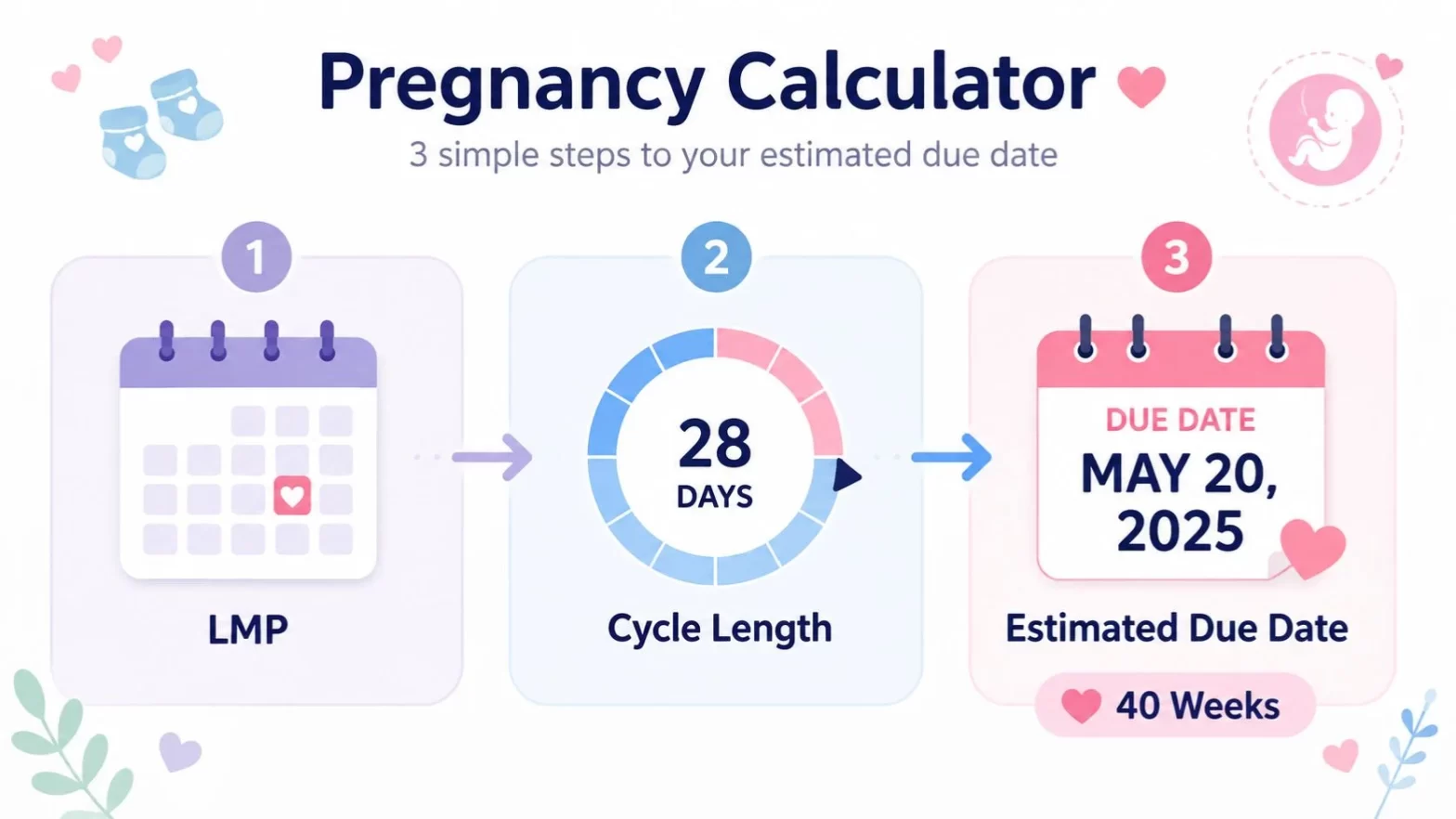
A pregnancy calculator can give you an estimated due date when you know the first day of your last menstrual period and your usual menstrual cycle length. That date is useful for understanding the expected pregnancy timeline, but it is not a prediction of the exact day your baby will be born. Cycle regularity and certainty about the last period date can affect how closely a calculator estimate reflects clinical pregnancy dating.
Key takeaway: The pregnancy calculator estimates your due date from the first day of your last menstrual period and your average cycle length. Pregnancy is commonly dated from the start of the last menstrual period, with an estimated due date around 40 weeks later. The result is an estimate, and the date may be revised when menstrual dates are uncertain, cycles are irregular or clinical assessment gives a different pregnancy dating estimate.
Enter the date your last period started and your usual cycle length into the existing calculator. Use the result as a pregnancy-timing reference rather than as an exact birth-date prediction.
How is the estimated due date calculated?
Pregnancy dating commonly starts from the first day of the last menstrual period. A standard pregnancy due-date estimate is based on a pregnancy length of about 40 weeks, or 280 days, from that date.
The calculator also asks for your usual menstrual cycle length. This matters because menstrual cycles are not identical for everyone, so the cycle-length input helps the calculator make the estimate more relevant to the information you provide.
The calculation is still based on menstrual information rather than direct observation of conception. For that reason, the result should be read as an estimated due date, not as proof of the exact date on which conception occurred or birth will take place.
Get a personalized diet plan designed by Chief Nutritionist Vasanthi, with 21 years of experience and multiple awards in clinical nutrition, weight loss, holistic health, and nutrition innovation.
Consult in person at Bangalore HSR Layout, Koramangala, Bellandur, Haralur, or Electronic City, or online across India.
What does your estimated due date mean?
Your estimated due date is a reference date used to place the pregnancy on a timeline. It can help you understand approximately how far the pregnancy has progressed and when the pregnancy is expected to reach the usual full-term period.
An estimated due date does not mean labour must begin on that exact day. Actual birth timing can be earlier or later, and pregnancy dating may be adjusted if later clinical information indicates that a different date is more appropriate.
This is why the most useful way to read the result is as a planning date. The calculator answers the question ‘When is the pregnancy approximately due?’ rather than ‘On which exact date will birth occur?’
How accurate is a pregnancy calculator?
A pregnancy calculator can be useful when the first day of the last menstrual period is known and menstrual cycles are reasonably predictable. Its accuracy becomes more limited when the information entered does not closely reflect the timing of the pregnancy.
The estimate may be less reliable when cycle length varies substantially, when the last menstrual period date is uncertain or when the pregnancy has been dated differently through clinical assessment. Ultrasound assessment may be used to establish or revise gestational dating when menstrual information is uncertain or does not match the clinical picture.
The calculator therefore gives a useful starting estimate, while clinical pregnancy dating provides the context needed when dates do not line up clearly.

What if your cycles are irregular or you do not know your last period?
Irregular cycles make a last-period-based due-date estimate less dependable because the timing represented by one cycle may not match the timing of another. Entering an average cycle length can still provide an approximate result, but the calculator cannot account for every variation in ovulation or cycle timing.
If you do not know when your last menstrual period started, this calculator does not have the main date it needs for a reliable menstrual-based estimate. In that situation, pregnancy dating may need to rely more on clinical assessment rather than on a manual or online calculation.
The important point is not to keep trying different dates until a preferred result appears. If the menstrual history is uncertain, the limitation belongs to the input, not to something that can be corrected by repeating the same calculation.
Pregnancy weeks, months and trimesters
Pregnancy is usually tracked in weeks because weeks provide a clearer way to follow gestational timing than calendar months. The pregnancy week count begins from the first day of the last menstrual period used for dating.
| Pregnancy stage | Approximate weeks |
| First trimester | Weeks 1 to 13 |
| Second trimester | Weeks 14 to 27 |
| Third trimester | Week 28 to around the due date |
Months are commonly used in everyday conversation, but they do not divide pregnancy as neatly as weeks. If your calculator result or clinical notes refer to pregnancy weeks, that is the more precise way to understand the stage of pregnancy.
When can the estimated due date change?
A due date may be revised when the original menstrual dates are uncertain, menstrual cycles are irregular or clinical assessment indicates a different gestational age. A revised date does not mean the original calculator failed; it means newer information may provide a better basis for pregnancy dating.
The calculator is therefore best used at the beginning of the process, when you want an estimate from the information you already know. If later pregnancy dating is updated during clinical care, the clinically established date becomes the more relevant reference for ongoing pregnancy care.
What this pregnancy calculator does not calculate
Keeping the calculator’s purpose narrow makes the result easier to understand. This tool is designed to estimate a due date from menstrual information, not to answer every pregnancy-related question.
- It does not confirm whether a pregnancy is present.
- It does not determine the exact conception date.
- It does not identify whether the pregnancy is a single or multiple pregnancy.
- It does not calculate a due date from an embryo-transfer or egg-retrieval date.
- It does not assess fetal growth or replace clinical pregnancy dating.
Using the calculator only for the question it was built to answer helps prevent an approximate date from being mistaken for a broader pregnancy assessment.
Nutrition after you know your estimated stage of pregnancy
Once you know the approximate stage of pregnancy, nutrition becomes a separate question from pregnancy dating. Nutritional needs can change across pregnancy and may also be influenced by appetite, dietary pattern, health history, laboratory findings, food preferences and daily routine.
For information focused specifically on food and nutrition during pregnancy, see Newtrist’s pregnancy nutrition guidance. The due-date calculator should not be used to decide a personal diet, food quantity or nutrition target.
Frequently asked questions
Does the calculator show the conception date?
No. The calculator uses the first day of the last menstrual period and average cycle length to estimate a due date. It does not directly identify the date of conception, which is a different question from menstrual-based pregnancy dating.
Is this calculator designed for IVF or embryo-transfer pregnancies?
No. The calculator on this page asks for last menstrual period information and cycle length rather than an egg-retrieval or embryo-transfer date. Pregnancies dated from fertility-treatment dates require a different calculation approach, so those dates should not be forced into this calculator.
Can the calculator tell whether I am expecting twins?
No. A due-date calculator cannot identify a multiple pregnancy. The calculator uses menstrual information to estimate timing and does not assess the number of fetuses or other clinical pregnancy findings.
Why is pregnancy usually counted in weeks instead of months?
Weeks provide a more consistent way to describe gestational timing because calendar months vary in length. Pregnancy dating therefore commonly uses the number of weeks from the first day of the last menstrual period.
Conclusion
A pregnancy calculator is useful for estimating a due date from the first day of the last menstrual period and the usual cycle length. The result gives you a practical pregnancy-timing reference, but it should remain an estimate rather than an exact birth-date prediction. When menstrual dates are uncertain or clinical dating differs, the wider pregnancy assessment provides the more useful context.

When personalised pregnancy nutrition guidance may help
Knowing the estimated pregnancy stage does not tell you exactly what dietary approach will suit you. Personalised pregnancy nutrition may need to consider health history, laboratory findings, appetite, food tolerance, dietary preferences, regional food habits, activity, daily routine and the stage of pregnancy together.
Readers who need individual guidance may consult Chief Nutritionist Vasanthi Senthilvel at Newtrist Nutritionist Dietitian Dietician for a personalised diet plan for clinical nutrition during pregnancy. The assessment can help identify nutritional priorities and develop practical recommendations suited to the individual’s needs and routine rather than relying on a general pregnancy article or calculator result.
Consult Chief Nutritionist Vasanthi Senthilvel for a personalised clinical nutrition diet plan developed around your pregnancy stage, health history, food preferences and daily routine.
Author
Chief Nutritionist Vasanthi Senthilvel leads Newtrist Nutritionist Dietitian Dietician, providing personalised diet plans for weight management and clinical nutrition for children, adolescents, adults and families.
She has 21 years of experience in nutrition and has received professional recognition for her work.
- Pride of Bharat Awards 2026: Outstanding Achievement in Holistic Health & Nutrition Innovation
- Doctor of The Year: Nutritionist 2026: Excellence in Clinical Nutrition and Weight Loss.
Her approach considers age, growth, health history, medical conditions, laboratory reports, medication, body composition, weight history, dietary preferences, regional food habits, family routines, activity, sleep and personal health goals. Recommendations are developed according to individual needs rather than using one standard diet for everyone.
Consultations are available in person at Bangalore HSR Layout, Koramangala, Bellandur, Haralur and Electronic City, as well as online across India.
Independent Medical Review Panel
Newtrist health and nutrition articles undergo medical review, where appropriate, by doctors with relevant specialist expertise. The medical professionals listed below contribute to Newtrist’s review process within their respective specialties.
| Speciality | Doctor |
|---|---|
| Endocrinology | Dr Vinay Prasad MBBS, MD, DM |
| Gastroenterology & Hepatology | Dr Sunil kumar N MBBS, MD, DM |
| Gynaecology | Dr Prathiba G MBBS, DNB, FIRM, FMAS |