
Written by: Chief Nutritionist Vasanthi Senthilvel
21 years of experience | Newtrist Nutritionist Dietitian Dietician
Best Nutritionist in Bangalore with multiple awards for excellence in clinical nutrition, weight loss, holistic health and nutrition innovation.
Medically reviewed by: Dr Dr Prathiba G MBBS, DNB, FIRM, FMAS | Dr Sunil kumar N MBBS, MD, DM | Dr Vinay Prasad MBBS, MD, DM
Medical Disclaimer: Nutritional needs vary based on an individual’s profile. The information on this page is for general educational purposes only and is not intended to replace personalised medical or nutrition care.
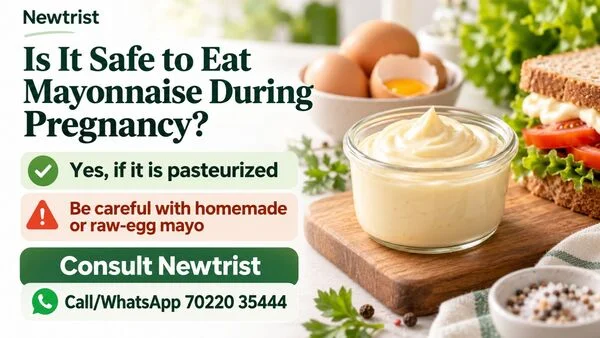
Yes, mayonnaise made with pasteurised eggs can be eaten during pregnancy when prepared and stored safely. Eggless mayonnaise is another option, provided its ingredients are suitable and storage instructions are followed. Avoid mayonnaise containing raw, unpasteurised eggs or preparations whose ingredients and handling you cannot confirm.
You do not need to rule out a favourite sandwich simply because it contains mayonnaise. Check what the mayonnaise is made with and how the whole dish has been prepared and stored.
Table of Contents
Which mayonnaise can you eat during pregnancy?
| Type of mayonnaise | What to check |
| Packaged mayonnaise containing eggs | Confirm that it uses pasteurised eggs or egg products. Follow the storage instructions and use-by date. |
| Eggless or vegetarian mayonnaise | Check the ingredients and allergens. Eggless does not mean dairy-free or remove the need for safe storage. |
| Homemade mayonnaise | If the recipe includes uncooked egg, use pasteurised eggs. Homemade mayonnaise is not automatically safer. |
| Restaurant mayonnaise or aioli | Ask whether it contains raw egg and whether that egg is pasteurised. Choose another accompaniment if staff cannot confirm. |
Commercial mayonnaise commonly uses pasteurised eggs, but products and preparation methods vary. If the packaging is unclear, check with the manufacturer rather than assuming.
Risks of Mayonnaise During Pregnancy
The main food-safety concern is contamination, including from raw, unpasteurised eggs or unsuitable handling. Contaminated eggs can carry Salmonella and cause food poisoning. A small portion does not make contaminated mayonnaise safe.
Fat and sodium are separate nutrition considerations. Their amounts vary between products and should be considered within your overall diet; they do not make every mayonnaise product unsuitable for pregnancy.
Store mayonnaise and prepared dishes safely
Follow the label’s instructions before and after opening. Use a clean utensil and promptly return mayonnaise requiring refrigeration to the fridge.
For a sandwich or salad containing mayonnaise, consider the whole dish. Its vegetables, chicken, eggs, or other ingredients also need safe preparation and storage.
- Keep refrigerated food at 4°C or below.
- Discard perishable prepared food left at room temperature for more than two hours.
- When the temperature is above 32°C, shorten that limit to one hour.
These time limits apply to foods requiring refrigeration, not automatically to an unopened, shelf-stable jar.
How much mayonnaise can you have during pregnancy?
There is no single pregnancy-specific serving that suits everyone. Use mayonnaise as an accompaniment and check the label for its serving size, energy, fat, and sodium content.
For example, spread a thin layer on a sandwich rather than adding several spoonfuls without measuring. This is a practical portion suggestion, not a medical safety limit.
If you follow an individual nutrition plan, consider the complete meal and your care team’s advice. Avoid restricting a wide range of foods because of concerns about one ingredient.
Alternatives to mayonnaise
If you prefer a different dip or spread, whisk thick curd until smooth and add washed herbs or a little lemon juice. Choose curd made from pasteurised milk and keep it refrigerated.
Almond or cashew paste can also provide a creamy texture if you tolerate nuts. These alternatives offer variety but are not automatically lower in calories. Check ingredients and allergens in packaged substitutes.
For help with meals beyond dips and spreads, explore our pregnancy food chart.
FAQs
Can I eat mayonnaise during early pregnancy?
The same preparation and storage precautions apply in early pregnancy. Choose pasteurised-egg or suitable eggless mayonnaise and avoid preparations containing raw, unpasteurised eggs. There is no separate mayonnaise allowance for the first trimester.
Can I eat mayonnaise at night during pregnancy?
The food-safety precautions are the same at night. Mayonnaise should not be singled out as a cause of gestational diabetes simply because it is eaten in the evening. If a rich evening meal makes you uncomfortable, adjust the portion or timing to your tolerance.
Is mayonnaise good for the womb or the baby?
Mayonnaise is a condiment, not a food prescribed to strengthen the womb or improve fetal development. It can add flavour, but it does not replace a varied diet that supplies the nutrients needed during pregnancy.
What if I already ate mayonnaise and do not know how it was made?
Uncertainty about an ingredient does not mean you will become ill or that your baby has been harmed. If possible, check the packaging or ask the person who prepared it.
If you develop fever, vomiting, diarrhoea, or abdominal pain, contact your maternity team or doctor for advice. Seek prompt medical help for severe pain, bloody diarrhoea, signs of dehydration, or difficulty keeping fluids down.
Make everyday pregnancy food choices easier
If questions about spreads, snacks, and meals are leaving you unsure what to eat, personalised guidance can help you plan around your preferences and pregnancy needs.
Consult Chief Nutritionist Vasanthi Senthilvel for personalised pregnancy nutrition. Guidance can consider your pregnancy stage, relevant health reports, food preferences, and daily routine, alongside your obstetric team’s advice.

Author
Chief Nutritionist Vasanthi Senthilvel leads Newtrist Nutritionist Dietitian Dietician, providing personalised diet plans for weight management and clinical nutrition for children, adolescents, adults and families.
She has 21 years of experience in nutrition and has received professional recognition for her work.
- Pride of Bharat Awards 2026: Outstanding Achievement in Holistic Health & Nutrition Innovation
- Doctor of The Year: Nutritionist 2026: Excellence in Clinical Nutrition and Weight Loss.
Her approach considers age, growth, health history, medical conditions, laboratory reports, medication, body composition, weight history, dietary preferences, regional food habits, family routines, activity, sleep and personal health goals. Recommendations are developed according to individual needs rather than using one standard diet for everyone.
Consultations are available in person at Bangalore HSR Layout, Koramangala, Bellandur, Haralur and Electronic City, as well as online across India.
Independent Medical Review Panel
Newtrist health and nutrition articles undergo medical review, where appropriate, by doctors with relevant specialist expertise. The medical professionals listed below contribute to Newtrist’s review process within their respective specialties.
| Speciality | Doctor |
|---|---|
| Endocrinology | Dr Vinay Prasad MBBS, MD, DM |
| Gastroenterology & Hepatology | Dr Sunil kumar N MBBS, MD, DM |
| Gynaecology | Dr Prathiba G MBBS, DNB, FIRM, FMAS |