
Written by: Chief Nutritionist Vasanthi Senthilvel
21 years of experience | Newtrist Nutritionist Dietitian Dietician
Best Nutritionist in Bangalore with multiple awards for excellence in clinical nutrition, weight loss, holistic health and nutrition innovation.
Medically reviewed by: Dr Dr Prathiba G MBBS, DNB, FIRM, FMAS | Dr Sunil kumar N MBBS, MD, DM | Dr Vinay Prasad MBBS, MD, DM
Medical Disclaimer: Nutritional needs vary based on an individual’s profile. The information on this page is for general educational purposes only and is not intended to replace personalised medical or nutrition care.
You have been told that your blood pressure is high and that you should “watch your diet”.
Then the questions begin.
Should you stop salt completely? Avoid pickle? Give up rice? Drink coconut water every day? Switch to rock salt? Follow DASH?
A gestational hypertension diet does not need to become a long list of foods you are frightened to eat.
The more useful approach is to identify what in your current food pattern genuinely needs attention, protect the nutrition you still need, and avoid making drastic dietary changes that do little to address the real problem.
Key takeaway: A gestational hypertension diet should support medical management, not replace it. The main nutrition priorities are usually reducing unnecessary exposure to highly salted and heavily processed foods, maintaining a varied and nutritionally adequate diet, and checking whether protein, calcium-rich foods and overall food quality are appropriate. It should not automatically become a salt-free, carbohydrate-free or highly restrictive diet.
Table of Contents
What Should a Gestational Hypertension Diet Actually Focus On?
Not every part of your diet needs changing.
Start with the areas most likely to matter.
| Nutrition priority | What to review | What not to do automatically |
| Sodium | Frequent packaged, preserved and restaurant foods | Remove all salt from home-cooked food |
| Food quality | Reliance on highly processed foods | Search for one “BP-lowering” food |
| Protein | Whether regular meals contain adequate protein | Start a very high-protein diet |
| Calcium-rich foods | Whether these are regularly included | Increase supplements without medical advice |
| Meal pattern | Long gaps, poor appetite or unbalanced meals | Skip meals or fast |
| Supplements | What has actually been prescribed | Add herbal, potassium or high-dose supplements yourself |
The diagnosis tells you that your blood pressure requires medical attention.
It does not automatically tell you which food in your diet is responsible.
What Should You Eat With Gestational Hypertension?
There is no special food that treats gestational hypertension.
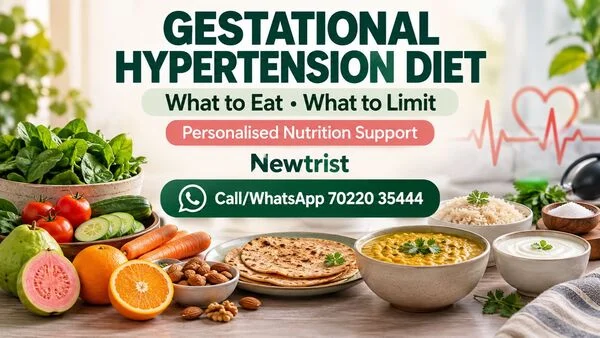
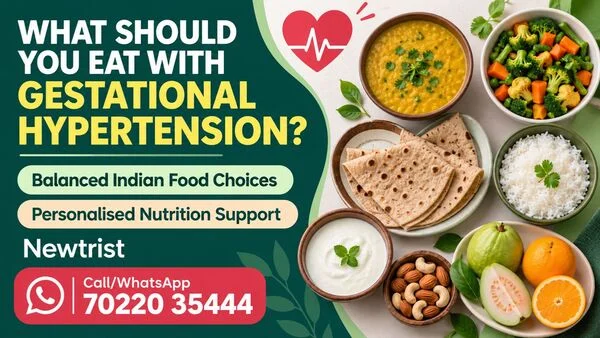
For most women, the useful diet is an improved version of familiar home food rather than an entirely different “BP menu”.
Choose mostly minimally processed foods
Home-prepared meals make it easier to control ingredients than heavily processed or packaged foods.
Your normal eating pattern can still include familiar foods such as:
- dals and pulses
- vegetables
- fruits
- rice or roti
- milk and curd
- paneer
- eggs
- fish or chicken, if eaten
- plain nuts and seeds
The right combination depends on your normal diet and nutritional requirements.
Keep vegetables and fruits varied
Vegetables and fruits contribute fibre, potassium, vitamins and other nutrients. For ideas on familiar pregnancy-friendly vegetables, see Newtrist’s pregnancy vegetables guide.
Use familiar seasonal choices rather than concentrating on one food because it is promoted online for blood pressure.
There is no need to build the diet around large quantities of beetroot, banana, pomegranate or any other single “BP food”.
Make sure protein remains adequate
When women become worried about blood pressure, they sometimes start removing foods without noticing what disappears nutritionally.
Protein still matters.
The appropriate sources may include dals, pulses, milk, curd, paneer, eggs, fish or chicken depending on food preference.
Gestational hypertension does not require protein loading. The objective is adequate intake.
Rice and roti do not automatically need to go
Gestational hypertension is not a reason to remove carbohydrate foods indiscriminately.
Rice, roti and other familiar staples can remain part of an appropriate diet.
What matters more is the balance of the complete eating pattern and whether another clinical condition changes your individual requirements.
Do You Need to Stop Salt?
No. Gestational hypertension does not automatically mean eating completely salt-free food.
The more useful goal is to identify excess sodium, particularly sources that are easy to overlook.
Foods worth reviewing include:
- pickle
- papad
- namkeen
- chips and savoury packaged snacks
- salted nuts
- instant noodles
- packaged soups
- commercial sauces
- seasoning mixes
- processed meats
- frequent restaurant or takeaway foods
A woman eating several of these foods regularly may have meaningful sodium reductions available.
A woman eating almost entirely home-prepared meals with few salty extras has a different starting point.
Very aggressive sodium restriction has not been shown to be an effective treatment for mild pregnancy-induced hypertension, so making every meal increasingly bland is not automatically better nutrition.
What about pink salt, rock salt and sea salt?
They still contain sodium.
Changing the type of salt is not the same as reducing excessive sodium exposure.
“Where is most of the sodium in my usual diet coming from?”
What About Calcium, Potassium and “Blood Pressure Foods”?
These nutrients matter, but they should not become DIY treatments.
Calcium
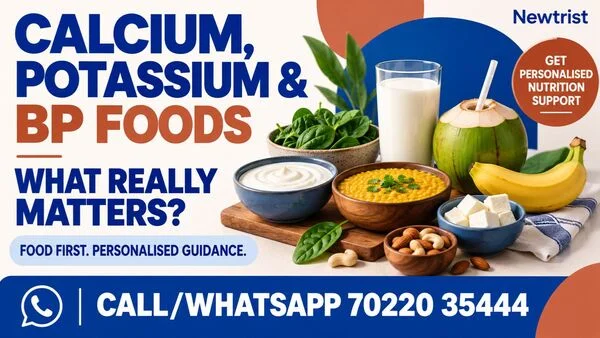
Calcium-rich foods remain an important part of pregnancy nutrition.
Depending on your diet, these may include milk, curd and other suitable foods.
If calcium supplementation has been prescribed, take it according to medical advice rather than increasing the dose yourself. Calcium supplementation has a recognised role in pregnancy in populations with low dietary calcium intake, but that is different from using calcium as a self-treatment after gestational hypertension has developed.
Potassium
Vegetables, fruits, pulses and other minimally processed foods naturally provide potassium.
That does not mean that large quantities of banana or coconut water will treat high blood pressure.
Potassium tablets and potassium-based salt substitutes should not be started without professional advice because kidney function, medications and other clinical factors can affect their suitability.
Use nutritious foods as food, not as substitutes for medical treatment.
Should You Follow the DASH Diet?
The DASH eating pattern is well known for managing hypertension outside pregnancy.
Several of its principles make nutritional sense here too, including more minimally processed foods, vegetables, fruits, pulses, nuts and fewer heavily processed high-sodium foods.
But DASH should not be presented as a proven treatment for gestational hypertension.
Current evidence does not establish that DASH reliably prevents or treats gestational hypertension, so it is better used as a source of broadly healthy eating principles than as a rigid therapeutic pregnancy diet.
Instead of trying to copy a rigid DASH menu, use the relevant principles to improve the foods you already eat.
For an Indian household, that may be much more practical than trying to reproduce a diet designed around a different food culture.
What Should You Avoid Changing on Your Own?
A diagnosis can create an understandable urge to act immediately.
That is also when unnecessary restriction can begin.
Do not start the following solely because you have gestational hypertension without appropriate professional advice:
- a completely salt-free diet
- fasting
- detox diets
- aggressive calorie restriction
- very restrictive low-carbohydrate diets
- potassium supplements
- potassium-based salt substitutes
- herbal products marketed for blood-pressure control
- high-dose vitamin or mineral supplements
Also do not stop or alter prescribed blood-pressure medication because your diet has improved or a home reading looks better.
Gestational hypertension requires appropriate medical assessment and monitoring; nutrition plays a supporting role rather than replacing treatment.
Can Diet Lower Blood Pressure in Gestational Hypertension?
Diet can support management, but it cannot be relied upon to control gestational hypertension by itself.
That is an important expectation.
Improving food quality and reducing unnecessary high-sodium foods may make the diet more appropriate for your health.
But gestational hypertension is not simply the result of having eaten the wrong foods.
If your blood pressure remains high despite eating well, that does not mean your diet has failed.
Nutrition and medical treatment have different roles.
Why a Generic Gestational Hypertension Diet Chart Can Be Misleading
A gestational hypertension diet chart sounds reassuring because it promises certainty.
Breakfast: eat this. Lunch: eat this. Dinner: eat this.
But the diagnosis alone does not tell us what needs changing.
Consider three women with the same diagnosis.
One woman eats restaurant food frequently and also has pickle, packaged savoury snacks and other salty foods most days. Her diet may contain several obvious sodium sources.
Another woman eats almost entirely home-cooked food but has very limited protein and calcium-rich foods. Removing more foods may make her diet worse.
A third woman has already stopped rice, snacks and several familiar foods because she is frightened that eating them will increase her blood pressure. Her priority may be rebuilding an adequate diet rather than restricting it further.
The diagnosis is the same. The nutrition problem is not.
“What in my current diet actually needs changing?”
When Does Personalised Gestational Hypertension Nutrition Become Useful?
Personalised nutrition becomes useful when broad instructions such as “eat healthy” and “reduce salt” stop being specific enough.
It may be particularly valuable when:
- you do not know which foods in your current diet actually need changing
- most of your meals are Indian home food and generic online diet plans do not fit
- packaged or restaurant foods form a significant part of your routine
- fear of high blood pressure has made you unnecessarily restrict foods
- poor appetite or other symptoms make eating adequately difficult
- your protein or calcium-rich food intake may be insufficient
- medicines and supplements need to be considered alongside food choices
- your weight trend or investigations create additional nutrition considerations
- different people are giving you conflicting advice
If your pregnancy weight trend is also part of the nutrition question, that should be interpreted separately rather than folded into a generic hypertension diet.
The goal is not to create more rules.
“Which rules actually apply to me?”
What Does a Personalised Nutrition Assessment Need to Answer?
A useful personalised diet starts with your existing eating pattern.
Chief Nutritionist Vasanthi Senthilvel can review factors such as:
- usual meals and snacks
- major sodium sources
- packaged and restaurant-food frequency
- protein intake
- calcium-rich foods
- vegetable and fruit intake
- appetite and food aversions
- weight trend
- relevant investigations
- medicines and supplements
- vegetarian, egg-based or non-vegetarian preferences
- work and meal timings
- family eating habits
- affordability and food availability
The assessment should answer three practical questions:
What genuinely needs reducing?
What needs improving?
What can stay exactly as it is?
The third question matters as much as the first two.
Personalised nutrition should not change every food simply because a diagnosis has been made.
The objective is to find the smallest set of meaningful changes that makes your diet more appropriate while keeping it nutritionally adequate and practical.
Frequently Asked Questions
Is home-cooked Indian food automatically low in sodium?
No. Home cooking gives you more control, but sodium can still become high when meals regularly include pickle, papad, salty chutneys, packaged masalas or generous added salt.
Should I switch to low-sodium or potassium salt?
Not automatically. Many salt substitutes contain potassium and may not be appropriate for everyone. Discuss them with the healthcare professional managing your care before switching.
Are electrolyte drinks useful for gestational hypertension?
Not as a treatment for blood pressure. Electrolyte drinks vary in sodium, potassium and sugar content and should be used for a specific reason rather than because gestational hypertension has been diagnosed.
Your Diet Does Not Need More Restrictions. It Needs the Right Priorities.
After a gestational hypertension diagnosis, it is easy to think that the safest diet is the one with the most restrictions.
Usually, that is not the useful goal.
You may need to reduce hidden sodium.
You may need a stronger overall food pattern.
You may need better protein or calcium coverage.
You may need reassurance that ordinary home foods do not all need to disappear.
Or your existing diet may already be reasonably appropriate and require only a few targeted changes.
The diagnosis alone cannot tell you which situation applies.
Chief Nutritionist Vasanthi Senthilvel at Newtrist provides personalised clinical nutrition support by reviewing your actual eating pattern alongside your weight trend, available investigations, medications, symptoms, food preferences and the medical guidance you are already receiving.
The purpose is not to give every woman with gestational hypertension the same low-salt diet chart.
It is to identify what your diet needs, what it does not need, and how to make the necessary changes practical with foods you actually eat.
If you have been told to “watch your diet” but still do not know what should actually change on your plate, a personalised gestational hypertension nutrition consultation can turn that broad instruction into clear, individual guidance.
Author
Chief Nutritionist Vasanthi Senthilvel leads Newtrist Nutritionist Dietitian Dietician, providing personalised diet plans for weight management and clinical nutrition for children, adolescents, adults and families.
She has 21 years of experience in nutrition and has received professional recognition for her work.
- Pride of Bharat Awards 2026: Outstanding Achievement in Holistic Health & Nutrition Innovation
- Doctor of The Year: Nutritionist 2026: Excellence in Clinical Nutrition and Weight Loss.
Her approach considers age, growth, health history, medical conditions, laboratory reports, medication, body composition, weight history, dietary preferences, regional food habits, family routines, activity, sleep and personal health goals. Recommendations are developed according to individual needs rather than using one standard diet for everyone.
Consultations are available in person at Bangalore HSR Layout, Koramangala, Bellandur, Haralur and Electronic City, as well as online across India.
Independent Medical Review Panel
Newtrist health and nutrition articles undergo medical review, where appropriate, by doctors with relevant specialist expertise. The medical professionals listed below contribute to Newtrist’s review process within their respective specialties.
| Speciality | Doctor |
|---|---|
| Endocrinology | Dr Vinay Prasad MBBS, MD, DM |
| Gastroenterology & Hepatology | Dr Sunil kumar N MBBS, MD, DM |
| Gynaecology | Dr Prathiba G MBBS, DNB, FIRM, FMAS |