Protein Intake Calculator: Estimate Daily Protein Needs
Written by: Chief Nutritionist Vasanthi Senthilvel 21 years of experience | Newtrist Nutritionist Dietitian Dietician Best Nutritionist in Bangalore with multiple awards for excellence in clinical nutrition, weight loss, holistic health and nutrition innovation. Medically reviewed by: Dr Dr Prathiba G MBBS, DNB, FIRM, FMAS | Dr Sunil kumar N MBBS, MD, DM | Dr Vinay Prasad MBBS, MD, DM
Medical Disclaimer: Nutritional needs vary based on an individual’s profile. The information and calculator on this page is for general educational purposes only and is not intended to replace personalised medical or nutrition care.
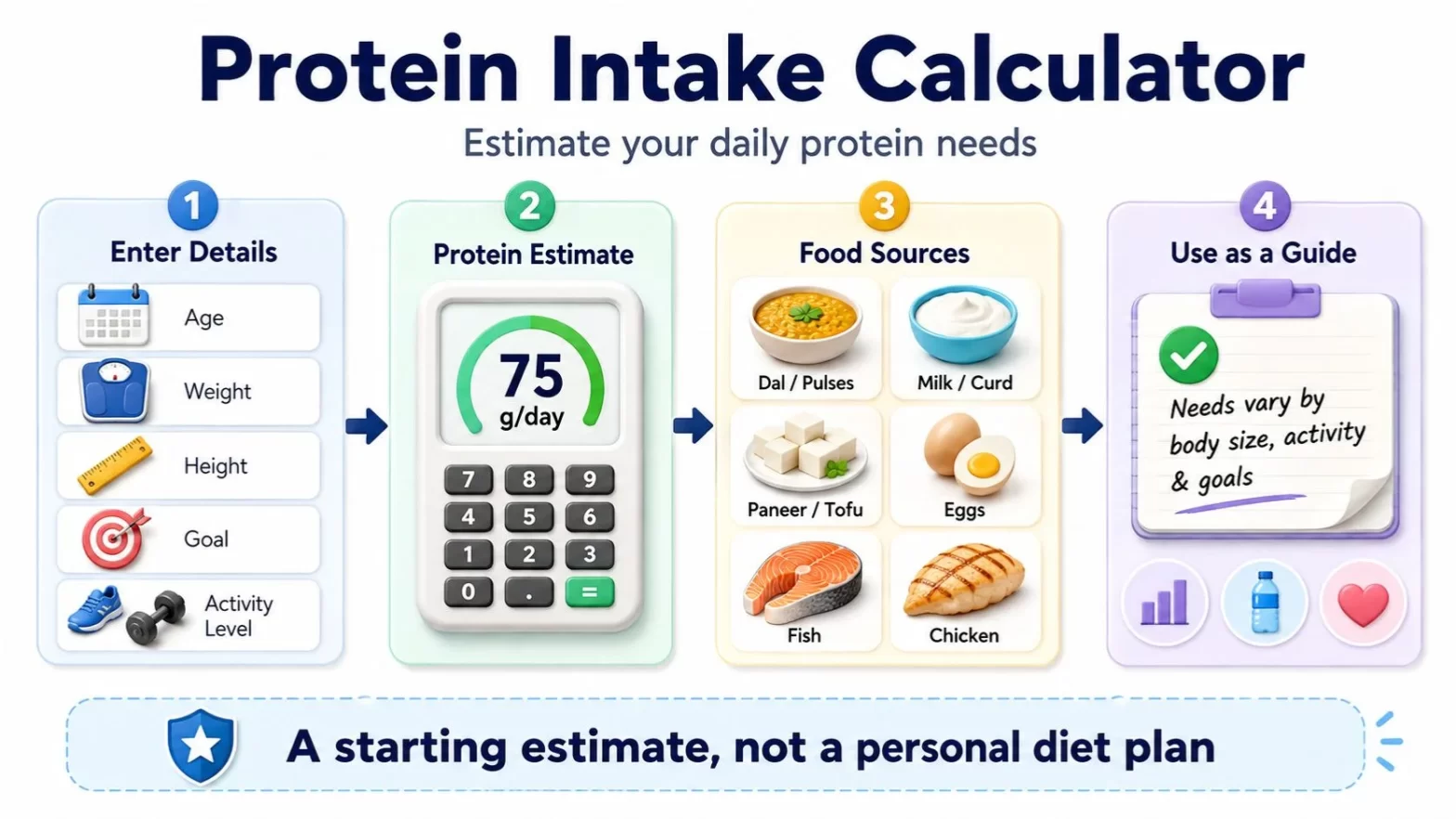
A protein intake calculator can turn a vague question such as ‘Am I getting enough protein?’ into a practical starting estimate. This calculator uses the details you enter, including age, sex, height, weight, goal and activity level, to estimate daily protein needs. The result is useful for orientation, but it is not a ready-made food plan because protein requirements and the way they fit into the rest of the diet differ between individuals.
Key takeaway: The protein intake calculator estimates a daily protein requirement from the information entered into the tool. The result is a general estimate rather than an exact personal prescription, because protein needs can vary with body size, activity, training demands, life stage and individual health circumstances. Use the number to understand the scale of your requirement, not as an instruction to copy a standard high-protein diet.
Enter the requested details and review the calculator result first. The sections below explain how to interpret that number without turning it into a meal-by-meal target or a self-designed diet plan.
Protein Intake Calculator
require
age should be in 14 to 80 range
require
require
You should take ...... of protein per day
What does your protein result mean?
The result represents the calculator’s estimate of how much protein you may need across the day. It is intended to give a daily total based on the inputs you selected, not to tell you how much protein to eat at one time or which foods you should choose.
Protein is an essential macronutrient made from amino acids. The body uses protein for growth, maintenance and repair of tissues and for many structural and functional processes. Because these demands are not identical in every person, a daily estimate is more useful when you understand the factors that shaped it.
A calculator result can therefore answer ‘roughly how much protein might be relevant to my current inputs?’ It cannot answer the more individual question of how that protein should fit with your total food intake, appetite, dietary pattern and nutritional goals.
Get a personalized diet plan designed by Chief Nutritionist Vasanthi, with 21 years of experience and multiple awards in clinical nutrition, weight loss, holistic health, and nutrition innovation.
Consult in person at Bangalore HSR Layout, Koramangala, Bellandur, Haralur, or Electronic City, or online across India.
Protein needs are not determined by body weight alone. The calculator combines several details because the amount of protein that is relevant to one person may not suit another person with a different body size, activity pattern or goal.
Body size influences the estimate
A larger body generally has a greater amount of tissue to maintain than a smaller body, so body size is an important part of protein estimation. Height and weight therefore help the calculator place the result in relation to the individual rather than returning one universal number.
Activity and training change demand
Regular physical activity can increase the body’s need for tissue repair and adaptation, particularly when training places repeated demands on muscle. The type, frequency and intensity of activity matter, which is why an active person may receive a different estimate from someone with a more sedentary routine.
The goal selected in the calculator matters
A person focused on changing body weight or supporting training is not asking exactly the same nutrition question as someone simply checking general intake. The selected goal helps the calculator adjust its estimate, but the result still cannot determine whether the overall dietary approach is nutritionally appropriate.
Age and life stage can change context
Protein needs and the reasons for those needs can change across the lifespan. Growth, ageing, changes in activity and changes in body composition can all affect how a protein estimate should be interpreted. A general adult calculator should therefore not be treated as a substitute for age-specific or life-stage-specific nutrition assessment.
Protein quality matters as well as quantity
Knowing a daily protein estimate is only part of the picture. Protein foods differ in their essential amino acid profile and digestibility, so two diets providing a similar total amount of protein may not be identical nutritionally.
For Indian diets, useful protein sources can come from both plant and animal foods. Examples include dal, pulses, beans, soy foods, milk, curd, paneer, eggs, fish and chicken. Nuts and seeds also contribute protein, although they are eaten for a broader mix of nutrients rather than as protein alone.
Vegetarian and non-vegetarian diets can both provide adequate protein when the overall diet is varied and nutritionally appropriate. The important point is not to label one food as the perfect source, but to look at the overall pattern of foods, dietary preferences and total nutritional needs.
Protein needs for physically active people
Physically active people often pay more attention to protein because training creates repeated demands for recovery and adaptation. That does not mean that simply increasing protein as much as possible will improve performance or body composition.
Training volume, strength work, endurance activity, total food intake, recovery and body-composition goals all influence how a protein estimate should be applied. Protein is one part of sports nutrition, and adequate overall energy and other nutrients still matter.
If your main concern is training, performance or recovery, Newtrist’s sports nutrition guidance provides the more relevant next context. The calculator can estimate a daily amount, while a sports-focused assessment can consider the demands of the actual training routine.
Can a protein calculator tell you what to eat?
No. A protein calculator can estimate a daily amount, but it cannot create an appropriate food pattern for every individual. The number does not tell you which foods suit your preferences, how protein should be distributed within your usual eating pattern, or how the rest of your nutritional intake should be adjusted.
This matters because focusing only on the protein number can crowd out the bigger nutrition question. A suitable diet also has to provide enough overall energy, carbohydrates, fats, fibre, vitamins, minerals and hydration for the person’s needs.
The calculator also cannot account for every health circumstance. Some people may need protein requirements interpreted more carefully because their nutritional needs are influenced by health history, appetite, digestion, body composition or other individual factors. A general calculator should not be used to create a condition-specific protein prescription.
Common mistakes when using a protein estimate
A protein number can look precise, which makes it easy to use it more rigidly than intended. The following mistakes can make a useful estimate less useful.
Treating the calculator result as an exact requirement that never changes.
Assuming more protein is automatically better.
Copying another person’s protein intake because their body weight or goal looks similar.
Focusing on protein while ignoring overall nutritional adequacy.
Trying to convert the result into a complete eating plan without considering appetite, routine and food preferences.
The better approach is to keep the result in proportion. It gives you a starting estimate that can help you ask better questions about your diet, especially if your goal involves weight management, body composition or regular training.
When the calculator result needs more individual context
A general estimate may be enough if you simply want to understand the approximate scale of your daily protein needs. More individual context becomes useful when you want to change body weight, support a demanding training schedule, manage appetite or decide how protein should fit within a broader eating pattern.
Two people can receive similar protein estimates while having very different food preferences, routines and nutritional priorities. One may follow a vegetarian diet, another may eat eggs or animal foods, and their work schedules, appetite and training demands may be completely different.
This is where the difference between a calculator result and a personalised diet plan becomes clear. The calculator provides the number; individual assessment determines how much importance that number should have and how it can be met within a nutritionally balanced and practical diet.
Frequently asked questions
Does a higher activity level always mean I should eat much more protein?
Not necessarily. Higher activity can increase protein needs, but the size of the difference depends on the type and amount of training, body size, overall food intake and personal goals. A calculator can adjust its estimate for activity, but it cannot assess the full training programme or determine the most appropriate dietary pattern.
Can vegetarian diets provide enough protein?
Yes. Vegetarian diets can provide adequate protein when they include a suitable variety of protein-containing foods and meet overall nutritional needs. Dal, pulses, beans, soy foods, milk, curd and paneer can all contribute, depending on the type of vegetarian diet. The required quantity still depends on the individual rather than on one standard food list.
Is protein only important for building muscle?
No. Protein has roles throughout the body, including growth, tissue maintenance and repair, and the formation of many functional proteins. Muscle is one important use, but protein intake should not be viewed only through a bodybuilding lens. General nutritional adequacy matters even when muscle gain is not the goal.
Should I use the calculator result as a fixed target every day?
The result is better viewed as an estimate than an inflexible rule. Daily food intake naturally varies, and requirements can change when body size, activity, training or personal goals change. If the number is being used to guide a significant dietary change, individual assessment can help determine how it fits into the broader diet.
Conclusion
A protein intake calculator can give you a useful estimate of daily protein needs based on your current inputs. The number is most useful when you understand why it varies and remember that protein quantity is only one part of a complete diet. If you want to apply the estimate to weight management or a demanding training routine, the wider nutrition context becomes more important.
When personalised nutrition guidance may help
Personalised nutrition guidance may be useful when you need more than an estimated protein number. An individual assessment can consider body composition, weight history, activity, appetite, eating patterns, food preferences, vegetarian or non-vegetarian choices, work routine, sleep and personal goals together.
Readers who need individual guidance may consult Chief Nutritionist Vasanthi Senthilvel at Newtrist Nutritionist Dietitian Dietician for a personalised diet plan for weight management. The assessment can help determine how protein fits within the person’s overall nutritional needs and daily routine rather than treating the calculator result as a stand-alone instruction.
Consult Chief Nutritionist Vasanthi Senthilvel for a personalised diet plan developed around your weight-management goals, activity, food preferences and daily routine.
Chief Nutritionist Vasanthi Senthilvel leads Newtrist Nutritionist Dietitian Dietician, providing personalised diet plans for weight management and clinical nutrition for children, adolescents, adults and families.
She has 21 years of experience in nutrition and has received professional recognition for her work.
Pride of Bharat Awards 2026: Outstanding Achievement in Holistic Health & Nutrition Innovation
Doctor of The Year: Nutritionist 2026: Excellence in Clinical Nutrition and Weight Loss.
Her approach considers age, growth, health history, medical conditions, laboratory reports, medication, body composition, weight history, dietary preferences, regional food habits, family routines, activity, sleep and personal health goals. Recommendations are developed according to individual needs rather than using one standard diet for everyone.
Consultations are available in person at Bangalore HSR Layout, Koramangala, Bellandur, Haralur and Electronic City, as well as online across India.
Independent Medical Review Panel
Newtrist health and nutrition articles undergo medical review, where appropriate, by doctors with relevant specialist expertise. The medical professionals listed below contribute to Newtrist’s review process within their respective specialties.